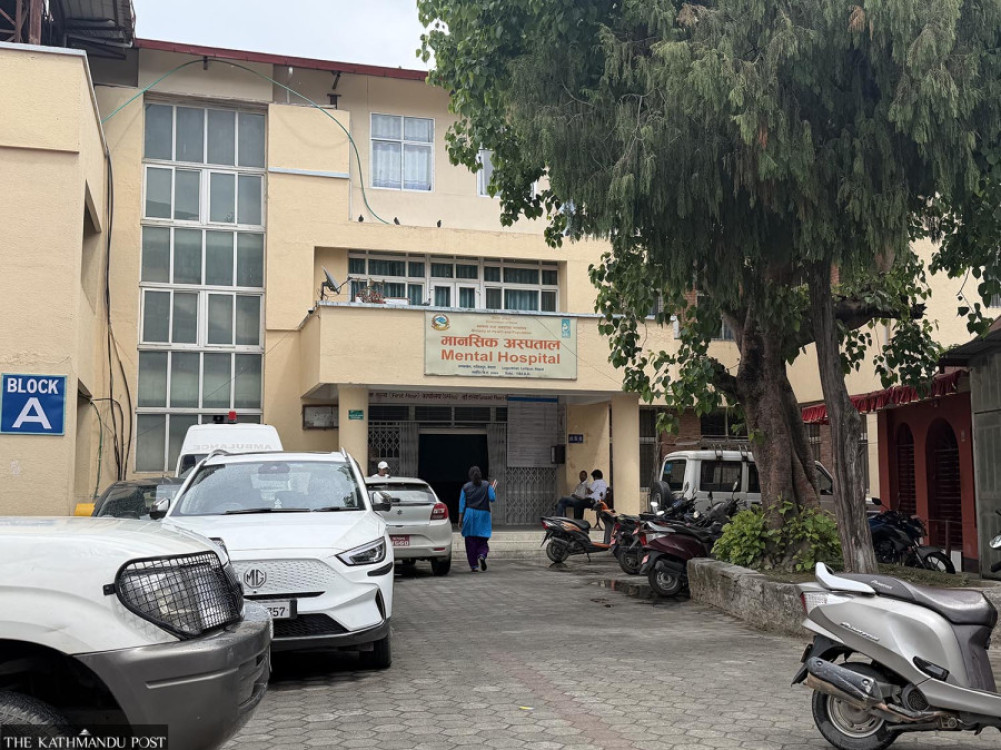
Lagankhel Mental Hospital, a shelter for mental patients from across the country, is facing problems in expanding services due to limited beds, medicines, and manpower.
We use Google Cloud Translation Services. Google requires we provide the following disclaimer relating to use of this service:
This service may contain translations powered by Google. Google disclaims all warranties related to the translations, expressed or implied, including any warranties of accuracy, reliability, and any implied warranties of merchantability, fitness for a particular purpose, and noninfringement.
The corridor of the ward where the teenagers are kept is very long. The cracked walls have been painted a light green to make them look better.
The doors to the rooms are cracked and half-open, where the beds are visible. Some patients are surrounded by relatives; their fathers or mothers are sitting on the floor or on nearby benches with mattresses spread out. Other patients are alone.
They sleep on old mattresses, covered with thin blankets, and stare blankly at the fan that is spinning above them. On the other side of the corridor is an 'art room' decorated with various stickers and bright colors. There are sketch pads, markers, and coloring books for children to play with.
The waiting room, located a few floors down, is filled with plastic chairs. People sit shoulder to shoulder, mostly in silence.
Some are shaking their hands, while others are staring at the floor or gawking at the nurses. Doctors are bringing and sending patients to the consultation room. They are hearing stories of anxiety, addiction, depression and insomnia, which have gone untreated for months or years. For many patients, their conditions have become so complex that hospitalization is no longer an option.
Every day, people from different parts of the country arrive at the mental hospital, Lagankhel. This service is still not available in many districts. Despite limited beds, medicines and manpower in the overcrowded wards, doctors and nurses are struggling to serve everyone.
'We have to compromise on everything,' says Sushila Dangol, head of nursing at the mental hospital, Lagankhel, describing the condition of the ward, which is overcrowded with patients.
Despite additional assessments, inadequate infrastructure, shortage of manpower, low budget and lack of a robust psychiatric support system, the hospital's first response is often 'we are managing'.
The mental health service that started in 1961 from the psychiatric OPD of Bir Hospital was organized and expanded, and a separate hospital was opened in Lagankhel in 1984. It is now the only government-run central mental hospital in Nepal, where more than 150 patients come to the OPD daily. 14 psychiatrists and five resident doctors are working here.
This hospital, which has a history of more than 6 decades, has become the main shelter for mental health patients from all 77 districts. Probably, people choose it because of its accessible treatment services. Dangol says, 'This hospital has become the choice of people because it is the only government-run mental hospital and the treatment cost is low,' Dangol said.
Patients come to the hospital with various types of mental problems. Doctors in the OPD usually treat anxiety, psychotic disorders, drug addiction, depression, bipolar disorder and epilepsy (seizures). Cases of obsessive-compulsive disorder (OCD) are also common among anxiety-related problems.
'We often see serious conditions in patients with depression, sometimes with suicidal thoughts,' says Dr. Suraj Tiwari, director of Lagankhel Mental Hospital.
Before diagnosing a patient, the medical team evaluates various possibilities and consults the psychology department. Only then is the disease formally diagnosed.
After meeting a psychiatrist in the OPD, the patient formally enters the hospital's treatment system. If the doctor feels that the patient needs further psychological evaluation, they are referred to the psychology department.
Lab tests are also done on some patients, although psychiatrists say that the diagnosis of mental health depends more on the patient's history and mental state than on a physical examination.
The patient is usually called for a follow-up after two weeks. Then, the doctor decides on the next stage of treatment based on whether the medication has worked or not. According to hospital staff, problems like anxiety require long-term care; many patients need to continue treatment for at least a year even after symptoms start to disappear.
However, not all patients continue treatment. Some stop taking the medication after discharge and return to the hospital when symptoms reappear.
Many cases of such 'relapses' (problems flare up) come to the hospital. Dr. Vasudev Karki said that this happens when patients reduce the dosage of medication or stop it altogether after feeling a little better. He said that this situation arises because there are various questions and doubts about mental health treatment in our society. He believes that this is due to the environment in our society, where mental health treatment and medication are still viewed with suspicion.
The hospital currently has more patients than its capacity. Although the government has approved 50 beds, 69 beds are currently in operation. According to Dangol, it has 47 adult, 12 adolescent and 10 emergency beds.
Of the adult beds, 24 are for women and 23 for men. It also includes some cabin beds. A separate 'seclusion room' is available in each ward for patients who show aggressive behavior.
The fee for a general bed is Rs 100 per day, after which four meals and available medicine are provided. The fee for a cabin bed is Rs 300 per day.
The hospital also provides psychosocial counseling as well as physical therapy services such as electro-compulsive therapy (ECT), repetitive transcranial magnetic stimulation (RTMS) and transcranial direct current stimulation (tDCS).
The hospital also operates a 24-hour suicide prevention hotline (1166). This service, which was started with the support of the NGO TPO Nepal, was eventually run by the government.
This hotline, which is monitored by a crisis management counseling team, is run by nurses and social workers led by psychologists.
The hospital receives about 30 calls a day. Although many people depend on the hospital, the physical infrastructure is not available as per the demand.
Dr. Karki says that there is a need for more buildings and wards for patients referred from all over the country. Many patients require longer-term admission than the hospital can currently provide. 'We need long-term admission services and life management skills,' says Karki.
Many patients want to stay in the hospital for a while longer, but due to limited beds, they are forced to be discharged soon. 'It makes us feel helpless,' says Karki, 'People come hoping for proper care and support, but due to the lack of beds, they have to be sent to private centers where they have to pay expensive fees. Some cannot afford such fees. '
He says there is a pressing need to expand the ward infrastructure to keep patients in the hospital until their symptoms disappear and they are ready to be discharged.
Although mental health is being considered a public health issue and awareness is increasing, social stigma persists, Dangol said. According to staff, society's response is still negative.
Patients try to hide their problems, initially going to general practitioners and only when they are in dire need of treatment do they end up in mental hospitals. 'People don't want to come here unless it is absolutely necessary,' says Tiwari.
The problem of stigma is not limited to society or the patient's perspective, but is also seen in the relationship between healthcare workers and the hospital. As a result, the hospital is facing problems in retaining staff.
'It is natural for patients to be hesitant to come to this hospital, but even the staff working here are afraid to mention the name of their workplace,' added Dangol.
Dr. Karki says it is important to identify the various dimensions of mental health and bring them to the attention of policymakers and consultants. 'It should start at the individual and family level,' he says, 'this is the right time to work on mental health.'
State-level decisions have shown that mental health issues have been given low priority. According to the 2022 'History of Psychiatry in Nepal' research, less than 1 percent of Nepal's total health budget is allocated to mental health. Similarly, only 2 percent of medical and nursing training is devoted to mental health training.
The research showed that most of the available mental health services are concentrated in urban areas, where only 21.4 percent of Nepal's total population lives.
According to Dangol, in the adult ward, patients meet a psychiatrist, take medication (especially available psychotropic drugs) and are finally referred according to their needs.
However, in the adolescent ward, 'teamwork' is considered the key. There, social workers, special educators, psychologists and consultant psychiatrists are involved in the treatment. Every patient gets the opportunity to interact with specialists.
Childhood and adolescence are considered a time of transformation in human life. According to the World Health Organization (WHO), lack of mental assessment during this age group can limit the chances of success in adult life. A global study conducted in (10-19 years of age) shows that 1 in 7 people have mental problems.
Therefore, to protect adolescents from adversity, a child and adolescent ward was established in Lagankhel Mental Hospital in 2023. It serves children aged 14 to 18. Children up to the age of 14 are seen by Kanti Children's Hospital.
The hospital team consists of one child and adolescent psychiatrist, four consultant psychiatrists, two social workers, one special educator, eight nurses and four clinical psychologists. They provide medication management and psychological counseling services.
Nurses have also expressed dissatisfaction with the hospital management. 'Many educational institutions in Nepal offer 'psychiatric nursing'. There are many skilled manpower with master's degrees in this subject, but only general nurses are admitted to the hospital,' said Amrita Pun, a nurse at the hospital.
Tests such as MRI, CT scan and blood tests are also required during mental evaluation. But due to lack of equipment and sufficient space, patients are forced to be sent to other hospitals for tests. 'Manpower, budget and infrastructure are our main obstacles,' says Pun.
'We find ourselves helpless in any situation,' adds Dr. Karki. According to consultant psychiatrist Dr. Niranjan Bhattarai, the main goal of the child and adolescent ward is to reintegrate children into society and schools. Social workers are working for this.
'Some children are unable to engage in social and educational activities due to behavioral or mental problems,' says Bhattarai. When legal cases of children who have committed crimes or have been victims of crimes (physical and sexual abuse, intimidation and neglect) come in, they are brought to this ward. The entire team is involved in the treatment.
The ward also provides 'milieu therapy' facilities, where children are taught social interaction and skills in their own comfortable environment. 'Our aim is to protect their human rights, remove stigma and teach them to live with dignity,' says Bhattarai.
This ward, which was started independently by Sibin Nepal in 2023, is now in the process of coming under the government's control. However, there are still some hesitations. 'There is a risk that the level of facilities currently being provided will deteriorate once the government takes over,' he adds.
According to the World Health Organization, global spending on mental health is woefully inadequate. The 2024 Mental Health Atlas shows that there has been no increase in the resources available for mental health services since the last survey. The budget is limited to an average of 2 percent of total government health spending. The study also shows a huge gap between rich and poor countries; high-income countries spend $65 per capita on mental health, while low-income countries spend just $0.04.
But Dr. Ananta Prasad Adhikari, the hospital's chief consultant, is optimistic about the future. Currently, there are about 250 psychiatrists working in Nepal, and 35 to 40 new psychiatrists are being added every year.
"I believe that the shortage of manpower will be filled within a few years," he says. However, the question remains whether the existing social stigma will prevent skilled health workers from coming to the hospital.