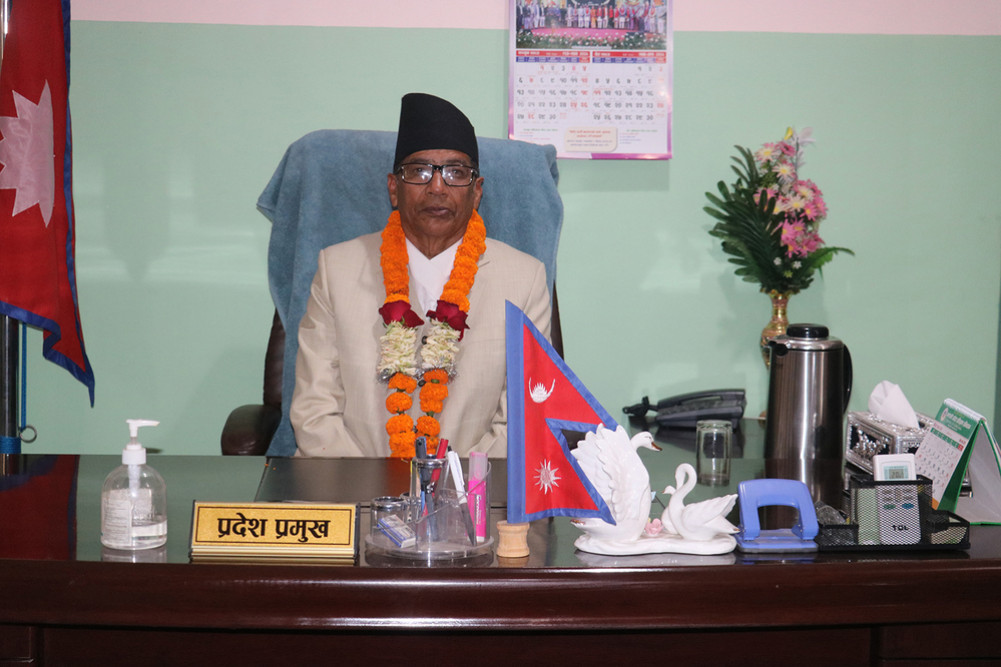
The Provincial Assembly Secretariat submitted the bill to the Office of the Provincial Head for authentication after it was certified by the Speaker on 30 Asar. Nine days later, that is, on 8 Saun, Provincial Head Bhatt decided to return the bill without authentication in accordance with constitutional provisions.
We use Google Cloud Translation Services. Google requires we provide the following disclaimer relating to use of this service:
This service may contain translations powered by Google. Google disclaims all warranties related to the translations, expressed or implied, including any warranties of accuracy, reliability, and any implied warranties of merchantability, fitness for a particular purpose, and noninfringement.
The much-discussed ‘Cannabis Bill’, passed by the Gandaki Provincial Assembly and sent for authentication, has been returned by Provincial Chief Dilliram Bhatt for reconsideration. Provincial Chief Bhatt sent the bill back to the Provincial Assembly on Friday with a message, stating that the bill, which was drafted to regulate and utilize cannabis cultivation for medicinal and industrial purposes, was found to be inconsistent with Nepal’s Constitution and existing federal laws.
The Provincial Assembly Secretariat had submitted the bill to the Office of the Provincial Chief for authentication after it was certified by the Speaker on 30 Asar. Nine days later, on 8 Shrawan, Provincial Chief Bhatt decided, in accordance with constitutional provisions, not to authenticate the bill and to return it. According to the Office of the Provincial Chief, the bill was sent back with a message for reconsideration as per Sub-Article (3) of Article 201 of Nepal’s Constitution.
This decision by the Provincial Chief is based on constitutional and legal grounds. Sub-Article (6) of Article 57 of Nepal’s Constitution clearly states that when making laws, the Provincial Assembly, Village Assembly, or Municipal Assembly must ensure that such laws do not conflict with federal laws. According to this constitutional provision, any law made by the Provincial Assembly that conflicts with federal law is automatically invalid to the extent of the conflict.
Similarly, Section 4, Sub-section (2) of the Intergovernmental Relations Act, 2077, specifies matters to be considered by the province when making laws. Clause (b) of that sub-section clearly provides that the province must ensure that any law or policy made on matters of its exclusive or shared jurisdiction does not conflict with federal law. The message states that the cannabis-related bill prepared by the Gandaki Provincial Assembly violates these constitutional and legal grounds.
The main legal obstacle to the bill’s passage is the Narcotic Drugs (Control) Act, 2033, which remains in force as a federal law and completely prohibits cannabis. Section 3, Clause (a), Sub-clause 1 of the Act defines cannabis, and Sub-clause 2 defines medicinal cannabis as narcotic drugs. Section 4, Clause (a) of the Act completely bans activities such as cultivating, producing, preparing, buying, selling, exporting, importing, transporting, storing, and consuming cannabis.
The press release issued by Pravin Paudel, spokesperson for the Office of the Provincial Chief, clarifies that although the bill mentions medicinal and industrial purposes, the federal law considers cannabis a narcotic drug and completely prohibits it, making it clear that the province alone cannot make such a law.
The Office of the Provincial Chief holds that unless the federal law is amended or revised, it is not possible to legalize cannabis cultivation or use at the provincial level by enacting a separate law, and therefore, reconsideration of the bill is necessary. Chief Minister Surendra Raj Pandey has also been stating in public forums that it is necessary to amend laws and acts made in 2033, before the advent of federalism.