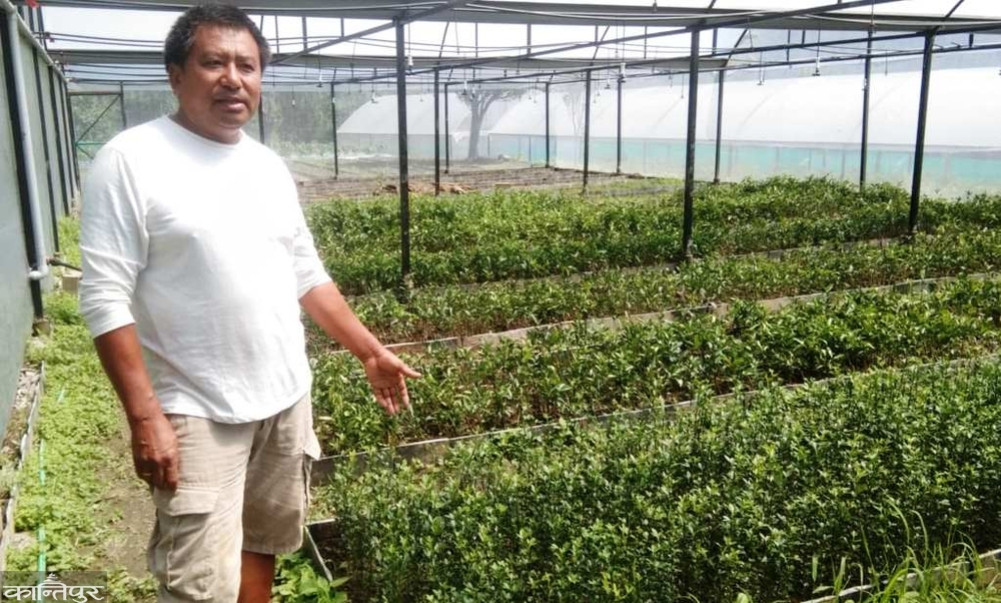
Thapa, who received the first farmer identity card from the government, is preparing to provide seedlings to local farmers at low prices through a technology-friendly nursery.
We use Google Cloud Translation Services. Google requires we provide the following disclaimer relating to use of this service:
This service may contain translations powered by Google. Google disclaims all warranties related to the translations, expressed or implied, including any warranties of accuracy, reliability, and any implied warranties of merchantability, fitness for a particular purpose, and noninfringement.
Ganga Bahadur Thapa, 51, of Gaundakot, Baglung Municipality-3, has started commercial farming with a goal of producing 40,000 orange seedlings annually through a high-tech nursery. He is producing orange grafted seedlings using modern technology at the 'Panchakot Krishi Nursery', which he established by renting five ropanis of land in Laherepipal, Baglung Municipality-6.
Although it looks like a vegetable farm inside the plastic tunnel at first glance, the local Khoku variety of oranges is being grafted onto the roots of a wild three-leafed plant called Typhlet, producing seedlings that can withstand disease and adverse weather conditions.
The most special feature of the nursery is the automatic irrigation system. Thapa says that since the system can be operated from a mobile phone, there is no need to stay in the nursery regularly. Entry into the tunnel has also been restricted to reduce the risk of insects and diseases. He said that about Rs. 2.5 million has been invested in the construction of the nursery and technology installation. The Prime Minister's Agriculture Modernization Project has provided Rs. 400,000 in cost sharing, while he himself has made the remaining investment.
Thapa's plan is to make Baglung Municipality-6, 7, 8 and 9 the main area for orange production. For that, preparations have been made to provide seedlings to farmers at subsidized rates. 'Commercial orange cultivation can be done by utilizing barren land,' he said. 'There is a possibility of increasing production in the village and sending truckloads of oranges to the market.'
He started a small nursery in Bhakimli, Myagdi five years ago and said that he will sell about half of the target seedlings along with the production there this year. Next year, he is preparing to send 40,000 seedlings to the market from the Panchakot nursery.
Thapa has been cultivating oranges, kiwi and vegetables on 100 ropanis in Bhakimli, Myagdi with four partners. His agricultural firms are operating on an area of 15 ropanis in Gaundakot, Baglung, 100 ropanis in Myagdi and five ropanis in Panchakot. He has also made a plan to link all three firms with agritourism. His goal is to make Panchakot, which is increasingly attracting religious tourists, an agritourism destination within a few years.
Thapa, who has been active in commercial agriculture since 2057 BS, is also the first farmer to receive a farmer identity card from the Nepal government in 2072 BS. The Mirmire Agricultural Cooperative Society affiliated with him currently has more than 250 farmer members.