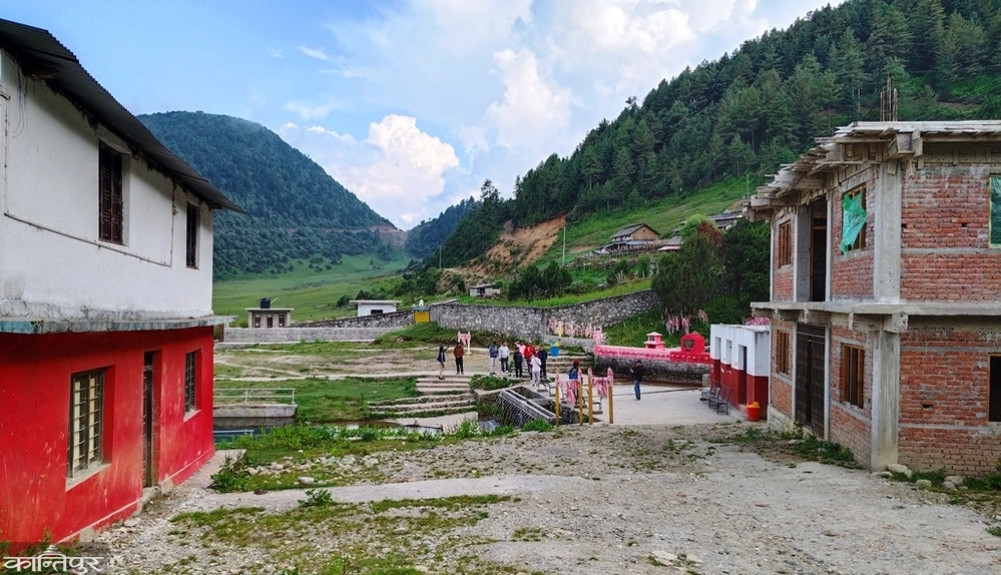
Conservationists say that concrete structures should not be built to protect the natural charm of Dhorpatan.
We use Google Cloud Translation Services. Google requires we provide the following disclaimer relating to use of this service:
This service may contain translations powered by Google. Google disclaims all warranties related to the translations, expressed or implied, including any warranties of accuracy, reliability, and any implied warranties of merchantability, fitness for a particular purpose, and noninfringement.
Permission from the reserve is required for construction of structures in the Dhorpatan Valley, which is within the hunting reserve area. The Integrated Development Office here could not build a stone-and-earth trail from Dhorpatan to Buki due to lack of coordination from the reserve.
The Integrated Development Office had to visit dozens of government offices, including the Reserve and Forest Department, to spend the budget allocated for the construction of a trail from Dhorpatan to Bukipatan via Garpa Chheda, said the office head, Shiv Sharma. While the Reserve Office did not give permission to build wooden bridges and stone-and-earth walkways to make it easier for tourists to reach their destinations, the hotels on the right and left have been built of concrete and sloping.
Pucca houses are also being built in the Tibetan refugee camp, saying that they will build hotels. More than 40 hotels are currently operating in the Dhorpatan Valley, and there are also some homestays. The houses where the homestays are located have also been built on slopes. Local hotelier Shiva Kandel said that the sloped houses were built using half of the cement. The hospital under construction in Dhorpatan is also made of concrete. Two concrete houses have been built in the premises of the historical and religious place Dhorbarah temple. There is a fierce competition to build sloped houses nearby. The municipality has provided a grant to build the houses in the Dhorbarah temple premises. Cham Bahadur Thapa, a priest of Dhorbarah, said that those houses were built to house stores and priests. There is an army check post and a reserve entrance at the gate to enter the valley. Those structures are also made of RCC. Locals complained that they were not able to mine and collect sand from the Uttar Ganga. Not only that, locals also complain about not being able to extract grass and firewood for daily necessities. ‘We have stopped the indiscriminate excavation, the reserve collects and provides it with a fee for essential materials,’ said Sagar Subedi, the reserve’s information officer. ‘We did not allow the original material here to be collected so that it would not be damaged.’ But he said that he had suggested not to build houses on slopes.
Conservationists say that concrete structures should not be built here to preserve the natural charm of Dhorpatan. ‘We did not build Dhorpatan, it is a natural asset, it is only our job to protect it,’ said solo traveler Sirjana Oli. ‘It is not good to build concrete buildings in the reserve when climate change is affecting it.’ She said that the municipality and the reserve should immediately stop this and allow the construction of original traditional houses.
In Dhorpatan, it is traditionally a custom to have houses made of mud and covered with wooden planks. Small wooden bridges are also placed in the ravines. There is also a tradition of grazing animals and not cutting the grass here. Many initiatives are underway, such as using only compost manure in potatoes and not spreading chemical fertilizers. The residents of Dhorpatan, which is at an altitude of 3,000 meters, still eat anto and dhido. The locals who raise sheep and cows in the mountains do not use much of the goods brought from the market. Local milk and ghee are used a lot. Local Bhumiraj BK said that apart from local chickens, there is no tradition of bringing in developed goods such as boilers. The municipality has not shown any interest in Dhorpatan, where concrete structures are being built. ‘So far, the local building construction standards of Dhorpatan Municipality have not been formulated,’ said Engineer Buddhi Rana Magar. ‘Only after the standards are formulated, the municipality can tighten the local standards.’ Currently, only the federal standards are applicable.’ But since the municipality is not paying attention to the standards, houses that violate the standards and lose their originality are being built in a hurry.
Another engineer, Dhwaj Saund, said that the renovation work of the houses has also been stopped for a year and a half. The municipality has not worked even though it was aimed to get the maps of the houses built before the formation of the local government approved and the standards adjusted. ‘If the standards are formulated next year, we will tighten them,’ he said. ‘Right now, houses are being built in a hurry, nothing can be said.’ The Burtiwang market is already filled with concrete. Apart from that, concrete houses have been erected in large numbers in Ward 5's Sahikhola, Ward 7's Bobang Village, and Dhorpatan Valley.
The reserve has banned the dumping of plastic products and the construction of cement structures on the trekking route, but has not said anything about the construction of individual houses. Such houses can also be seen near the reserve office. Locals are concerned that if Dhorpatan cannot be kept in its original style, it will not be possible to increase the number of tourists and that the climate will change and the heat will increase. 'This valley should be left in its green and original form, otherwise there is a question of why tourists will come,' said Krishna Prasad Acharya, Gandaki Province President of Nepal Travel and Trekking Agency (TAAN), Nepal. 'Tourists look for convenience, but not concrete houses.' He said that originality can be given to local wooden and stone houses.
30 to 35 thousand tourists visit here every year with the permission of the reserve. This number is increasing. But the reserve and the municipality, which have considered the waste management challenge when they arrive, have not been able to stop the construction of concrete houses. Local Ramita Pun said that if originality and hospitality can be provided, up to one lakh tourists can be brought to Dhorpatan annually and homestays can be developed for that period. She suggests that arrangements should be made to maintain greenery, go trekking and eat local dishes for tourists to enjoy.
Dhan Bahadur Kayat, the acting head of the municipality of Dhorpatan, said that they will develop an integrated settlement while preserving the originality of Dhorpatan, focus development plans on Dhorpatan and take initiatives to make Dhorpatan an original style tourist hub. He has also suggested not to use concrete. Instead, the locals are demanding that the road leading to Dhorpatan be made level. Tourists have been suffering during the rainy season as the Saljhandi-Dhorpatan Road Project Office has repeatedly failed to complete the work on time. The project, which started 16 years ago, has not been completed yet.