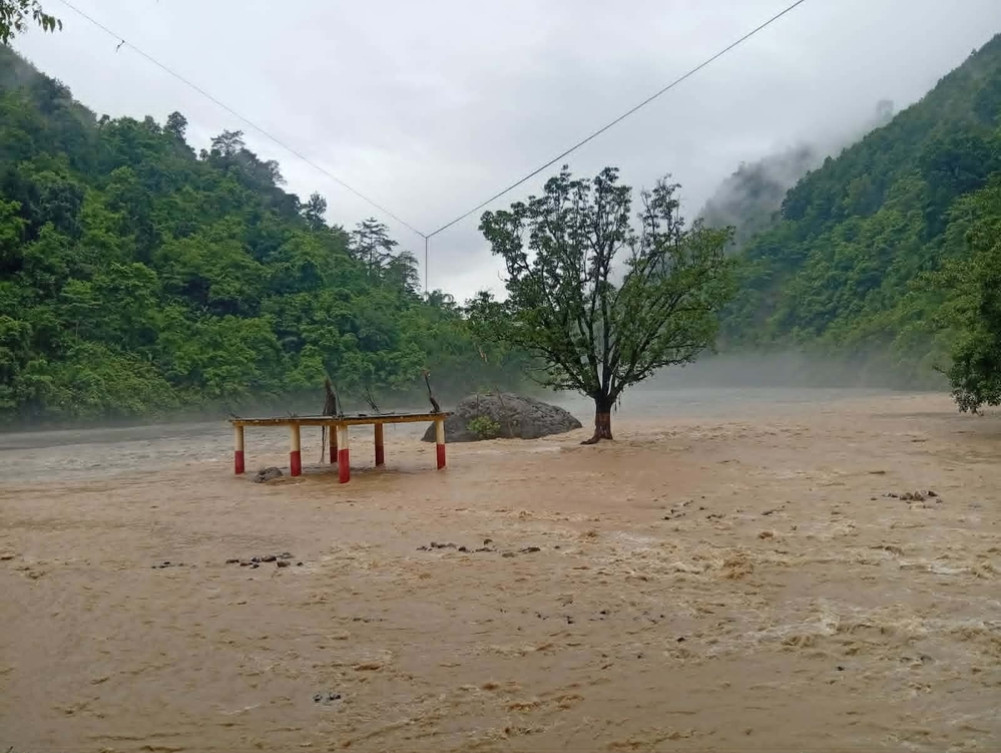
As the river level continues to rise, not only the religious site but also the nearby Setiveni Bazaar is at high risk of flooding.
We use Google Cloud Translation Services. Google requires we provide the following disclaimer relating to use of this service:
This service may contain translations powered by Google. Google disclaims all warranties related to the translations, expressed or implied, including any warranties of accuracy, reliability, and any implied warranties of merchantability, fitness for a particular purpose, and noninfringement.
The Shaligram Rock, which is important from a religious and touristic point of view, located in Setiveni, the confluence of Parbat and Syangja, has been submerged Local residents are forced to stay awake all night due to the fear of flooding entering the settlement.
According to Rajan Patel, Police Inspector of the Parbat District Police Office, the local administration has urged people to be on high alert as the risk of flooding and landslides has increased in various streams and rivers, including the Setiveni area. The police have increased surveillance in the riverbank area as the risk can come at any time.
Local residents and public representatives have accused the Kaligandaki 'A' Hydropower Project as the main cause of this crisis. According to Man Bahadur Basyal, Ward Chairman of Bihadi Rural Municipality-6, before the project was built, the Shaligram rock used to flow about 100 meters away from the Kaligandaki River through the Gulmi road and was always safe during the winter and rainy season.
'Now it is unbelievable that it is the Virat Shaligram. Even in winter, only the upper part of the rock can be seen. The settlements along the river have been displaced and the market residents have to live in fear,' he said.
The Kaligandaki 'A' Hydropower Project (144 MW) dam has been built about 7 kilometers downstream from Setiveni. Due to the dam, large stones, gravel and sand carried by the river are piling up in the area above the dam, causing the river level to rise every year. Although the project has promised to clean up river-borne materials, if it is not implemented, the entire historical market and the rock are at risk of disappearing, said locals Dilliram Bhusal and Arjun Neupane.
Local residents have demanded that the state should extract the stones and sand accumulated in the river and make it a source of income and take immediate concrete steps to protect the existence of the Shaligram Rock. The construction of the 144-megawatt Kaligandaki Hydropower Project, operated by the Nepal Electricity Authority, began in 2054 BS and has been generating electricity since 2059 BS.