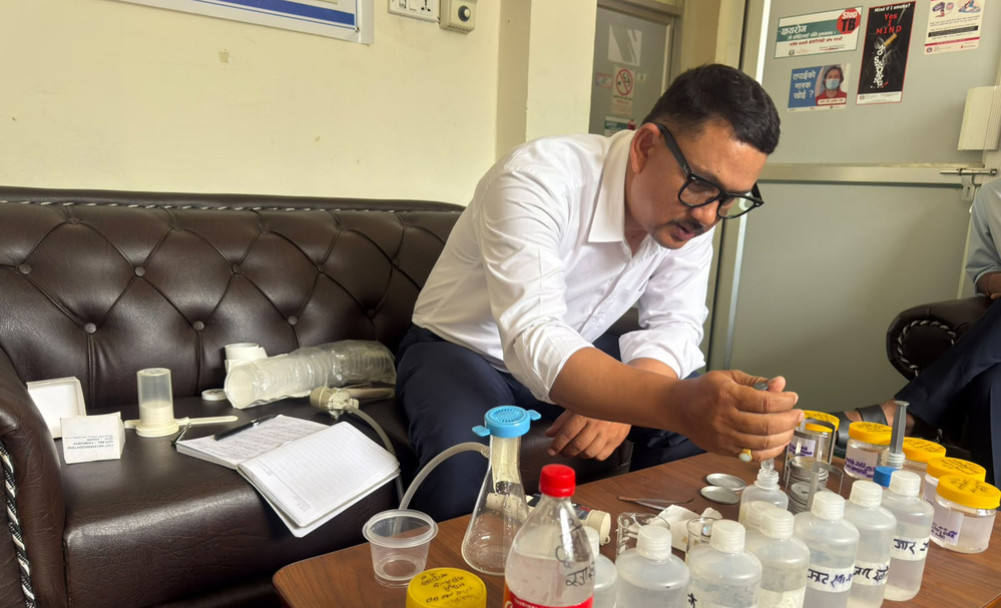
According to the office, the amount of E-coli has been found to be 100 or more in the tap water distributed by the Drinking Water Scheme and Consumers Committee.
We use Google Cloud Translation Services. Google requires we provide the following disclaimer relating to use of this service:
This service may contain translations powered by Google. Google disclaims all warranties related to the translations, expressed or implied, including any warranties of accuracy, reliability, and any implied warranties of merchantability, fitness for a particular purpose, and noninfringement.
Fecal-borne microorganisms (E-coli) have been found in the water being distributed to consumers' taps and drinking water sources in Lamjung.
The Provincial Public Health Office has found high levels of E-coli in water samples collected from sources including springs and even in water reaching consumers' taps.
According to the office, the amount of E-coli in taps distributed by the Drinking Water Scheme and Consumers' Committees has been found to be 100 or more.
According to the office's report, out of 129 samples collected from springs, taps and other drinking water sources, E-coli has been found in 98 (76 percent). Only 31 (24 percent) samples have zero E-coli. Out of 86 samples collected from consumers' taps, 70 (81 percent) have found E-coli. Only 16 (19 percent) samples have been found safe. According to the report, the water becomes more contaminated after reaching the distribution system than at the source.
Out of 31 samples tested in Besisahar Municipality, 24 were found to be E-coli. Out of 28 samples tested in Sundarbazar Municipality, 20 were found to be E-coli, 11 out of 15 samples tested in Madhya Nepal Municipality, and 5 out of 10 samples tested in Rainas.
Out of 11 samples tested in Marsyangdi Rural Municipality, 9 out of 11 samples tested, 8 out of 11 samples tested in Dordi, 8 out of 8 samples tested in Dudhpokhari, and 13 out of 15 samples tested in Kholasothar were found to be E-coli.
Out of 17 samples tested in Besisahar Municipality, which is also the district headquarters, 15 out of 17 samples tested were found to be E-coli. E-coli has been found in 8 out of 9 samples from Sundarbazar, 7 out of 8 samples from Madhya Nepal, 5 out of 10 samples from Rainas, 8 out of 10 samples from Marsyangdi Rural Municipality, 8 out of 11 samples from Dordi, 6 out of 6 samples from Dudhpokhari and 13 out of 15 samples from Kholasothar. According to Niroj Kumar Shrestha, Lab Technician Inspector of the office, the amount of E-coli has been found to be 100 or more in some drinking water schemes, sources and distributed taps. The amount of E-coli has been found to be 100 or more in the drinking water of Danda Drinking Water and Sanitation Consumer Committee in Besisahar Municipality 10, Besisahar Bhachowk and the traditional gair tap in the district headquarters Besisahar. The gair tap in Besisahar is a place where consumers flock to drink water every day.
Similarly, the amount of E-coli has been found to be 100 or more in 2/2 drinking water sources in Sundarbazar, Madhya Nepal and Rainas Municipality. Lab technician inspector Shrestha said that the amount of E-coli was found to be 100 or more in 1/1 of Marsyangdi, Dordi and Kholasothar and 4 drinking water sources in Dudhpokhari rural municipality.
According to Dr. Ambika Dawadi, medical officer of Provincial Hospital Lamjung, the presence of E-coli in water sources indicates that there is directional pollution. He says that the consumption of polluted water increases the risk of spreading water-borne diseases including diarrhea, cholera, typhoid, dysentery, hepatitis 'A' and 'E'. Not only that, but it can also cause vomiting, worms, urinary tract infections, and pneumonia, he said. This is especially problematic for the elderly and children.
'When I came to Besisahar 2 years ago, the water from Sheetalpati and Gairidhara was seen as unsafe. Consumers have been consuming these traditional drinking water sources. "It gets even more polluted during the rainy season," he said. "It is necessary to avoid consuming the water here as much as possible and if you have to, boil it or purify it." He said that drinking water should be consumed only after boiling it or purifying it through appropriate methods. "Some people are getting sick from polluted drinking water. If you get sick, there is no option but to go to a health facility. It is better to drink Jeevan Jal water first," he said.