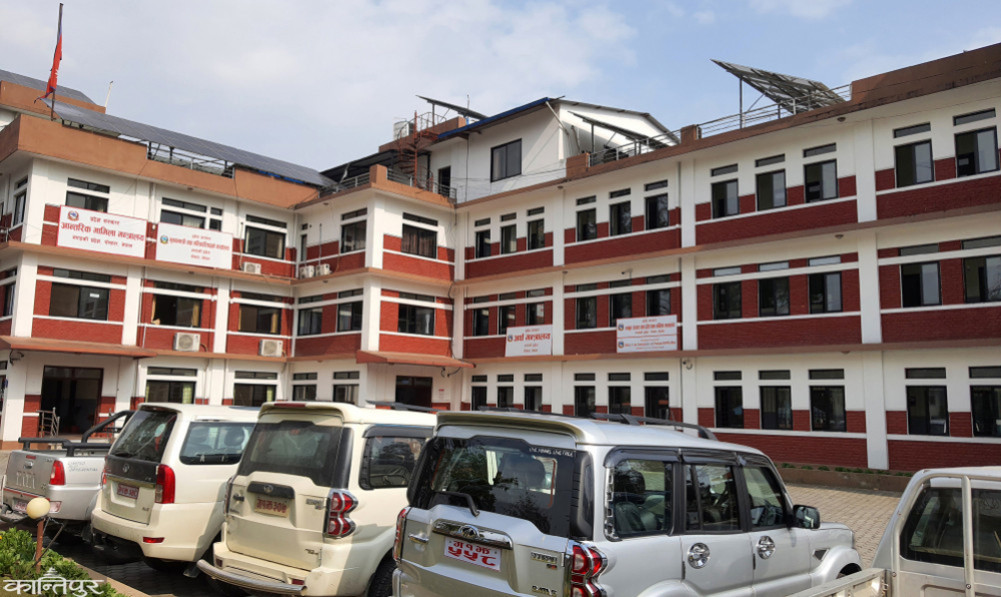
The province's budget expenditure had not fallen below 66 percent in previous fiscal years.
We use Google Cloud Translation Services. Google requires we provide the following disclaimer relating to use of this service:
This service may contain translations powered by Google. Google disclaims all warranties related to the translations, expressed or implied, including any warranties of accuracy, reliability, and any implied warranties of merchantability, fitness for a particular purpose, and noninfringement.
The Gandaki Provincial Government has implemented the weakest budget since the establishment of the province in the current fiscal year. The province has set a new low record in terms of expenditure after spending only 64.26 percent of the total allocated budget.
According to the data of the Provincial Treasury and Controller of Accounts Office, out of the 32 billion 60 million 835 thousand rupees allocated for the current fiscal year, only 20 billion 60 million 50 million 65 thousand 978 rupees have been spent. A total of 11 billion 45 million 71 million 21 thousand rupees could not be spent.
The provincial government, which had spent only about 40 percent of the budget by mid-Jeshtha, increased the payment pressure in Ashar, and the expenditure rate reached 64.26 percent. According to Provincial Controller of Accounts Suresh Subedi, since this is the preliminary details up to the payment period, there may be minor fluctuations in the final figures.
The province's budget expenditure had not fallen below 66 percent in previous fiscal years. In the fiscal year 077/78, 66 percent of the budget was spent and in the fiscal year 080/81, 66.59 percent of the budget was spent. The highest expenditure was in the fiscal year 078/79. Out of the budget of 31.35 billion rupees, 75 percent, or 22.04 billion rupees, was spent that year. There is data that 69 percent of the budget was spent in 075/76, 70 percent in 076/77, 71 percent in 079/80, and 69.54 percent in 081/82, the first fiscal year after the establishment of the province.
According to the nature of the budget, out of the 12.54 billion rupees allocated for the current year, 7.60 billion rupees, or 60.6 percent, have been spent. Out of the 19.26 billion rupees allocated for the capital year, 12.99 billion rupees, 66 million rupees have been spent, and the implementation has reached 67.4 percent. However, the 250 million rupees allocated for financial management could not be spent.
The Ministry of Energy, Water Resources and Drinking Water is at the forefront in terms of ministry-wise expenditure. The ministry has spent Rs. 3.7 billion 75 million out of the Rs. 4.32 billion 55 million budget, achieving 85.7 percent progress.
The Ministry of Forest and Environment has spent Rs. 829.4 million out of Rs. 1.6 billion, or 77.6 percent. The Ministry of Social Development, Youth and Sports has spent Rs. 1.73 billion out of a budget of Rs. 2.31 billion, achieving 75.25 percent progress. The Ministry of Industry and Tourism has spent Rs. 586 million out of Rs. 852.2 million.
The Ministry of Health has spent Rs. 2.3 billion out of Rs. 3.2 billion, or 63.59 percent. The Ministry of Physical Infrastructure Development and Transport Management, which has the largest budget in the province, has been able to spend only Rs. 7.88 billion 72 million out of Rs. 12.17 billion, or 64.8 percent. The Ministry of Agriculture and Land Management has achieved 60.39 percent progress by spending Rs 1.21 billion 97 million out of Rs 2.19 billion. The Office of the Chief Minister and Council of Ministers has spent Rs 495 million or 50 percent of the Rs 988 million budget. The Ministry of Economic Affairs has the lowest expenditure. The ministry, which received a budget of Rs 233 million, has been able to spend only Rs 871 million or 37.4 percent.
Chief Minister Surendra Raj Pandey had earlier informed the Provincial Assembly about the issue of budget expenditure not being as expected. He had said that many projects were affected due to the 'Genji' movement, economic slowdown and fuel price hike. The Provincial Treasury and Controller of Accounts Office says that the contract process of some projects has been affected due to the increase in fuel prices and the contracted projects have not been completed on time, resulting in payment being delayed.