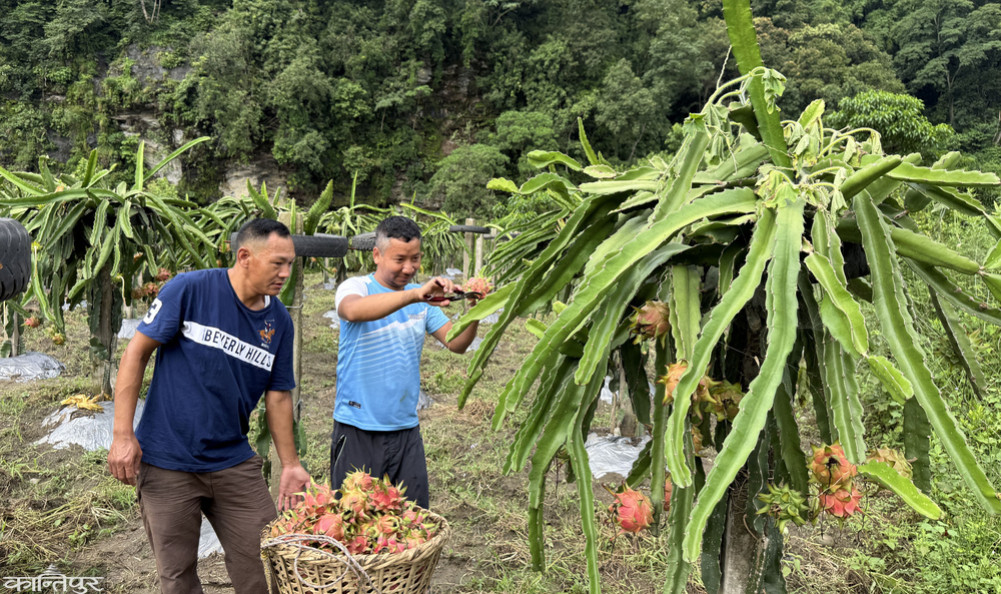
The dragon fruit farming that has begun on barren land in Besisahar–10 has shown new possibilities in production, employment, and agro-tourism.
We use Google Cloud Translation Services. Google requires we provide the following disclaimer relating to use of this service:
This service may contain translations powered by Google. Google disclaims all warranties related to the translations, expressed or implied, including any warranties of accuracy, reliability, and any implied warranties of merchantability, fitness for a particular purpose, and noninfringement.
The land on the banks of the Marshyangdi River at Khasur, Besishahar Municipality–10, Lamjung, which had lain fallow for two decades, is now covered with bright red dragon fruit. Thanks to the initiative of three young men who chose to seek their future in agriculture at home rather than going abroad, the once barren land is now becoming a center for production, employment, and agri-tourism.
“Looking at this thorny plant from the outside, I never imagined it would bear such a sweet fruit,” says Indra Bahadur Ghale of Besishahar–10, offering dragon fruit to visitors. As soon as you slice open the red skin and taste the deep red pulp inside, the sweetness spreads in your mouth. Most people who visit the farm taste dragon fruit for the first time here.
This orchard, spread across Gangadil, is reached by crossing the suspension bridge over the Marshyangdi River after passing Belauti Bisauna on the road from Besishahar to Manang. It has now become an attraction for domestic tourists. From morning walkers to dragon fruit enthusiasts, many people come here. While many used to come looking for watermelon, they now leave carrying dragon fruit.
Initially, they leased the village’s fallow land and started cultivating lemons. However, due to the dampness of the riverbank, the lemons did not succeed. They then tried planting Akabare chili, but deer destroyed the plants while they were still young, leading to another failure. After two consecutive setbacks, they chose dragon fruit as an alternative.
They brought 50 dragon fruit cuttings from Damauli in Tanahun and planted them on poles. Expanding from there, dragon fruit is now grown on 500 poles. About 250 poles have already started bearing fruit, and they plan to expand by another 250 poles this year. However, since the pipeline for the under-construction 50-megawatt Divyajyoti Hydropower Project will pass through the same area, the expansion plan has been put on hold for some time.
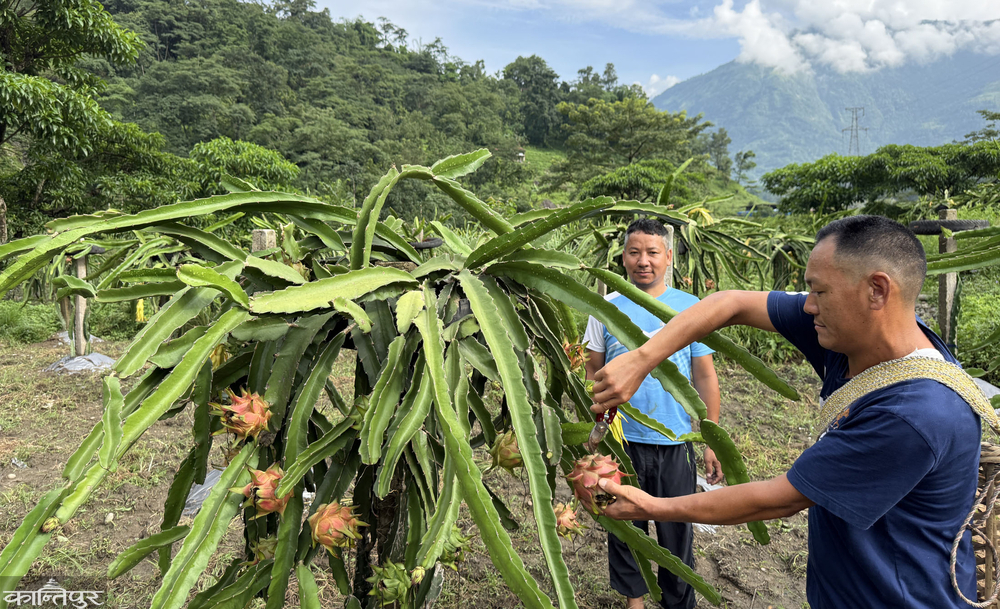
Many young people initially joined with the aim of doing something on the village’s fallow land. But over time, most dropped out. In the end, only Indra Bahadur Ghale, Ram Bahadur Gurung, and Yog Bahadur Ghale remained committed to the plan.
After graduating with an MBS from Shankardev Campus and working for a few years in a cooperative, 38-year-old Indra Bahadur has been engaged in agriculture since 2013. Forty-year-old Ram Bahadur Gurung spent about four years in Qatar and Malaysia. He tasted dragon fruit for the first time in Malaysia and learned about its cultivation there. After returning to the village around 2016, he decided not to go abroad again and chose agriculture as his profession.
Yog Bahadur Ghale returned to the village in 2018 after spending five years in South Korea. He, too, joined his friends in the agricultural enterprise. The three of them established “Marshyangdi Beach Agro Farm” in 2021. They leased about 40 ropani of fallow land from villagers and cleared the brush. Currently, 15 ropani of land is being utilized, with dragon fruit cultivated on 10 ropani.
They have found that the sandy soil on the banks of the Marshyangdi River, an altitude of about 750 meters, and the cool climate are very suitable for dragon fruit cultivation. Last year, the farm produced five quintals, and this year, production is expected to exceed 15 quintals. So far, two quintals have already been sold, and another five quintals are ready for sale. They say the fruit sells for 500 rupees per kilo directly from the farm.
According to Ram Bahadur, hotels and restaurants in Besishahar as well as the general public have now become regular customers. “Now we don’t have to worry about where to sell our produce,” he said. For customers buying more than 10 kilos, home delivery is available in Besishahar, and delivery is arranged to other locations as well. Dragon fruit starts to ripen in the first week of Asar and continues to be harvested until Kartik.
Each of the three initially invested 300,000 rupees. Now, the farm’s total investment has reached about 3 million rupees. Without hiring outside workers, they handle all tasks themselves, from farming to market management.
Along with dragon fruit, they also cultivate watermelon. Last year, they sold 10 quintals of watermelon, and this year, 15 quintals. As dragon fruit cultivation expands, the area for watermelon is gradually decreasing.
The farm received a grant of about 600,000 rupees from the Prime Minister’s Agriculture Modernization Project for land leveling. They also received 61,000 rupees from the Agriculture Development Office for constructing dragon fruit poles, and 24,000 rupees from Besishahar Municipality for watermelon cultivation.
The nearby Marshyangdi River provides irrigation. To manage organic fertilizer, they have also raised three buffaloes. One is currently lactating, and another is about to give birth.