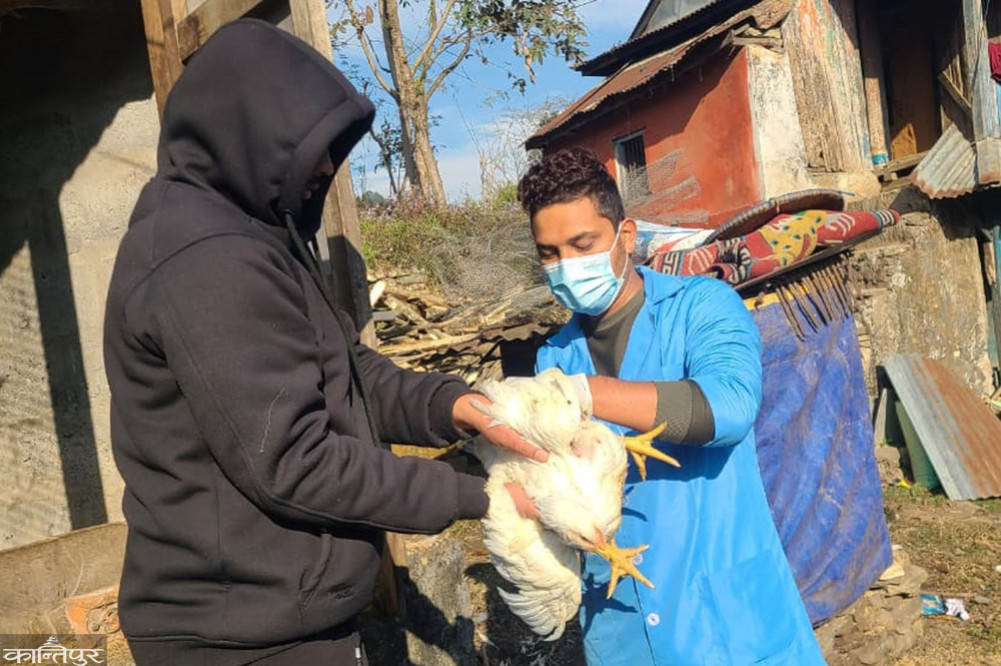
When transporting chicks and other live birds, it is mandatory to have a veterinary health certificate issued by a registered veterinarian.
We use Google Cloud Translation Services. Google requires we provide the following disclaimer relating to use of this service:
This service may contain translations powered by Google. Google disclaims all warranties related to the translations, expressed or implied, including any warranties of accuracy, reliability, and any implied warranties of merchantability, fitness for a particular purpose, and noninfringement.
To prevent the spread of bird flu infection, the import of chickens and poultry products from other districts into Lamjung has been banned.
The Veterinary Hospital and Livestock Service Office Lamjung issued a public appeal on Thursday, requesting that, until further notice, the transport of chicken meat, processed chicken, and eggs should not take place.
After bird flu was confirmed in three districts of the Kathmandu Valley and in Kavrepalanchok, strict measures have been implemented to prevent the disease from spreading to Lamjung by restricting the import of chickens and poultry products, according to Dr. Sunil Nyaupane, Chief of the Veterinary Hospital and Livestock Service Office Lamjung. According to him, the ban on importing poultry products from other districts was imposed as per the decision of the Bird Flu Disease Control Committee.
He stated that regular monitoring is being conducted to check for the presence of the disease in chickens. “So far, bird flu has not been detected in the district. However, to prevent its entry, we have had to impose a ban on imports from other districts,” he said.
According to the office, when transporting chicks or other live birds, it is mandatory to have a veterinary health certificate issued by a registered veterinarian. The office has also requested that cartons and crates previously used for storing eggs should not be reused.
The office has requested poultry farmers to allow vehicles entering poultry farms only after disinfection, to strictly adhere to biosecurity standards, and to make necessary arrangements to prevent contact between domestic chickens and wild birds such as crows.
Similarly, instructions have been issued not to dispose of dead chickens in open areas, but to manage them safely by burying them in deep pits.
The office has also requested that, if an unusually large number of chickens fall ill or die in any poultry farm or other location, the concerned Livestock Service Branch or the Veterinary Hospital and Livestock Service Office, Lamjung, should be informed immediately.