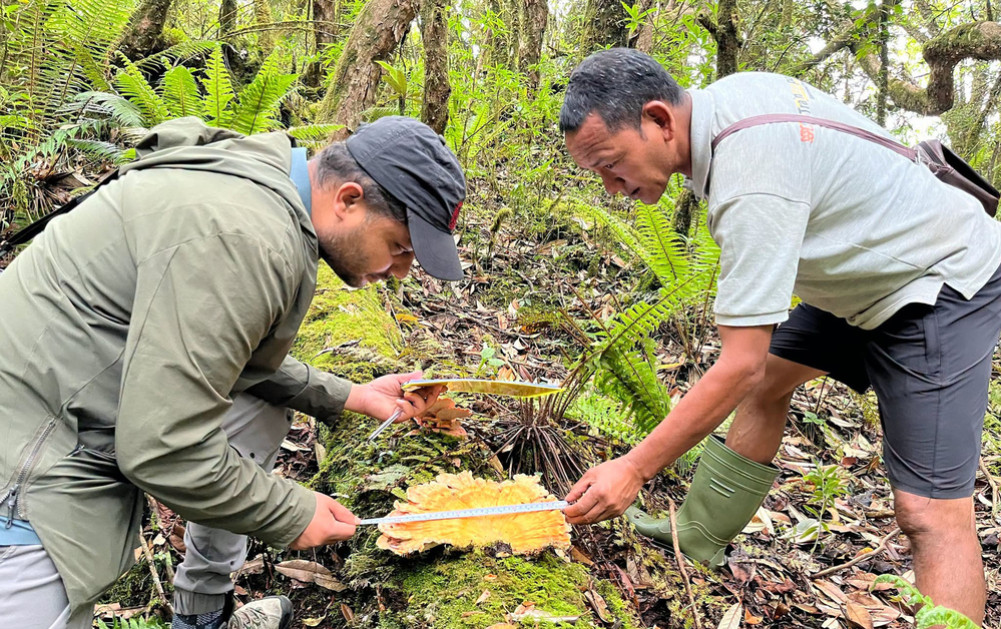
During the survey, details on the condition, distribution, habitat, and biodiversity of mushrooms were collected at every 500-meter altitude interval.
We use Google Cloud Translation Services. Google requires we provide the following disclaimer relating to use of this service:
This service may contain translations powered by Google. Google disclaims all warranties related to the translations, expressed or implied, including any warranties of accuracy, reliability, and any implied warranties of merchantability, fitness for a particular purpose, and noninfringement.
The Area Conservation Office under the Annapurna Conservation Area Project (ACAP), Bhujung Lamjung has conducted a study survey of mushrooms found in the forest.
ACAP has stated that it conducted a survey of wild mushrooms to identify, collect data and document the diversity of wild mushrooms found within its scope.
According to Pramod Raj Regmi, Head of ACAP Bhujung Office, the mushroom survey was conducted on three routes: Siurung-Khilapu-Koprong-Thurju-Dudhpokhari, Thurju-Phurju-Dhom-Rorochho-Bhujung and Bhujung-Hragun-Pasgaun-Kamagaun. He said that the survey took a week.
This area falls under the Marsyangdi Rural Municipality and Kholasothar Rural Municipality areas of Lamjung. During the study, mushrooms were found up to the Deurali area before reaching Dudh Pokhari, which is on the border of Lamjung and Manang, said Regmi, the head of the office. According to him, mushrooms have been found up to Deurali, which is about 4,300 meters above sea level.
He said that details about the condition, distribution, habitat and biodiversity of mushrooms were collected at every 5/500 meter altitude interval during the survey. ‘The collected data is being analyzed. The exact details of the mushroom species will be found after the study,’ he said. According to him, more than 50 species of mushrooms have been found on all three routes.
According to Regmi, a questionnaire survey on the collection, identification, use and conservation of edible and inedible mushrooms has also been conducted with the local community in this area. During the survey, the local community has also informed about their experiences, traditional knowledge and suggestions related to mushrooms. He said that the information obtained will help in the conservation of local biodiversity, sustainable use of mushrooms and making research more effective.
Basudev Neupane, Natural Resources Conservation Assistant at ACAP, said that both edible and inedible types of mushrooms were found in the initial study. He said that the survey conducted with the participation of local resource persons from Siurung has provided the basis for preparing a record of mushrooms found within the conservation area.
According to Regmi, the study has documented the number of edible and inedible mushrooms in the Annapurna region, the way in which local communities collect and use mushrooms, the contribution of mushrooms to local livelihoods, as well as traditional knowledge. He said that the details obtained from the survey will help prepare a scientific record of mushroom species within the conservation area, make studies on biodiversity more effective, and set an important basis for conducting conservation, sustainable use and research programs in the future.