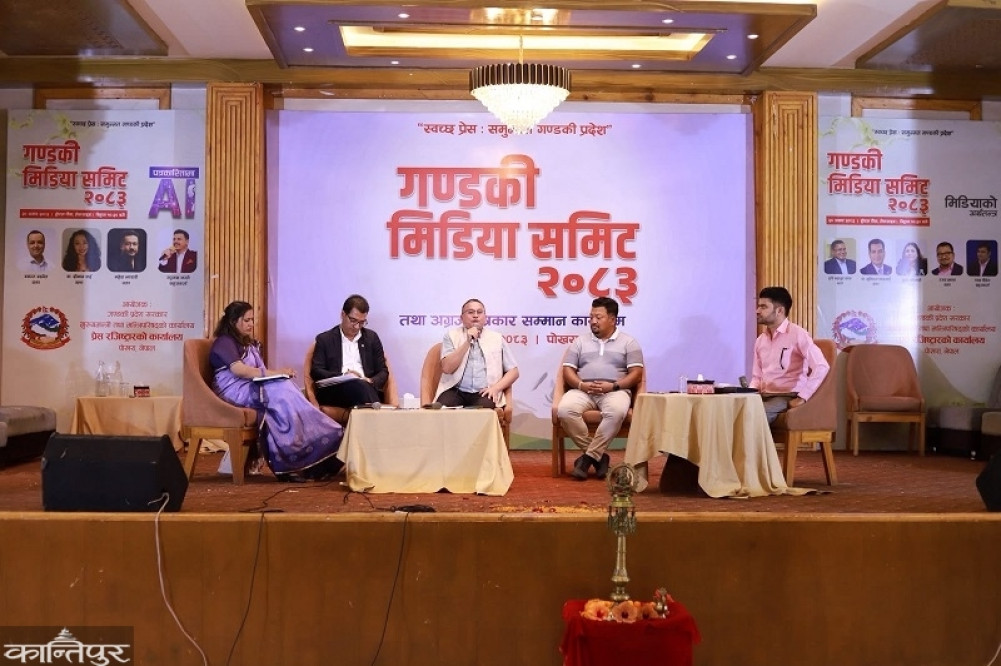
A discussion held in Pokhara concluded that a clear state policy, new sources of investment, and technology-friendly transformation are indispensable at a time when traditional media outlets are facing financial crisis.
We use Google Cloud Translation Services. Google requires we provide the following disclaimer relating to use of this service:
This service may contain translations powered by Google. Google disclaims all warranties related to the translations, expressed or implied, including any warranties of accuracy, reliability, and any implied warranties of merchantability, fitness for a particular purpose, and noninfringement.
The Gandaki Province Press Registrar's Office has honored five senior journalists for the first time.
On the occasion of the 'Gandaki Media Summit' organized in Pokhara on Saturday, Pokhara's Tilakman Gubhaju and the late Keshav Raj Parajuli, Nawalpur's Prem Chandra Rauniyar, Tanahun's Bishwabandhu Bhandari and Parbat's Saraswati Sharma 'Jigyasu' were honored with Rs 50,000 each and a copper plaque. They were honored by Gandaki Province Chief Minister Surendra Raj Pandey.
On behalf of the late Parajuli, who passed away at the age of 91 three days ago, former presidents of the Federation of Nepali Journalists Kaski Krishna Prasad Bastola and Narayan Karki accepted the honor. The book 'Journalism of Our Time', which includes the contributions of all the five journalists honored on the occasion, has also been made public.
At the program, Chief Minister Pandey said that press freedom is the basis of democracy and no one can stop the right to speak and write the truth. 'With the development of technology, opportunities as well as challenges have increased in the mass media sector,' he said, 'The role of the media is important in explaining the difference between social media and mainstream journalism to the citizens.'
Press Registrar Bimala Bhandari said that the honor program was started with the aim of documenting the lives, struggles and contributions of senior journalists. According to her, a campaign has been launched to preserve the experiences of senior journalists in the form of books and digital archives to pass on the history of journalism to future generations. She said that the office is committed to institutionalizing truthful, impartial, professional and responsible journalism.
Honored journalist Bishwabandhu Bhandari said that journalists are a bridge between the rulers and the people and that the honor has made them feel more responsible.
Federation of Nepali Journalists Gandaki Province President Ramesh Poudel said that the media sector is currently going through an economic crisis and expressed dissatisfaction with the policy of limiting government advertisements to government media only. Stating that the budget allocated for health insurance of journalists is inadequate, he urged the government to provide a special opportunity to the media outlets that have not been renewed to renew their health insurance once.
Among the honorees, the late Keshav Raj Parajuli was the founder and editor of Janamat Dainik. He is also a freedom fighter and a person honored with the Pokhareli Navratna. Tilakman Gubhaju has been active in journalism and Buddhist philosophy studies for more than five decades. Prem Chandra Rauniyar has been doing journalism in Nawalpur for three decades, while the magazine 'Bhanjyang' has been continuously published since 2039 BS under the editorship of Vishwabandhu Bhandari. Saraswati Sharma is known as an inquisitive writer and social activist.
A selection committee was formed under the coordination of Krishna Prasad Lamsal, Law and Communication Secretary of Gandaki Province, for the Senior Journalist Award.
Emphasis on new investment and digital transformation to boost media
A discussion held in Pokhara concluded that a clear state policy, new sources of investment and technology-friendly transformation are indispensable when traditional media is facing an economic crisis.
In a discussion on the topic of ‘Media Economy’ under the ‘Gandaki Media Summit-2083’, speakers expressed their views on the government’s advertising policy, the growing influence of digital media and the sustainability of media.
Journalist Hari Bahadur Thapa said that the state should bring an investment-friendly policy to save traditional media, which is the basis of investigative journalism. He said that even though private media creates jobs, government policies have weakened them.
Communication expert Dr. Bhumiraj Chapagain said that digital media is attracting readers and advertisers based on data and said that the media should diversify its sources of income. He suggested making a one-year revenue plan, a three-year digital plan and a five-year sustainability plan.
Advertising entrepreneur Ujay Shakya said that even if the advertising market does not decline, the media should adopt technology and impact measurement systems. One Vice President Durga Adhikari opined that the media can survive only by strengthening quality content and relationships with the community.
‘Newsrooms without AI are now unimaginable’
The use of artificial intelligence (AI) in journalism is increasing rapidly and its use is becoming inevitable, a conclusion was drawn in a discussion on ‘AI in Journalism’.
In the discussion, Online News Editor-in-Chief Basanta Basnet, AI expert Dobhan Rai and media entrepreneur and content creator Mahesh Bhandari expressed their views on the opportunities and challenges of AI.
Basnet said that newsrooms without AI are now unimaginable. Stating that AI has been used in his media for a year and a half, he stressed that the final decision on news should be made by humans. 'We should not be under the illusion that AI always makes the right decision,' he said.
AI expert Rai said that the rapid development of technology is changing society, economy and working style. She said that the challenge of distinguishing false information is increasing as AI is making content very realistic. She also stressed that human values and aesthetic sense should be preserved along with technology.
Mahesh Bhandari said that AI should be used as an auxiliary tool, while creative thinking and commentary should be the responsibility of humans. He said that journalists should be able to use it effectively rather than being afraid of AI.