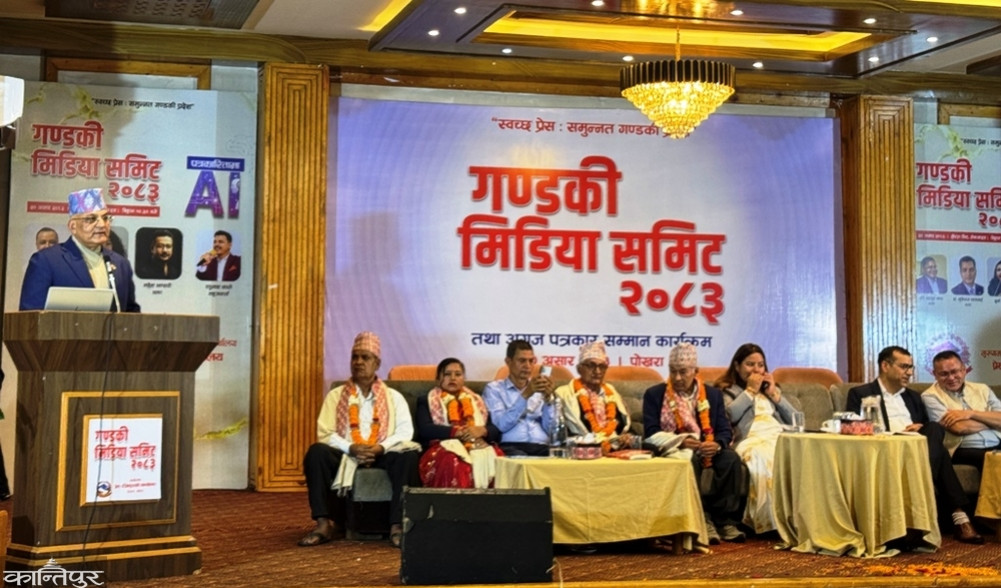
He said that the documents of the RSP general convention and the statements of the leadership displayed a double nature and commented that the new parties' views on federalism were not clear.
We use Google Cloud Translation Services. Google requires we provide the following disclaimer relating to use of this service:
This service may contain translations powered by Google. Google disclaims all warranties related to the translations, expressed or implied, including any warranties of accuracy, reliability, and any implied warranties of merchantability, fitness for a particular purpose, and noninfringement.
Gandaki Province Chief Minister Surendra Raj Pandey has accused the current government of moving forward with a spirit of revenge and revenge, warning that it will push the country back towards conflict.
Speaking at the Gandaki Media Summit organized by the Press Registrar's Office, Gandaki Province in Pokhara on Saturday, he expressed concern that the free press and democratic values are being attacked. He claimed that the country is gradually moving from an open democracy to a 'guided' and limited democracy.
'Nowadays, which minister or prime minister gives orders at any time,' he said, 'You must have remembered that most people are arrested after the courts close on Friday. They are detained in the name of investigation and released from the court after nothing is found. Those in the government often find it funny saying, 'Even if it is for two days, I have been detained, I have defamed the society.' Such a spirit of revenge should not be and should not be maintained by the prime minister.' He pointed out that if the government continues in this manner, the country is likely to fall into conflict again soon.
Stating that the documents of the general convention of the National Independent Party (NISP) and the statements of its leadership have shown a double character, he commented that the new parties' views on federalism are not clear. 'It is time for journalists to find out and investigate what their authority is in maintaining federalism or not, abolishing the provincial government and provincial assembly or not,' he said.
He warned that if federalism is tried to be abolished in the name of personal aspirations and change, the country will sooner or later fall into conflict again. Recalling the past 10 years of armed conflict, he said that history could repeat itself if the government and the ruling parties do not understand its seriousness.
Speaking on the issue of press freedom and the advertising market, he objected to the government's attempt to use the advertising market only in government ownership. Recalling that trade unions had threatened to stage protests when they had cut more than 300 staff positions and merged dozens of offices to cut administrative costs in the past, he said that even when the current government abolished unions and organizations, no one had been able to speak out. He called this the difference between 'open democracy' and 'guided democracy' and urged the media to write forcefully on such issues.