Preparation of disaster response plan slow
We use Google Cloud Translation Services. Google requires we provide the following disclaimer relating to use of this service:
This service may contain translations powered by Google. Google disclaims all warranties related to the translations, expressed or implied, including any warranties of accuracy, reliability, and any implied warranties of merchantability, fitness for a particular purpose, and noninfringement.
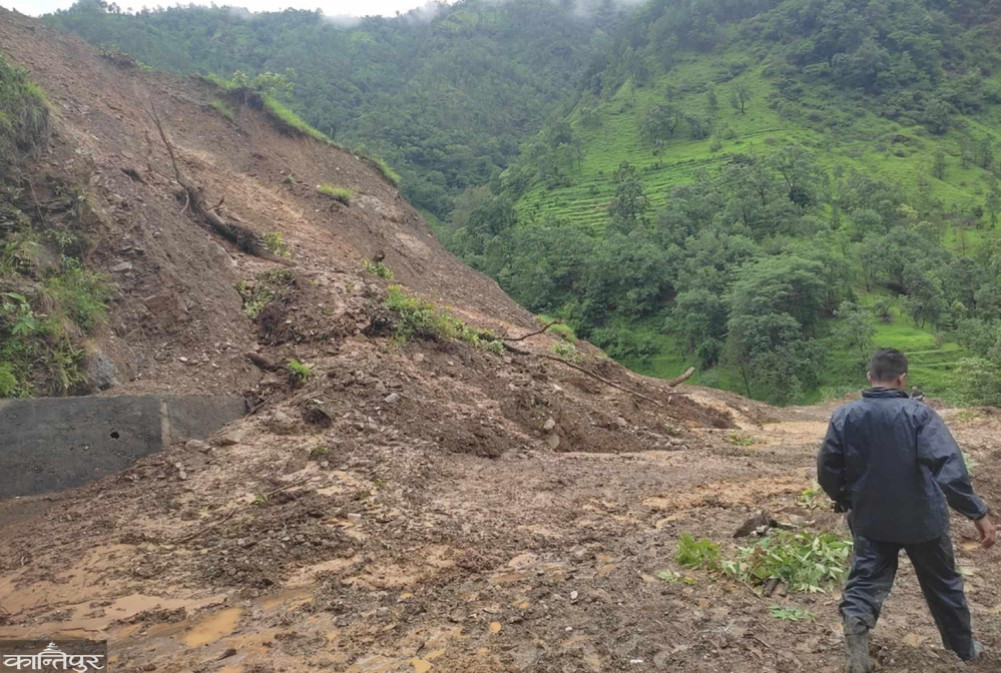
While COVID-19 was disrupting public life, a landslide occurred in Bhujikhola on 17 Bhadra 2077, damaging wards 7, 8 and 9 of Dhorpatan Municipality. The landslide swept away 126 houses, killing 22 people and leaving 17 still missing.
Even six years after the landslide, most of the victims have not been able to build houses. The government has not given additional installments to those who took the first installment to build houses because they built houses in rural areas without ‘meeting the standards’. Nor has the road damaged by the landslide been rebuilt. Work has finally been underway to repair it since last Jestha. ‘After the landslide, the river entered the road, and it has not been made safe yet,’ said Gyanodaya Mabika Principal Yam Bahadur Kayat, ‘There is a neglect in the work of building a well-organized road.’
Senior Soil Conservation Officer Sher Bahadur Shrestha believes that the risk of floods and landslides in Bhujikhola is the same next year. He suggests that settlements should not be built within 100 meters of Bhujikhola. Last year, 11 people lost their lives in a single day in wards 9 and 10 of Badigad Rural Municipality due to floods and landslides. Those who had taken temporary shelter during the disaster were unable to build their own homes before the rainy season began again. On the one hand, there is a fear of further damage, while the unorganized roads pose a risk of flooding and landslides anywhere.
No plan has been made yet on where to house the victims of the aforementioned incident. When Tamankhola Rural Municipality tried to come up with a plan to build an integrated settlement, federal law was in conflict. Chairman Joklal Budha said that it was difficult to establish settlements after the Forest Act was overturned. He argues that developing an integrated settlement would be cheaper than building roads in scattered settlements. “We could not even explain where to farm or where to build houses,” said Amar Thapa, head of the District Coordination Committee. “The local government should now be strict about it.” He suggests that the construction of houses along rivers, water bodies and roads should be stopped. The landslide in Dhorpatan is an example of that.
The District Disaster Management Committee has concluded that the recent unseasonal floods and landslides caused by climate change have caused more damage. “Most of the damage is due to human-caused causes, and if the roads dug haphazardly cannot be managed, the flow of streams and rivers will change, increasing the risk,” said committee chairman and District Administrator Krishna Prasad Acharya. “The damage is increasing due to unorganized settlements.” He said that the municipality has been asked to deploy technicians to prepare a safety plan along with the road and infrastructure plan for Karadau.
Nepal Red Cross Society Baglung President Jagannath Acharya says, “We only look for solutions after the disaster, that is not good.” He said that the cost of post-disaster rescue is hundreds of times higher than the cost of the plan prepared before the disaster. The law states that every municipality must prepare a disaster response plan. But most have not prepared it. Dr. Sudarshan Silwal, head of Dhaulagiri Multiple Campus, suggests that an integrated settlement development program should still be started in risk areas. "Half the cost of building two to four houses with roads, drinking water, and electrification will be enough to develop the settlement," Silwal said. "That will also help in sustainable development." He said that this work will also play an important role in flood and landslide control and environmental protection.
According to Baglung's statistics, 16 people lost their lives and 14 were injured in floods and landslides last fiscal year. According to the District Administration Office's statistics, 196.7 million rupees were distributed as relief to the victims of 47 incidents last year alone.