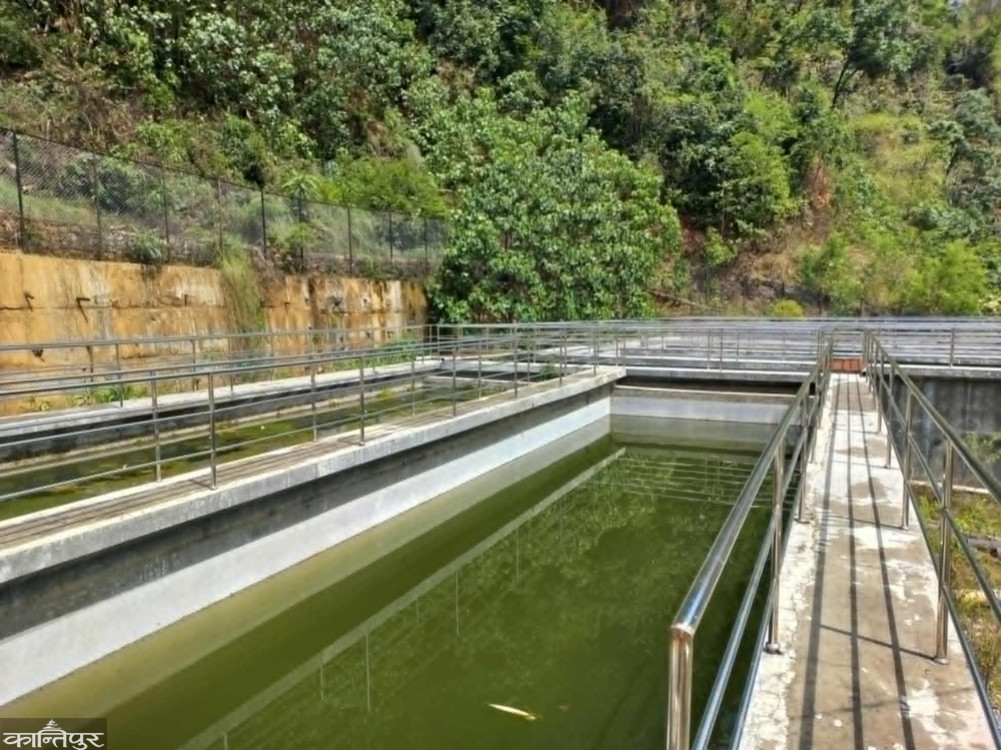
When testing water from 369 water sources in Baglung, coliform was found in 77 of them, due to which the number of patients with jaundice, typhoid and other diseases is increasing.
We use Google Cloud Translation Services. Google requires we provide the following disclaimer relating to use of this service:
This service may contain translations powered by Google. Google disclaims all warranties related to the translations, expressed or implied, including any warranties of accuracy, reliability, and any implied warranties of merchantability, fitness for a particular purpose, and noninfringement.
Three weeks ago, seven patients who had come to the OPD of Dhaulagiri Hospital on the same day were found to have jaundice. After receiving information that other members of their family had also developed fever and were resting at home, Dr. Sandeep KC called Praveen Sharma, head of the Provincial Public Health Office, Baglung. When the two reached Mulpani in Baglung Municipality-7, they learned that other people in the village were also sick. They use drinking water from a well. They were shocked to see that people were still drinking dirty water from the well in this village, which is 7 km away from the district headquarters. The water was dirty even in the house where the tap was connected. When the water samples were immediately brought to the Dhaulagiri Hospital and tested at the lab, coliform was found in both places.
After it was determined that they fell ill due to drinking water containing coliform, the District Drinking Water Quality Monitoring Committee tested 369 water sources across the district in Asad and found coliform in 77 places, said Dilli Acharya, laboratory chief of the Provincial Public Health Office, Baglung. Dhaulagiri Hospital receives 550 patients daily, of which more than half are found to be ill due to water and sanitation problems, said Dr. KC.
After this incident, a debate and discussion has started in the district about pure water. Even now, health workers have warned that there is a risk if some sources are not purified. ‘The main reason for diseases such as fever, diarrhea, malaria, and typhoid that come to hospitals is the lack of pure drinking water,’ said Acharya. ‘Most people have fallen ill because they do not pay attention to the use of water.’ The committee is investigating the coliform content of water sources and other problems every year. As this problem will worsen during the rainy season, the committee has issued a public appeal to purify drinking water.
Committee chairman Praveen Sharma said that the problem is being reported to drinking water consumer organizations, ward and local levels. ‘We have immediately informed them, advised them to clean the area, find ways to purify water and boil water at home,’ Sharma said, ‘People are still falling ill due to water due to lack of awareness.’
In the last financial year, out of 341 places where water was tested, coliform was found in 125 places. In the financial year 2080/081, coliform was found in 208 places. Coliform is found in 73 places. Coliform is found in human or other animal feces and other waste. Sharma pointed out the danger of diseases such as typhoid, malaria and jaundice due to water containing coliform. For that, it has been suggested that water should be purified or boiled for consumption.
Since it is not possible to measure water purification in the district lab alone, the committee has sent a suggestion requesting the purchase of machines at the municipal level, but only Badigad Rural Municipality and Tamankhola Rural Municipality have purchased them. If one testing machine can be purchased at each municipal level, the health department will be able to immediately give suggestions if coliform is found.
Although plans including drinking water treatment plants have been started recently, awareness about coliform has not yet been raised, said Hari Prasad Timilsina, head of the Divisional Drinking Water and Sanitation Office. ‘We are working on 300 projects a year, we are informing everyone about this,’ he said, ‘Consumers should be aware of their health.’ The committee has also assigned the committee officials to raise public awareness on a representative basis.
Coliforms have also been found in drinking water brought to the district headquarters. This year too, after such a problem was found, the committee immediately informed the project and ordered purification. Acharya says that if bleaching powder is placed in the tank and the water is sent only after 30 minutes, some purification will be done and coliforms will not be found. The committee has suggested purification, cleaning and, if necessary, bleaching powder in water sources every month. Sharma informed that it has also been suggested to boil water at home.