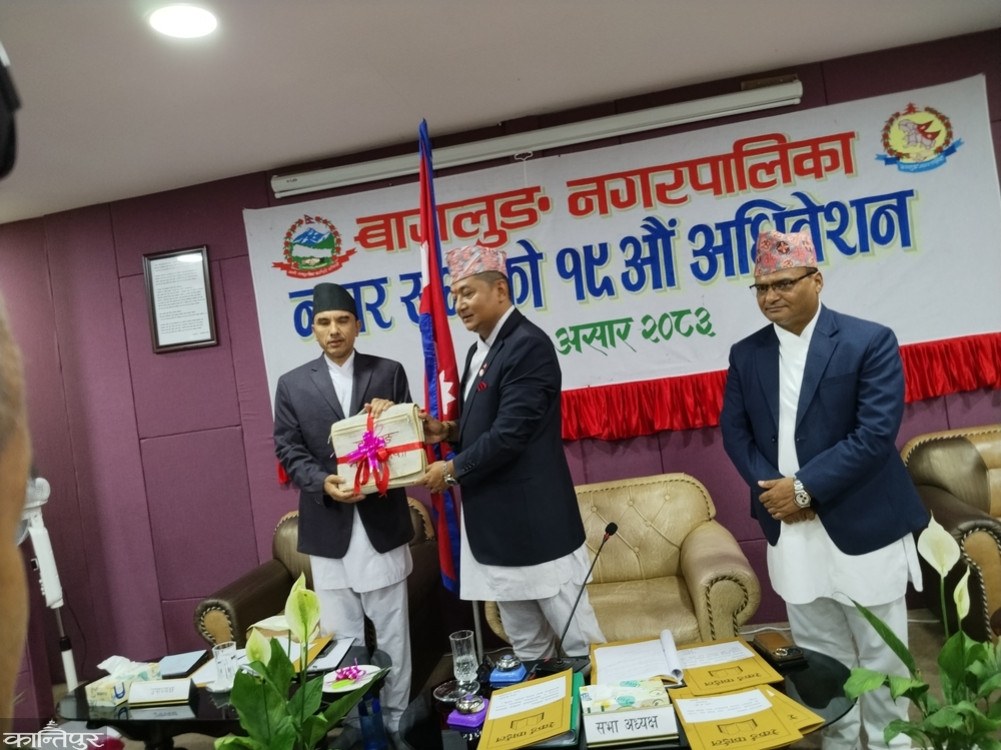
Deputy Mayor Raju Khadka has presented an income and expenditure estimate of Rs 1.14 billion 9.483 billion for the upcoming fiscal year 2083/084 at the 19th session of the Municipal Assembly.
We use Google Cloud Translation Services. Google requires we provide the following disclaimer relating to use of this service:
This service may contain translations powered by Google. Google disclaims all warranties related to the translations, expressed or implied, including any warranties of accuracy, reliability, and any implied warranties of merchantability, fitness for a particular purpose, and noninfringement.
The Baglung Municipality has brought the policy, program and budget on the same day the ministry asked for clarification. The Baglung Municipality has brought the policy, program and budget on the same day the Ministry of Land Management, Cooperatives, Federal Affairs and General Administration asked for clarification from the local levels that did not bring the policy, program and budget by Asad 10. Deputy Mayor Raju Khadka has submitted an income and expenditure estimate of Rs 1.149483 billion for the upcoming fiscal year 2083/084 at the 19th session of the Municipal Assembly. For that, it is estimated that the federal government will provide an equalization grant of Rs 1564 million, Rs 350 million from federal revenue sharing, Rs 20 million from royalty, a special grant of Rs 180 million, a complementary grant of Rs 600 million from the Gandaki Province government, and a federal conditional grant of Rs 590 million. The Deputy Mayor said that the budget aims to provide good governance and citizen-friendly services, create employment for workers by establishing a labor bank within the city, and also connect workers to social security programs. According to him, the budget also includes arrangements to expand the revenue base, conduct consultations with experts to increase tax revenue, and conduct taxpayer education programs.
In the policy announced on Wednesday, the municipality has made arrangements to provide a grant of Rs 10,000 to families with daughters. The amount will be given to the family by opening a fixed-term account. There is a provision that this amount cannot be withdrawn for 15 years. Baglung Municipality has stated that this policy has been introduced to encourage families to have daughters. Mayor Basanta Kumar Shrestha said that this campaign, which started from Rs 5,000 in the last fiscal year, has been increased by 100 percent to Rs 10,000. Shrestha said that this arrangement has been made to develop a culture of celebrating the birth of a daughter as a celebration, not a burden, by refining the 'City Daughter Program'.
The policy mentions the 'One Plant, One Hundred-Core Note' program as an environmentally friendly innovation policy. Under this policy, farmers who use barren land to plant valuable herbs including coffee and timur are encouraged to provide a subsidy of Rs 100 in the first year, Rs 75 in the second year, Rs 50 in the third year and Rs 25 in the fourth year. This program, based on the concept of agroforestry, is believed to prevent migration and reduce the challenges of barren land. Shrestha claims that this policy will also be useful for making people self-reliant in agricultural production, cash crops and other activities. The policy aims to make the recently established 'Dog Hostel' for the management of community dogs systematic. The municipality, in partnership with the Gandaki Province government, has recently put the hostel into operation by investing Rs 10 million. Work is underway to collect and house stray dogs here. Mayor Shrestha has called for support for the dog hostel. The policy has the slogan 'New habits that earn virtue, one-time food and water for hungry dogs'. It is believed that this policy and program will be useful for controlling the number of community dogs, vaccinating against rabies, and properly managing dogs kept at home.
There is a provision for those who want to keep healthy dogs kept in the hostel and take them home for a fee. Since it has been declared child-friendly, the policy mentions creating a nutrition-friendly municipality and making the city a human-free city.