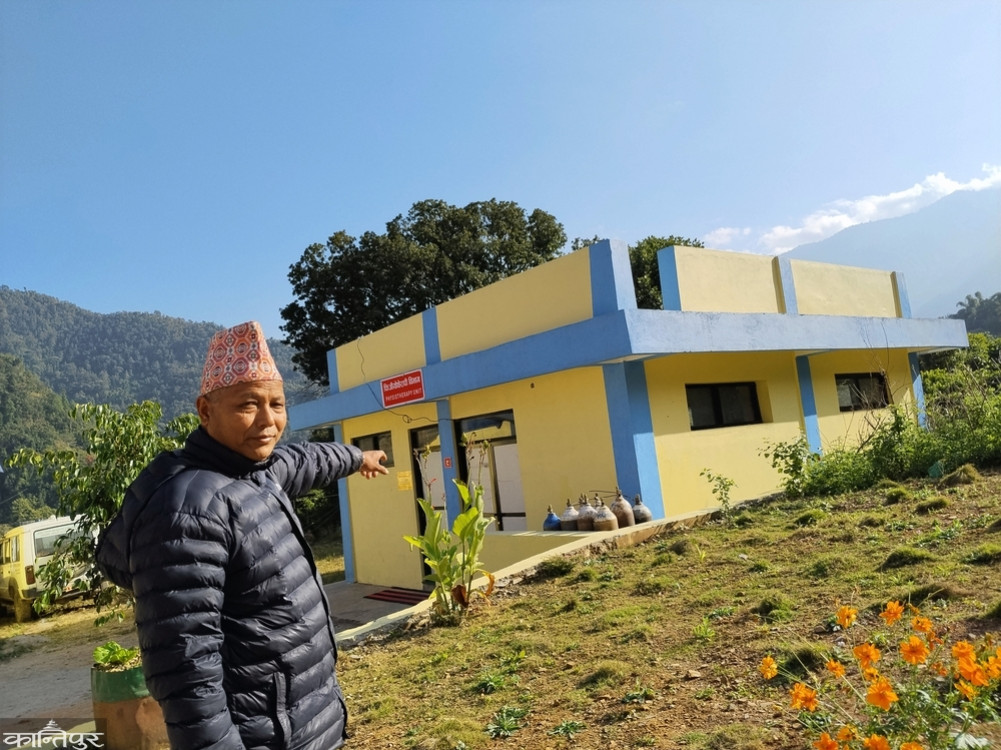
With the active participation of the ward residents and the support of various donors, physiotherapy services have been started in the village and patients have started receiving treatment easily.
We use Google Cloud Translation Services. Google requires we provide the following disclaimer relating to use of this service:
This service may contain translations powered by Google. Google disclaims all warranties related to the translations, expressed or implied, including any warranties of accuracy, reliability, and any implied warranties of merchantability, fitness for a particular purpose, and noninfringement.
In Lekhani of Kathekhola Rural Municipality-8, 30 patients come to the health institution every day. Out of them, one or two have neurological problems every day.
Since it is difficult to refer every patient to the district headquarters, the residents of the ward have started physiotherapy services at the Lekhani health post in the ward by finding various donors. The ward has also built a 3-room building with an investment of Rs 3.7 million. This building houses physiotherapy, adolescent-friendly services and a breastfeeding room. Health post chief Laxmi Prasad Niure said that additional services will also be operated from the manpower available here.
Counseling and medicine distribution will also be provided here on issues such as problems associated with physical changes in adolescents studying at the school level, sexually transmitted diseases, giving iron pills to adolescents, and problems caused by menstruation. The ward, which has received support from the Gandaki Province government in infrastructure construction, will manage the health post and provide services including medicines from the ward budget. Apart from that, hemoglobin is also tested in the bodies of teenagers.
This health post has a workforce of an obstetrician-gynecologist, an obstetrician-gynecologist, and a laboratory technician. There is still a shortage of 2 health workers. ‘Even though the number of patients coming daily has decreased due to the settlement, the number of people seeking physiotherapy services has increased,’ said Niule, ‘this center has been built to serve them.’ He said that the number of patients related to bones and nerves has started to increase.
Every year, more than 2,600 patients seek services from here. This year, 2,500 patients have received treatment here, while every day, 3 to 4 patients arrive in search of physiotherapy, Niule informed. They used to be sent to the district headquarters, but now they can be provided services in the village. Draupadi Shreesh, who came for treatment, said that she did not have to go to the district headquarters after receiving the service.
Last year, cholera patients were also found here. Apart from that, patients with tuberculosis and elephantiasis have also started appearing recently. Such patients are being sent to Dhaulagiri Hospital for treatment, keeping their names confidential. The work of keeping digital records at the health post has also been started.
Once the patients who come here are registered, the ward and municipality also get information. After this system, the municipality has been able to collect data on all patients and find out how many patients with which nature of disease are registered every day, said Som Sharma, head of the health branch. He informed that service delivery, medicine procurement and manpower recruitment are done based on this method.
Galkot Municipal Hospital has also operated a physiotherapy room through donations. The hospital's head, Dr. Rajesh Poudel, said that this service was funded by Rs. 1.5 million collected and sent by members of the Galkot Society, UK. 'Nowadays, many patients have started seeking physiotherapy,' Poudel said, 'If they are referred to the city, it costs a lot of money for the patient, so this service was started.' He said that up to 5 patients who come to the hospital daily are in need of physiotherapy services.