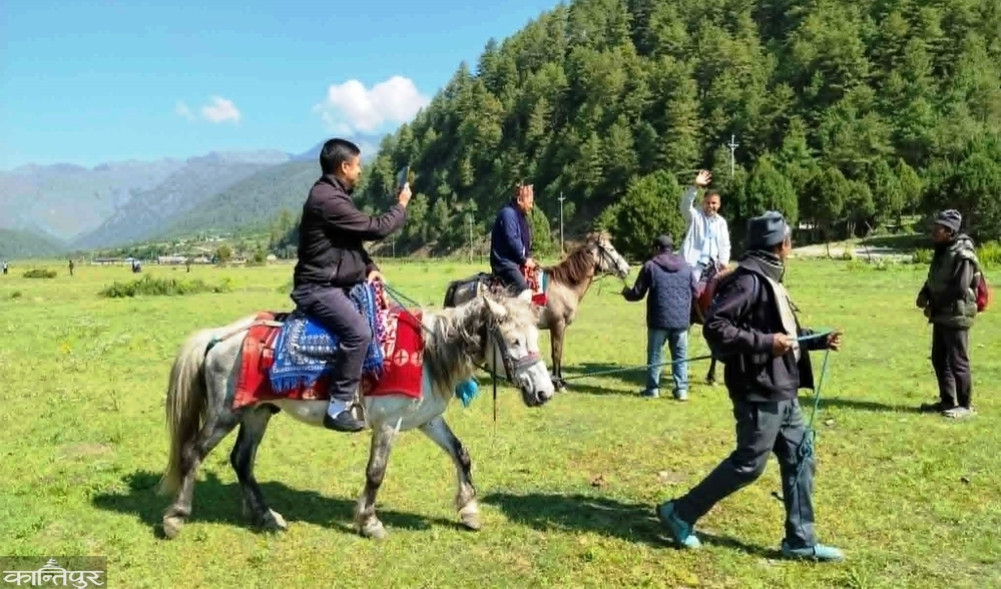
With the expansion of roads, homestays, trekking, and tourism infrastructure, a debate has begun to make Dhorpatan a destination based on mountainous beauty, culture, and biodiversity.
We use Google Cloud Translation Services. Google requires we provide the following disclaimer relating to use of this service:
This service may contain translations powered by Google. Google disclaims all warranties related to the translations, expressed or implied, including any warranties of accuracy, reliability, and any implied warranties of merchantability, fitness for a particular purpose, and noninfringement.
Dhorpatan is known worldwide as Nepal's only hunting reserve. The Nepalese government collects 40 to 50 million rupees in revenue annually from controlled hunting here. But in recent years, another question has begun to emerge strongly - does Dhorpatan's future lie in hunting tourism or in sustainable tourism based on natural beauty and biodiversity?
Locals, tourism entrepreneurs, conservationists and experts are currently engaged in this debate. Their common conclusion is that even though hunting tourism provides revenue to the state, if natural tourism can be expanded, the local community will directly benefit from it.
Until a few decades ago, accommodation facilities for tourists reaching Dhorpatan were poor. Currently, about two dozen homestays are operating here, and 40 hotels have opened. According to local businessman Shiva Kandel, the capacity to accommodate up to 700 tourists in a single day has been developed.
After the road reached the main Patan, the number of passengers reaching Dhorpatan has increased. Dhorpatan, which is about 3,000 meters above sea level, Garpacheda, which is 4,000 meters, and Tikadhara, which is 4,500 meters above sea level, are easily accessible for trekking. The number of domestic tourists who come to see the snowfall in winter and the blooming of the bookworms in Asar-Sharan is increasing. Researchers also visit Dhorbarah to study agricultural products such as Dhorbarah Puja, local culture, potatoes, apples, etc.
Dhorpatan has become a new destination for foreign and domestic tourists visiting Pokhara as it can be reached in about seven hours from Pokhara. According to tourism entrepreneurs, if accommodation facilities are expanded in places like Niseldhor, Gurja, Jaljala, and Garpacheda, the stay of tourists will be extended.
Krishna Prasad Acharya, President of Trekking Agencies Association of Nepal (TAAN) Gandaki, said that a new 'virgin route' could be provided to foreign tourists visiting Pokhara if a seven-day trekking route connecting Rukum-Dhorpatan-Myagdi could be developed. According to him, more than roads, hiking trails, viewpoints and nature-based infrastructure can provide a long-term basis for tourism in Dhorpatan.
Meanwhile, questions have also been raised about the appropriateness of hunting tourism. Every year, 26 wild boars and 20 to 22 wild boars are hunted here in a controlled manner. Foreign hunters are allowed to hunt only in blocks designated by the reserve after paying a prescribed fee. However, there are growing complaints that this does not contribute significantly to the income of the local community.
Tourism journalist Amrit Bhadgaun says that the need now is not hunting, but the expansion of nature-based tourism. According to him, tourism that earns money by showing live wildlife connects locals with employment and business, while hunting tourism focuses only on limited revenue.
Keeping this debate at the center, Dhorpatan Municipality organized the ‘Dhorpatan Summit’. The summit has brought the debate between hunting tourism and sustainable tourism to the national level. According to Dil Shirish, former president of the Federation of Nepali Journalists, Baglung, the start of multi-faceted discussions on the development of Dhorpatan is an important achievement in itself.
Hiker Sirjana Sijju said that Dhorpatan can be made a major nature-based tourism destination like Chitwan. According to her, if tourism infrastructure is developed targeting tourists seeking relief from the heat of Butwal, Chitwan and other Terai regions, Dhorpatan can attract tourists all year round. She emphasized the need to plan while preserving the original nature, protect water sources and prioritize the conservation of biodiversity.
Dhan Bahadur Kayat, the acting chief of Dhorpatan Municipality, also admits that the benefits of hunting tourism have not reached the locals. According to her, since hunters arriving by helicopter are confined within the reserve, local businesses have not been able to get the expected benefits. She said that the federal government should take the initiative to formulate a tourism policy that directly benefits the local community.
According to Sagar Subedi, information officer of Dhorpatan Hunting Reserve, there are 5,153 people living in 53 settlements within the reserve, which has an area of 1,300 square kilometers. Established in 2044 BS, more than 33,000 tourists have entered the reserve from the Deurali border crossing on the Baglung side in the current fiscal year. The number of tourists coming from Myagdi and Rukum sides is not included in this.
There are also complaints that the daily lives of the locals have been affected after the reserve regulated grazing, grass-firewood collection, and riverine material extraction. According to local Chandra Singh Kumai, restrictions have increased on resources that the community used to use in the name of conservation. Information officer Subedi, however, says that there are no restrictions on daily necessities and only illegal exploitation is being controlled.
He claims that hunting management is done on a scientific basis. According to him, although about 26 narwhals are hunted every year, more than 200 narwhals are born. He said that the reserve allows hunting only for mature males, and hunting of females and young animals is completely prohibited. The reserve has been conducting regular censuses of wildlife, and this year, a census of snow leopards is also being conducted.
The debate in Dhorpatan has now reached a point where it is decided whether to collect revenue only from hunting or to increase the income of thousands of locals by building on natural resources. If tourism can be expanded by focusing on biodiversity, mountainous landscapes, trekking, local culture, and communities, Dhorpatan has a strong potential to become another important sustainable tourism destination in Nepal.