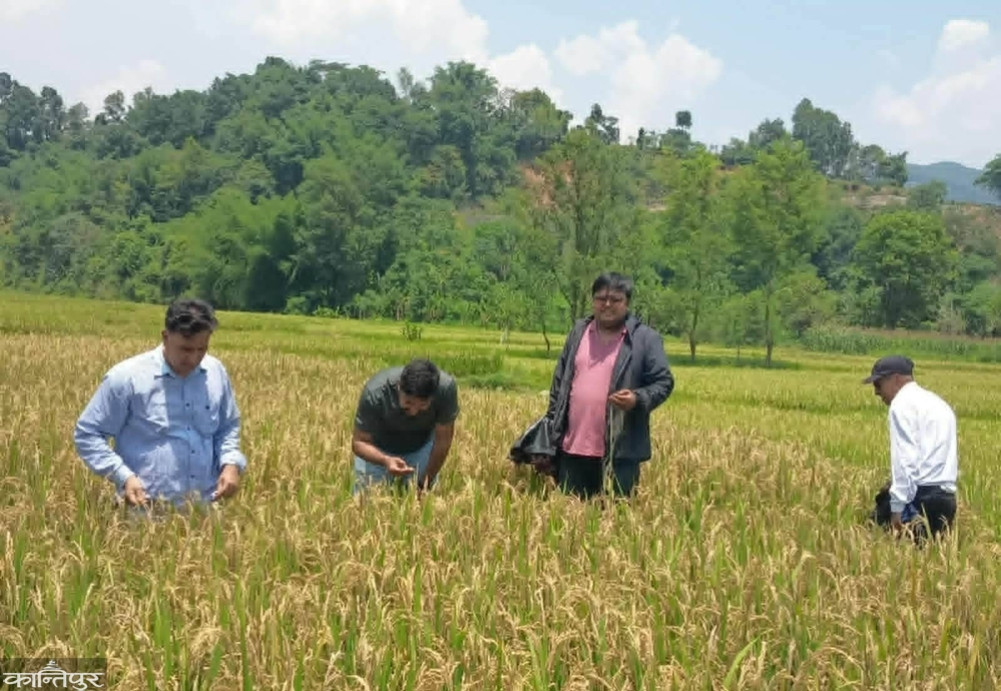
The rapid spread of neck blast disease in the space of 5 days has devastated the Chaite rice crop.
We use Google Cloud Translation Services. Google requires we provide the following disclaimer relating to use of this service:
This service may contain translations powered by Google. Google disclaims all warranties related to the translations, expressed or implied, including any warranties of accuracy, reliability, and any implied warranties of merchantability, fitness for a particular purpose, and noninfringement.
Neck blast and gall disease have damaged the Chaite paddy during its import to Gorkha. According to the Agricultural Knowledge Center Gorkha, neck blast and gall disease have been seen in Chaite paddy covering an area of more than 35 ropanis.
Neck blast, which was seen a week ago, has spread rapidly, said Vivek Poudel, Agricultural Extension Officer of the Agricultural Knowledge Center. ‘The neck blast has been spreading rapidly for about 5 days, the green rice ears today turn yellow and become brittle the next day, and the grains have not sprouted at all,’ he said.
He said that the neck of the hanging rice ears due to the neck blast rots and the grains become brittle. The gall disease, on the other hand, causes damage by eating the stems along with the water. ‘The problem of smut was seen in previous years too, there is a record of 25 to 30 percent damage to the smut in previous years too,’ said Poudel, ‘This year, along with smut, 3500 ropanis of rice crop have been completely destroyed in just 5 days.’ Farmers say that even when rice is damaged by the neck blast disease, the grains become soft and become only chaff.
The Knowledge Center has reported that the smut and smut diseases have destroyed the Chaite rice crop in Gorkha Municipality-10 and 11 Daraudi, Sirdi, Bhusunde of Siranchowk-4, Nibel of Bhimsen Thapa-1, Daraudi of Palungtar-1, and Ludikhola field of Gorkha Municipality-8. Chaite rice has been cultivated on 740 to 800 hectares in Gorkha.
The Gandaki Province government has also been running a Chaite rice promotion program for food security. After the outbreak of the Gawaro and Maruwa diseases, the technical team of the Provincial Agriculture Laboratory Pokhara has conducted an on-site study and taken samples for testing.
The technical team has also initially estimated that the rice crop was destroyed by neck blast and Gawaro diseases. ‘The test report has not yet come,’ he said, ‘We have distributed a pesticide called tricyclazole to control the disease, but it did not seem effective.’
After the outbreak increased, Gandaki Province’s Minister for Agriculture, Land Management and Cooperatives Bhim Bahadur Karki also came for an on-site inspection on Friday. Poudel said that if the spread of the disease cannot be controlled, the risk of it spreading to rain-fed rice has increased. "Now, the planting of rainfed rice will begin in 15-20 days. This disease has completely destroyed the Chaite rice. If it spreads to rainfed rice as well, the risk of food shortage may increase," he said. "We are trying to control it in time."