The goal is to double the number of Indian and Chinese tourists in five years. Emphasis on tourism, agriculture and the green economy, programs ranging from cannabis cultivation, 'branding' of home-made liquor to 'digital athletes'.
We use Google Cloud Translation Services. Google requires we provide the following disclaimer relating to use of this service:
This service may contain translations powered by Google. Google disclaims all warranties related to the translations, expressed or implied, including any warranties of accuracy, reliability, and any implied warranties of merchantability, fitness for a particular purpose, and noninfringement.
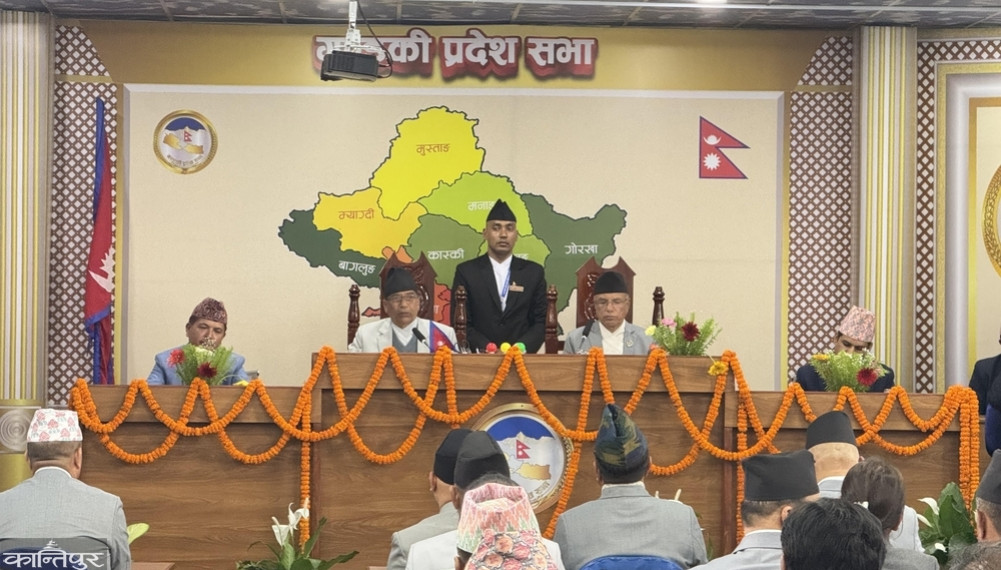
The Gandaki Provincial Government has prioritized tourism, agriculture, green economy, health and youth entrepreneurship in its policy program for the upcoming fiscal year 2083/84. The policy program presented by Provincial Chief Dilliraj Bhatta in the Provincial Assembly on Tuesday focuses on expansion of the productive sector, job creation, climate-friendly development and service delivery improvement.
The provincial government has announced that tourism, industry, high-value agricultural products and green industrialization will be developed as the main base areas for economic transformation. A new investment policy will be introduced to attract private sector investment and public-private partnerships will be expanded.
In the agricultural sector, the 'Return to Village' program has been introduced to provide interest subsidies on concessional loans to those who want to return to their villages from abroad or cities and engage in commercial farming. Programs such as expanding market access for local products, branding of indigenous crops, agricultural insurance, minimum support price and 'soil health certificate' will be continued. The goal is to declare Gandaki a fully vaccinated province within five years by controlling animal diseases.
In the forest and environment sector, priority will be given to forest-based enterprise development, timber import substitution, lake and watershed conservation, river-ghat cleaning, and climate resilience programs, giving priority to green economy. Emphasis has also been placed on reducing human-wildlife conflict and digital management of forest-related data.
In terms of tourism, after Pokhara was declared the tourist capital, special priority has been given to its implementation. A religious tourism circuit connecting religious destinations including Muktinath, Damodarkunda, Devghat, and Triveni Dham will be developed, while trekking routes will be upgraded in the Manaslu, Annapurna, and Dhaulagiri regions. The government plans to launch a special campaign with the goal of doubling the number of tourists from India and China within the next five years. Adventure tourism, heli skiing, sky diving, bungee jumping and a program to develop Pokhara as an international conference and health tourism center have also been included.
The plan to legally regulate and implement marijuana cultivation for medicinal and industrial purposes has become a topic of special discussion in the policy program. Similarly, the production, branding and regulation of domestic liquor will also be systematized.
In the health sector, expansion of specialist services in provincial hospitals, mental health testing and counseling, distribution of free sanitary pads, school-centered community nursing programs and air rescue of pregnant women at risk will be continued. A plan to make Gandaki a 'wellness destination' by promoting Ayurveda, yoga, meditation and naturopathy has also been included.
In the education and youth sector, a program has been introduced to provide knowledge on artificial intelligence (AI) and information technology from the school level. The government plans to connect technical education with the labor market, engage youth who have returned from abroad in entrepreneurship, and run a youth-targeted digital literacy program.
The 'Digital Athlete' concept will be implemented in sports and the achievements and records of players will be digitally documented. Priority will be given to the construction of multi-purpose covered halls, stadiums, or cricket grounds in each district, and the goal is to develop Gandaki as a sports tourism destination.
In terms of infrastructure, a policy has been taken to complete unfinished roads and bridges, continue the Korala-Pokhara-Triveni road and Shaligram corridor, upgrade bus parks, and gradually make public transport electric. A program to operate electric public transport in Pokhara in partnership with the Metropolitan City is also being taken forward.