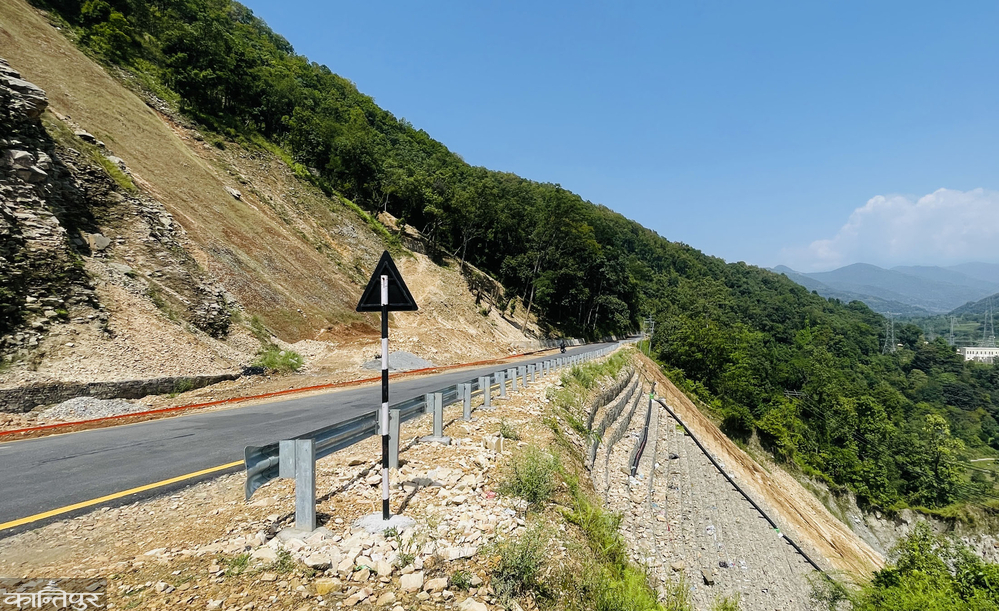
Landslides have been controlled by strengthening the soil through the 'soil nailing' technique, which involves burying iron rods under the soil and using a 3D mat mesh.
We use Google Cloud Translation Services. Google requires we provide the following disclaimer relating to use of this service:
This service may contain translations powered by Google. Google disclaims all warranties related to the translations, expressed or implied, including any warranties of accuracy, reliability, and any implied warranties of merchantability, fitness for a particular purpose, and noninfringement.
After the landslides continued to occur, the road in Udipur, Lamjung has been controlled using the 'soil nailing' technique.
The landslide in Udipur, Besisahar Municipality 1, along the Dumre-Besisahar road, was controlled by burying iron rods under the soil and using a 3D mat mesh to strengthen the soil using the 'soil nailing' technique.
According to Dumre-Besisahar-Chame Road Project Engineer Navin Bista, this is an Austrian technology. 'We have used modern geotechnical technology used to stabilize weak terrain in Udipur,' he said. According to him, this technology has been adopted on 1,860 square meters of the road to control landslides. A retaining wall with a length of about 150 meters has been built near the road.
Bio-engineering has been used in the landslide in the lower part of the road. Bamboo, Simli, Asuro, Bhujetro, Khar, etc. have been planted. A 44-meter-high gabion mesh wall has been built. Other
gabion mesh walls and checkwalls have been installed at various places. Micro piling has been done on the banks of the Marsyangdi River and around it for about 200 meters. 395 meters of blacktop has also been done with a width of 6.5 meters.
The road, which is used by vehicles in most areas including the entire Manang district and Lamjung district headquarters, Besisahar, was first washed away by a landslide on Bhadra 11, 2078 BS. The road was temporarily operated by pinching the corner and while the bidding process for the construction of the road was underway, the road was washed away again by a landslide on Asad 4, 2079 BS.
After the landslide swept away the road, a diversion road was constructed and operated from the upper gate of the Madhyamsyangdi Hydropower Project in Chipleti, through the dam site, through the Nepali Army camp, and up to Udipur via the Ritthebagar road. The Besisahar Municipality had also put another diversion road into operation via the upper village. But both were not permanent. Ak Bahadur Tamang, a Besisahar-Pokhara microbus driver, said that road safety has provided safety to both transport and passengers.
‘We got caught in this landslide many times, some of our friends’ vehicles were damaged. Some of their vehicles were buried in the landslide,’ he said, ‘There is no problem on the road that used to be scary before. Instead, it would have been better if the road had been widened elsewhere.’ According to him, it has become easier not only for long-distance vehicles but also for short-distance vehicles and passengers who have to commute daily.
Fewa Construction Pvt. Ltd. Kaski had signed an agreement to control the landslide on Chaitra 10, 2079, to be completed in 22 months. The agreement to control the landslide was signed for Rs. 136.515,163.97 including VAT. This landslide control work, which was supposed to be completed by Magh 10, 2081, has already taken more than double the time it was supposed to be completed.
According to the road office, the agreement was extended for the first time to be completed by mid-Asoj 2082. The Dumre-Besisahar-Chame Road Project has stated that the road was completed by the end of this Baisakh after extending the deadline twice. The project has stated that the final payment is in the process.

