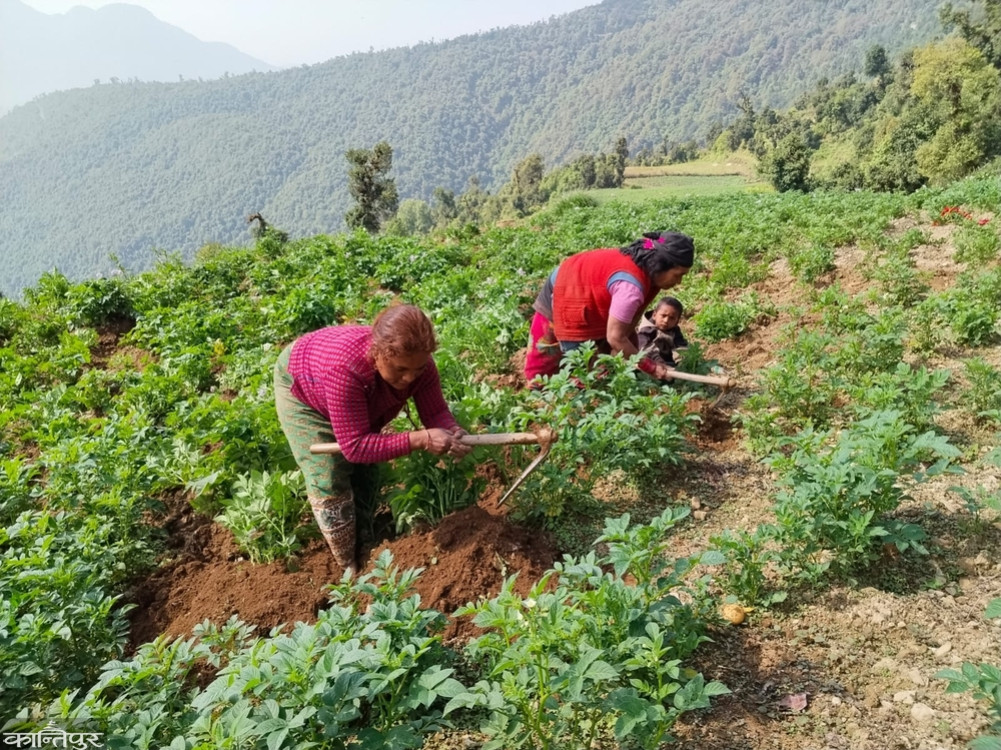
According to the season, the Muthachaur area has become lush with the hard work of farmers who move their cattle sheds and graze their animals in the lake, cultivating potatoes.
We use Google Cloud Translation Services. Google requires we provide the following disclaimer relating to use of this service:
This service may contain translations powered by Google. Google disclaims all warranties related to the translations, expressed or implied, including any warranties of accuracy, reliability, and any implied warranties of merchantability, fitness for a particular purpose, and noninfringement.
Beg Bahadur Bik of Bhayarbonga, Tamankhola Rural Municipality-2 is currently in Muthachaur, located at an altitude of 2,600 meters, at Barah Tal. When the cold started to subside in Chaitra, he moved his cowshed to Muthachaur, a 4-hour hike from his home. Muthachaur is a colder place than Bhayarbonga. His cowshed has been here since Chaitra. At that time, wheat and barley grown in Muthachaur were brought in. He has been keeping the calves (cows and buffaloes) here for 2 months. There are 10 cattle in his cowshed. He has planted potatoes on about 5 ropanis of land here. The manure required for this potato has been collected in the cowshed. Muthachaur also has ample grazing space for the cattle. There is ample grazing area around Barah Tal. The manure from his own cattle is enough to cultivate potatoes, fenugreek, barley and other crops. As the heat increases, Beg Bahadur starts moving the cowshed up the mountain. He is currently preparing to move the cowshed. While grazing his cattle, he reaches Dhorpatan at an altitude of 3,000 meters, Bukipatan at 3,500 meters, and Tikadhara at 4,000 meters.
61-year-old Beg Bahadur said that he started going to Buki at the age of 10. ‘Father Gopiram taught him how to go to the cowshed, and I am still doing the same profession,’ he said. ‘There was no school to read or write, we spent our lives herding animals, and I am still doing the same profession.’ Moving the cowshed up the mountain in the summer and down to the valley after winter sets in is a regular job for the locals. There is also a rush to dig potatoes in Muthachaur right now. They plan to go to the lake after finishing work soon.
Beg Bahadur's neighbors Dhal Bahadur Rasaili, Bhime Chantyal, and Maitadevi Rasaili are also busy digging potatoes all morning and grazing animals in the afternoon. Bhime Chantyal alone has planted potatoes in more than 20 ropanis. He is also digging potatoes with a farmer. This is the time for digging potatoes in the last week of Asar.
After finishing digging potatoes, they plan to go to Buki via Dhorpatan and Chentung, chasing their cattle. For that, Beg Bahadur's wife Bhim Kumari has come down to the valley to procure 'antho-pitho'. She also brings food to her neighbors. After carrying food and chasing the cattle, those who can do the digging come down to Muthachaur during the time of digging potatoes. At that time, most of them said that they would come with their friends in charge of their cattle.
After finishing work, they go out to graze their animals and reach Buki by the first week of Asad. The cowshed is kept there until Shrawan and Bhadau. They take turns looking after the animals and cattle during potato digging. Aile Ghartimagar of Tamankhola 2 Kholsebang has already gone to Buki with his cattle a few days ago. He will find a suitable place to keep the cowshed there and prepare. He has been helping Beg Bahadur during potato digging. Since Aile's house has a lot of space, he stays in Buki from Asad to Asoj. At that time, he helps by looking after the animals of some friends like Beg Bahadur.
Chasing the animals, they reach Muthachaur again when Asoj begins. At that time, it is time to sow wheat and barley here. After staying here for a month and cultivating, when Kartik begins, they descend towards Bhayerbonga, Bongadobhan and Suula. When the cold weather sets in, the Muthachaur, Barahatal, and Dhorpatan areas become deserted. This process happens every year. The locals cultivate some crops wherever they go.
Paddy does not grow here. That is why they bring rice to eat only for festivals. They have to buy rice, salt, and oil from Burtiwang, which is a day's journey away. Rice is only for festivals. At other times, they usually eat flour, flour, and dhido. They eat vegetables found in the lake, including dhakayo, garlic greens, potatoes, and wild mushrooms. Beg Bahadur said that they often cook Lekali bean dal there. ‘We cook rice for festivals and when guests come, but at other times we eat unleavened bread,’ he said, ‘Since we raise cows and buffaloes, we also keep ghee for frying.’ He said that the house only needs to buy one or two liters of oil a year.
It is not possible to carry a lot of things when going to the bookie. That is why after buying flour and salt, he said that he picks Lekali greens and eats bread and vegetables. From Asad to Asoj, hundreds of sheep and goats and cattle are taken to the bookie. There is a place here to graze. They have been grazing livestock in a nomadic style for generations. The locals take turns from the village and spend their food expenses for 15 to 20 days. They usually close their houses in the valley and climb the lake.
A fair is held at Barahatal in Baisakh when the locals climb the lake. It is believed that if you worship Barah, your livestock will not get sick, your crops will not be affected by pests, and good times will come. To protect this lake, the rural municipality has spent 50 lakhs to build a fence, temple reconstruction, public toilets, and a hiking trail. Since it is an attractive and suitable place to escape the heat, domestic tourists also visit here from Chaitra to Kartik.
Some tourists camp at Barahtal. They like the local potato dishes. From here, you can reach various places in Dhorpatan on a day's hike. Those going to areas like Jaljala, Gurjaghat, and Chentung can hike from here, said Joklal Budha, chairman of the rural municipality. 'This area is useful for seeing and enjoying the hard work of farmers, livestock grazing, farming, and the tradition of moving the barn,' Budha said, 'This area is also important for agricultural tourism.'
Budha said that the rural municipality has also included agriculture in Barahatal and Muthachaur in the tourism master plan. Budha said that the master plan is to link farmers' cyclical farming and livestock grazing to tourism promotion. 'We are trying to link not only our Barahatal, but also the culture of farmers to tourism,' he said, 'If we can take it as a potato digging and barn shifting fair, tourism can be promoted.' He said that investment has also been made to make the roads and footpaths leading here standard.