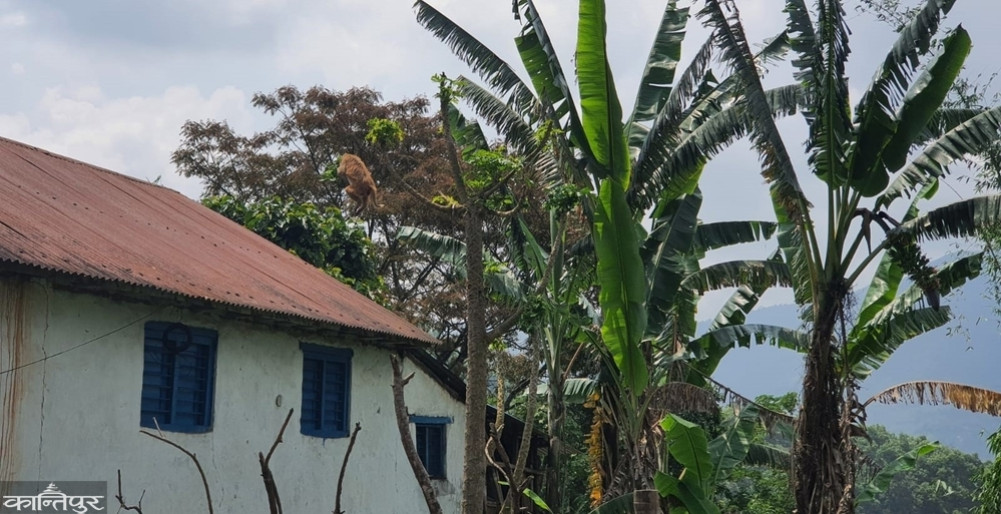
Locals say that settlements near forests, lack of natural food, forest destruction, and decreased human activity in villages may be the main reasons for the increase in monkey terror.
We use Google Cloud Translation Services. Google requires we provide the following disclaimer relating to use of this service:
This service may contain translations powered by Google. Google disclaims all warranties related to the translations, expressed or implied, including any warranties of accuracy, reliability, and any implied warranties of merchantability, fitness for a particular purpose, and noninfringement.
After the monkeys stopped them from settling in their homes, people have started migrating from rural areas of the district. Some have left their villages and moved to new places. Those who live in villages have also stopped farming. The hills in the district, which once looked lush with corn, millet, oranges, vegetables and fruits, have now become barren.
According to locals, before dawn, hordes of monkeys break and throw away the corn that is ripening in the fields. They uproot and destroy vegetables. They destroy fruits. The locals are disappointed as the year's hard work starts to be wasted in a few hours. Baburam Pokharel of Putali Bazaar-4, Ramkosh, complained that it is impossible to drive away the monkeys alone. 'I feel sorry when I see the crops being brought in,' he said, 'The hordes of monkeys come and occupy the houses.' He said that it would be easier to buy food from the market with the amount of money equivalent to the damage caused by the monkeys.
Galyang-10, Dubindanda area was terrorized by monkeys a few years ago. Former ward chair Dhruv Pangeni said that after that, the locals were forced to leave the village. He said that they were forced to leave the village after there was no food even in their homes. Now, the families living there have started keeping the cultivable land fallow.
According to the locals, earlier, people from all over the village used to be busy in the fields. The monkeys were confined to the forest. Now, the number of people living in the village has decreased. Due to which farming has stopped. Maiya Thapa of Biruwa Rural Municipality-3 said that it is scary to go to the fields alone due to the monkeys that come to the roofs, balconies and courtyards of the houses. ‘Even school-going children are scared of seeing monkeys,’ she said, ‘There are only old people in the village. Also, now it is easier to buy food from the market than to do farming.’
The local level has made various efforts to drive away the monkeys. In some places, noise-making equipment has been used. In some places, ‘monkey guns’ have been distributed. Somewhere, a campaign has been launched to chase away monkeys collectively. However, none of the measures have been effective in the long term. According to farmers, monkeys chased away today return to the same field the next day. Locals say that settlements near forests, lack of natural food, forest destruction and reduced human activity in the village may be the main reasons for the increase in monkey terror.
Waling Municipality spokesperson Padma Raj Gurung said that monkey terror in rural settlements of the district is not just a problem of wildlife. ‘This is also a serious social crisis linked to agriculture, economy and migration,’ he said, ‘As farms are being destroyed, villages are becoming empty. Production is decreasing and the traditional lifestyle of farmers is in danger.’