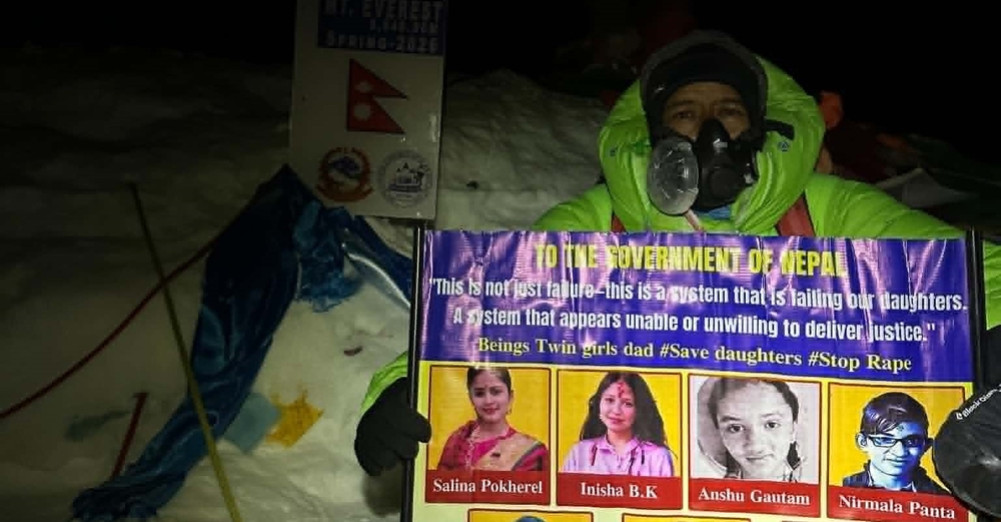
Amrit Pariyar of Pokhara-19 successfully climbed Mount Everest. He hoisted a banner at the peak demanding justice for victims of rape and sexual violence.
We use Google Cloud Translation Services. Google requires we provide the following disclaimer relating to use of this service:
This service may contain translations powered by Google. Google disclaims all warranties related to the translations, expressed or implied, including any warranties of accuracy, reliability, and any implied warranties of merchantability, fitness for a particular purpose, and noninfringement.
For most people, mountain climbing may be just a personal record, ambition or adventure. But for Amrit Pariyar of Pokhara Metropolitan City-19, Tallakot Thanti, the journey to the 8,848.86-meter-high Everest was not just a compromise with the snow. It was a strong rebellion against the self-respect of those who were relegated to the bottom of society and against the heinous crimes being committed in the country from the highest place in the world.
When Amrit set foot on the summit of Everest at 12:16 am on 7th Jestha, he did not celebrate the victory only as a climber. He echoed the silent voices of the girls who were victims of rape and murder, who had been waiting for justice for years, from the highest head of the world. He hoisted a banner on the peak demanding justice for those who were murdered after rape and sexual violence.
Born in an ordinary village in Pokhara, Amrit's early life was difficult. Despite growing up in a cycle of poverty and deprivation, his inner wisdom and desire to study never faded. After completing his school leaving certificate (SLC) with excellent marks from his village school, he moved to Pokhara with the dream of higher education. After starting his studies in the Faculty of Science and Technology from Prithvi Narayan Campus in Pokhara, his passion turned to the medical field. With hard work, he managed to get into Kantipur Dental College and completed his three-year dental diploma. 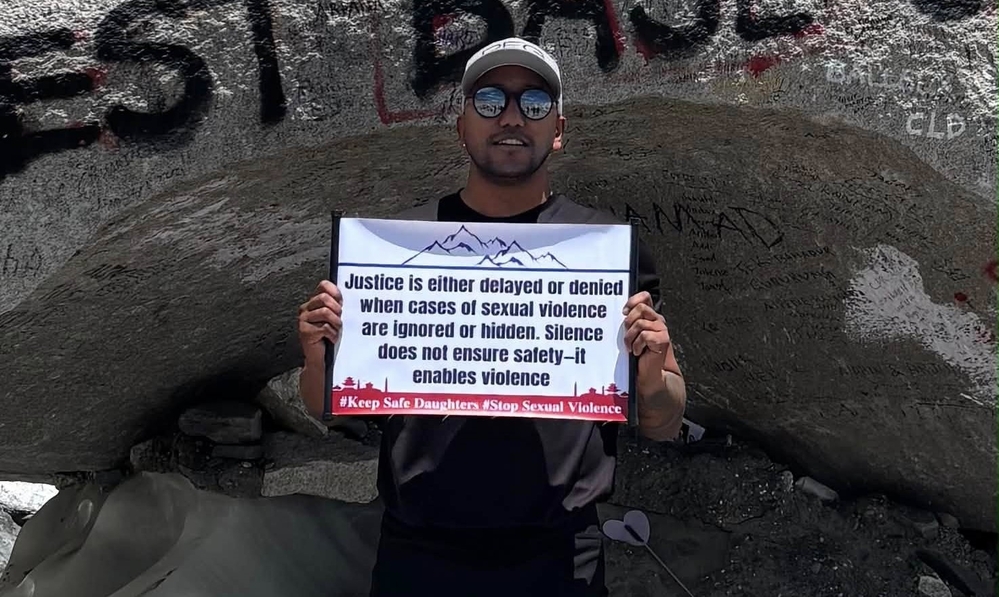
After completing his studies, he worked for a while at a local clinic, but he always had a burning desire to start his own business. Due to the harsh reality of the country, lack of investment and the weak state system, his dream was left stranded in Pokhara. Ultimately, the burden of family responsibilities and the rising unemployment in the country forced him to emigrate like millions of other Nepali youth. He left for America for employment. He is currently living in America with his wife and two daughters. Even though he has lived across seven oceans, his heart and mind have always been on the soil of Nepal and its contemporary issues. ‘I have always had a deep affection for the mountains, valleys and hills of Nepal,’ he says. ‘Whenever I returned to my homeland, I would go trekking in the foothills of the mountains.’ However, this time his return home was not just for entertainment or sightseeing. He had come to Nepal with a serious social purpose. The incidents of rape, sexual violence and brutal murders that have been happening in Nepal for a long time had broken his heart.
The sight of innocent girls like Nirmala Pant, Bhagirathi Bhattarai, Inisha Bik, Salina Pokharel, Anshu Gautam, Rashmi Pariyar, Aarti Bhattarai, Angira Pasi and Maya Bik not getting justice kept burning him . He came to the conclusion that some concrete steps must be taken against this terrible trend prevalent in society and the state's indifference . He chose the medium – Everest .
He resolved to climb the mountain, but the journey was not easy . For people from ethnically oppressed communities in Nepal, the economic and social obstacles are higher than Everest . He did not have enough time to find a sponsor for such an expensive trip that would cost millions of rupees . But the financial crisis did not stand in the face of strong will . He made a tough decision to bear the burden of this expensive trip himself at his own personal expense .
Before embarking on the difficult journey to Everest, Amrit had previously attempted to climb the 8,163-meter-high Manaslu mountain to experience the ‘death zone’ above 8,000 meters. Due to adverse weather, strong winds and avalanches, he could only reach 7,800 meters and could not touch the summit. ‘That failure did not embitter me, but rather gave me invaluable practical knowledge to deal with the challenges of the high-mountainous region, lack of oxygen and harsh environment,’ he said. ‘On the basis of the same learning from Manaslu and the unwavering support of the Sherpas, I successfully climbed Everest this time.’
He had set off towards the Everest base camp via Lukla with a long and arduous schedule of 45 days. After traditional prayers and rigorous technical training at the base camp, he slowly climbed up, crossing deep snow pits and rocks.
He did not reach Everest carrying just a national flag. He had a historic and sensitive banner in his hand, which drew the attention of the government and read – ‘Save Daughters’, ‘Stop Rape’. He carried the banner with the pictures of all those girls to the highest point in the world and spread it. He gave a strong message to the Nepalese government and the whole world from the peak of Everest, and after returning, he said, ‘Now let the girls live, punish the criminals and give justice to the victims.’
During the climb, he continued to pressure the state’s concerned bodies through social media from each camp. His effort to create history by representing an oppressed and marginalized community has not only fulfilled a personal dream, but has also created a strong source of inspiration for future generations by breaking through the existing caste discrimination and class gap in society. ‘It feels like I have not only conquered the snow peak,’ he said after returning from the climb, ‘it has also proven how to sound the trumpet of rebellion against injustice from the highest peak.’