According to ACAP, a maximum of Rs 35,000 can be charged from collectors for the registration fee. For buyers, a fee of Rs 20,000 per person has been fixed.
We use Google Cloud Translation Services. Google requires we provide the following disclaimer relating to use of this service:
This service may contain translations powered by Google. Google disclaims all warranties related to the translations, expressed or implied, including any warranties of accuracy, reliability, and any implied warranties of merchantability, fitness for a particular purpose, and noninfringement.
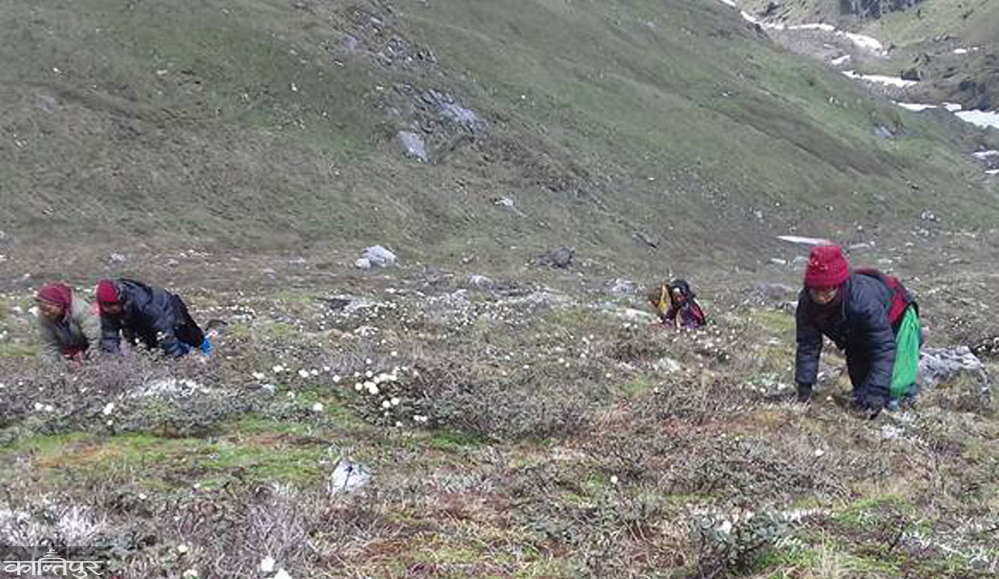
The collection of the valuable herb Yarchagumba has begun in the Himalayan district of Manang. This year's collection has started from Nhamgya Kharka (Namgya Lake), which is on the border of Naso Rural Municipality and Narpabhumi Rural Municipality.
Since Namgya Kharka is the border area of Naso and Narpabhumi Rural Municipality, a separate management subcommittee has been formed here to manage the collection of Yarcha. The subcommittee has been formed under the coordination of Yad Ghale, who is also the ward chairman of Naso Rural Municipality-8.
According to him, the collection work has started by distributing certificates from Wednesday. He informed that more than 100 collectors have reached the lake on Wednesday and Thursday. According to him, citizens within the district were given certificates at a fee of Rs 12,000 per person and those from outside the district were given certificates at a fee of Rs 17,000. Arrangements have been made to cut certificates and provide identity cards to collectors at the Chame Rural Municipality-3 Koto.
Consumption of liquor and gambling have been banned in the collection area. Ghale said that cutting of plants including Dhupi has also been banned. It takes at least a day to reach Kharka from Koto where Yarchagumba is found.
According to the Conservation Area Management Regulations 2053, Conservation Management Directive 2056 and Yarchagumba Collection and Transportation Directive 2080, in the case of Manang, it is allowed to collect herbs only after obtaining permission from the Annapurna Conservation Area Project (ACAP) Area Conservation Office. Accordingly, the Conservation Management Committee will be able to issue permits to collectors within its area of work.
According to Dhak Bahadur Bhujel, Chief of ACAP Manang, the committee obtains permission for collecting herbs within its area of work. He said that the decision on who to give the responsibility of collection or not will be made by the concerned Conservation Area Management Committee. According to him, the path to collecting herbs is opened only after obtaining permission from the office.
According to him, it was decided to make the Yarchagumba collection work safe and systematic in a program organized on Chaitra 20. He said that initially permission was given in Namgya Kharka and its management is being done jointly by Nar and Tachai sub-committees.
Within a few days, permission will also be given in Pisang of Manang Ngisyang Rural Municipality-1 and then in Manang and Tanki Manang areas in Ward No. 4, 6 and 8. According to him, 13 conservation area management committees are active across Manang and they are handling the responsibility of conservation and collection.
Along with Manang, people from Lamjung, Gorkha, Tanahun, Dhading as well as Rukum-Rolpa also reach Manang to collect Yarchagumbu. However, outsiders have been banned from the Kharkas of Narpabhumi Rural Municipality. According to sources, the citizens of Nar (Narpabhumi Rural Municipality 1-3) and Phu (Narpabhumi Rural Municipality 4-5) villages have decided to collect their own lakes and ban outsiders even if they are from within the district.
Village council chairman Konjo Tenzing Lama said that the collection of yarchagumba will start in the Nar and Phu areas from the third week of Jestha. ‘I was in Kathmandu. I have heard that only Phu villagers will collect in the Phu village lake and only Nar villagers will collect in the Nar village lake,’ he said, ‘I have heard that the villagers have decided, I am going, I will understand the reality. This decision is yet to be understood as it will be made by the conservation area management subcommittee.’
According to him, the production of yarchagumba is also low in the Nar and Phu areas. He said that this decision may have been made because the security challenges and irregularities will increase when outside collectors come.
Earlier, after 7 Gorkhalis were killed in the Nar area in 2066 BS, locals had been banning citizens of outside districts from collecting yarchagumba. Since 2079 BS, citizens of outside districts living in Manang have been allowed. This time, even citizens within the municipality have been strictly banned from going to each other’s lakes. Local sources have said that strict measures have been taken to prevent the recurrence of unpleasant incidents like the past, as the Nar and Phu areas are protected and prohibited areas.
Chief District Officer Nawaraj Paudyal said that a decision has been made to adopt risk reduction measures to make the collection of Yarchagumba systematic. ‘The collection will be carried out keeping in mind the security sensitivity in collaboration between the local level, ECAP and stakeholders,’ he said.
According to ECAP, a maximum registration fee of up to 35 thousand rupees can be charged from collectors. A fee of up to 20 thousand rupees per person has been fixed for buyers. He said that a district-level decision has been made that only 90 percent of Yarchagumba can be collected for conservation reasons.
Among the 4 local levels of Manang, except for Naso Rural Municipality-3 Dharapani and Ward No. 5 Thonche, Yarchagumba is found in most of the lake areas. ECAP stated that Yarchagumba is found in more than 25 lakes across the district.
According to ECAP, the federal government collects 31 thousand rupees per kilogram of Yarchagumba as revenue. The local level and the committee have been collecting a fee of Rs 10,000 per kilogram.
In the last fiscal year 2081/82, 112.693 kilograms of Yarchagumba were collected from Manang. From this, Rs 3,485,090 were collected in the federal government's account, Rs 1,128,200 in the local level and Rs 1,133,200 in the Conservation Area Management Committee. Last year, the price of Yarchagumba in the market was up to Rs 2 million per kilogram.
Last year, 1,524 people had obtained permits for Yarchagumba collection. Out of which, 1,036 were from outside districts and 488 were locals. The fee for the permit was between Rs 10,000 and 35,000 from outside collectors and Rs 5,000 from locals.

