He said that now that the Kaligandaki Corridor and the Mid-Hill Highway have been completed, it is necessary to promote tourism and develop agricultural enterprises.
We use Google Cloud Translation Services. Google requires we provide the following disclaimer relating to use of this service:
This service may contain translations powered by Google. Google disclaims all warranties related to the translations, expressed or implied, including any warranties of accuracy, reliability, and any implied warranties of merchantability, fitness for a particular purpose, and noninfringement.
President of the Federation of Nepalese Chambers of Commerce and Industry Chandra Prasad Dhakal has drawn the government's attention to operationalizing the Korala border crossing. He said that the media should also raise their voices about the benefits that the country will get from opening the Korala border crossing and take the government to a policy decision.
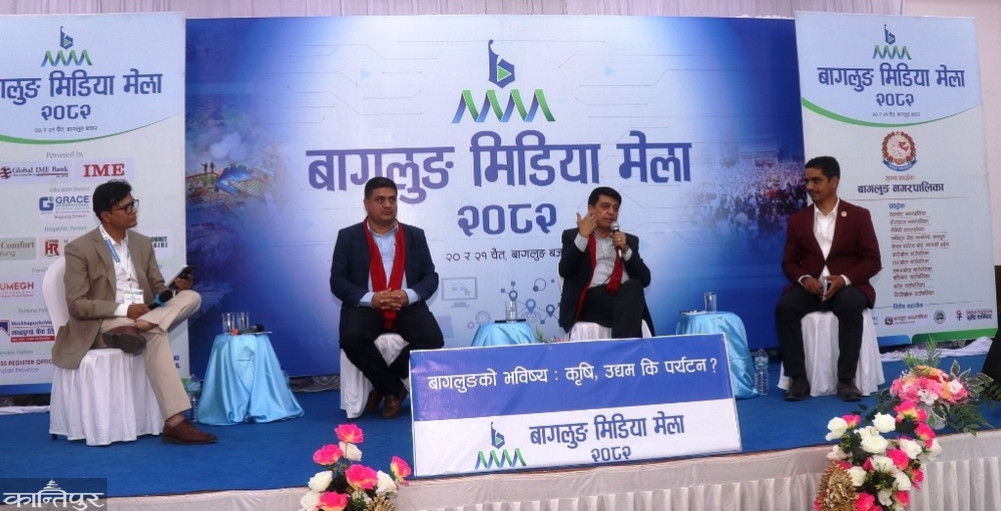
In a panel discussion on 'Baglung's Future: Agricultural Enterprises and Tourism' at the Baglung Media Fair organized by the Federation of Nepali Journalists in Baglung, Dhakal pointed out that Gandaki Province could become self-reliant by operating the Korala border crossing. He also said that a common initiative from everyone is necessary to make Gandaki Province an export-oriented province. He suggested that the provincial government should also formulate a policy on production and export and take pressure to the federal government.
He said that since the Kaligandaki Corridor and the Mid-Hill Highway have been completed, tourism promotion and development of agricultural enterprises are now more necessary than infrastructure development. ‘Operating the Korala checkpoint will not only make Gandaki Province prosperous, but the country itself can be made prosperous,’ he said, ‘Now let the locals start investing in increasing agricultural crops in rural settlements, businessmen are ready to come with additional investment.’ He believes that agricultural production should first be increased to develop agricultural enterprises. He said that placing agricultural crops under the responsibility of farmers will help in economic development through marketing and modernization.
Maniraj Lamichhane, the provincial head of the Tourism Board, agreed with Dhakal’s case since Gandaki Province is a center of tourism. He believed that Gandaki Province can become prosperous by bringing in Indian and Chinese tourists. He suggested that every religious place can be made a tourist center. Lamichhane was committed to supporting the board in making packages for that.
Gandaki Provincial Assembly member Dilliram Subedi said that although most places in Gandaki have the potential for religious tourism, there is a lack of accommodation and food infrastructure in those areas. He said that the province should formulate a policy for the campaign to create a religious tourism circuit and its implementation can be included in the plan of the local level and the tourism board.
In addition, he pointed out that since the religious circuit can attract maximum tourists, it is necessary to build a dharamshala at every religious place. Stating that the dharamshala in Muktinath has helped hundreds of tourists and devotees, he said that devotees who have reached dozens of places including Baglung Kalika, Bhairavsthan, Dhorpatan are forced to return as there is no normal shelter.
The need for the media and journalists to prioritize the development agenda, tourism, agriculture and entrepreneurship has also been raised at the media fair. The Baglung President of the Federation, Ram Thapa, said that work was done to find the future of journalism through a dozen group discussions at the fair. The central leadership of the Federation, the provincial press registrar, and media entrepreneurs are also participating in this fair. The style of the media was also discussed at the fair. Former president of the Federation, Dharmendra Jha, suggested that one can be aggressive in the content of journalism, but one should not force someone to say something by showing aggressive style. Journalists Shubha Shankar Kandel and Yubaraj Kandel said at the program that aggressive style has become the current style of journalism.