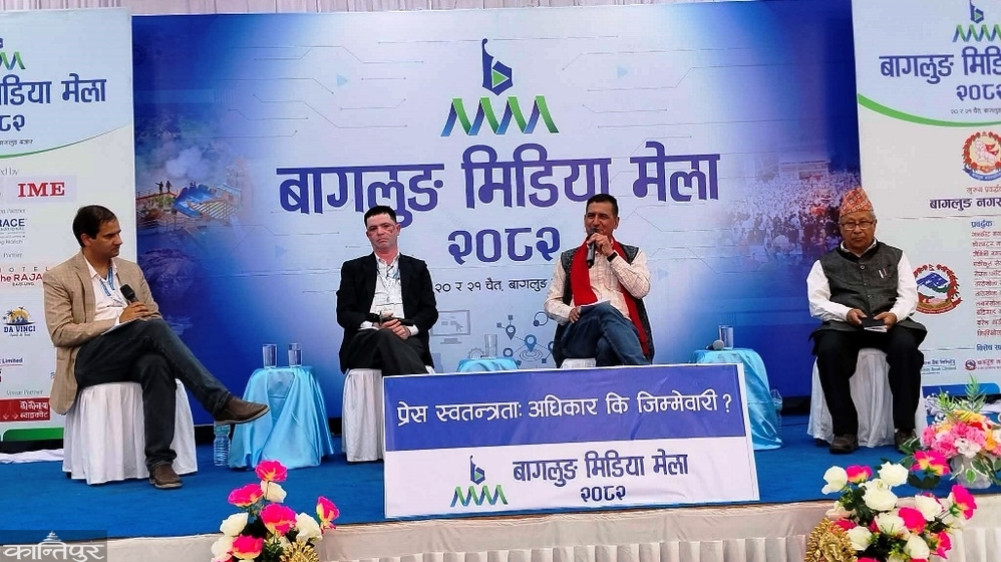
The media fair also includes activities such as a photo exhibition, traditional media material exhibition, and wall newspaper writing competition.
We use Google Cloud Translation Services. Google requires we provide the following disclaimer relating to use of this service:
This service may contain translations powered by Google. Google disclaims all warranties related to the translations, expressed or implied, including any warranties of accuracy, reliability, and any implied warranties of merchantability, fitness for a particular purpose, and noninfringement.
The Federation of Nepali Journalists (FNJ) has brainstormed from Giddepress to AI at a media fair organized in Baglung. Participants in the brainstorming session said that journalism should be learned with AI, but not ‘AI journalism’.
They said that filtered reporting, searching for truth, research, and confirmation of news are essential for journalism. Federation of Nepali Journalists (FNJ) General Secretary Ram Prasad Dahal said that the patience of waiting 24 hours to listen to news has been replaced by the challenge of journalism providing news in seconds.
He pointed out the danger that using AI in this hurry will make it technically easier but will lead to going beyond real journalism. ‘The future of journalism is not about writing about social media topics, our news should become the content of social media,’ Dahal said, ‘There should be a situation where journalists can survive by doing in-depth research.’
He said that journalists need an environment where they can report fearlessly, free from the compulsion to write news for numbers. He said that this would be possible in financially capable, socially fearless and mature journalism. Press Council member Keshav Sharan Lamichhane said that journalism should focus on facts. He said that he followed the code of conduct and should not be based on facts and violate the law. ‘We have been forced to take action against some journalist friends, that should not happen,’ he said, ‘Journalism should become a guide for society.’ The council warned that no one should engage in journalism that would lead to action while following the legal path that it has been creating moral awareness. Journalist Bimal Gautam said that journalism cannot survive in the traditional style anymore. He claims that since society has entered the digital age, journalists and journalism will die if they cannot operate through digital means. ‘Just as a tsunami occurred in old parties due to not understanding where politics is going, a flood will also occur in journalism if they do not understand the times.’
Another journalist, Ekraj Pathak, said that in order to operate journalism sustainably, investigative journalism and field reporting should be done. He said that every newspaper and other media outlets can become sustainable if they use digital methods. ‘It is necessary to end the trend of copying and pasting and bringing someone else’s news and making bylines,’ Pathak said. ‘If you can regularize your religion and belonging, journalism will not be greatly affected.’
Chandra Prasad Dhakal, President of the Federation of Nepalese Chambers of Commerce and Industry, said that journalism should show the country’s development potential. He believes that the state has created an environment for industrialists and businessmen to invest in it. ‘Journalism should explore possibilities, and when the state provides security, businessmen are ready to invest,’ Dhakal said. ‘Now the state also needs a digital marketing policy.’ He said that industrialists are trying to increase investment through that.
He argues that the prosperity of Gandaki Province can be sought by operating the Korala border checkpoint. For that, journalism has not been able to attract the attention of the state. He said that if entrepreneurs develop a system to supplement local investment rather than seeking investment from entrepreneurs, production in rural areas will increase, marketing can be done and youth migration will be stopped.
Gandaki Province member Dilliram Subedi said that the provincial government wants to make an investment-friendly policy and that journalism should also point out the need for it.
At the media fair, famous content creator Barsha Basnet, solo traveler Sirjana Sijju, software Arctic Chirag Thapa and senior advocate Kaji Gaunle Shrestha also said that the time has come for journalism to become credible and research-oriented. They said that the media fair should be able to give this message across the country.
The media fair also includes activities such as photo exhibitions, traditional media material exhibitions, wall newspaper writing competitions. The fair was inaugurated by Gandaki Province Chief Minister Surendra Pandey. Former president of the federation Dharmendra Jha, Kantipur journalist Deepak Sapkota, the first Nepali to reach Antarctica Bhuwan Singh Bishwakarma, singer Basanta Thapa, campaigner RK Adipta Giri, and planner Vijayraj Panta were also present at the fair, which will continue till Saturday, said federation president Ram Thapa. A Maithili language book 'Jaganmukti' written by former president of the federation Dharmendra Jha was also released at the fair.