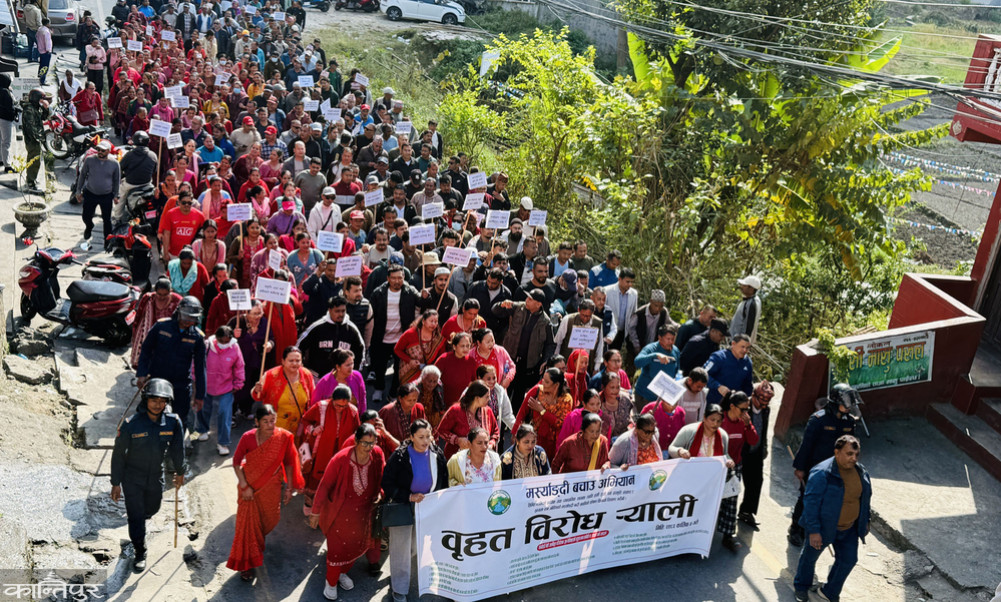
Locals have formed a 27-member Marsyangdi Sangharsh Samiti to oppose the construction of the 50-megawatt project. Flex prints of 14 potential impacts of the project have been posted at various places.
We use Google Cloud Translation Services. Google requires we provide the following disclaimer relating to use of this service:
This service may contain translations powered by Google. Google disclaims all warranties related to the translations, expressed or implied, including any warranties of accuracy, reliability, and any implied warranties of merchantability, fitness for a particular purpose, and noninfringement.
The residents of Besisahar in Lamjung have made a single-pointed demand, saying that the Marsyangdi Valley Hydropower Project should not be allowed to be built.
A protest rally was held in Besisahar, the district headquarters, on Thursday under the leadership of the Marsyangdi Bachao Sangharsh Samiti, formed to protest the construction of the project.
The rally, which started from Manange Chautara in Besisahar in the presence of local leaders of political parties as well as people's representatives, turned into a meeting by passing through Narayansthan Chowk, District Administration Office, Danaiphant Chowk, Shera Chowk-Narayansthan Chowk and Bhimsensthan Chowk. Along with the Sangharsh Samiti, the rally was attended by Congress District Vice President Shrikant Ghimire, UML Secretariat Member Jun Bahadur Tamang, Rastriya Swayamsevak Sangharsh Samiti Besisahar Municipal Committee President Menkaji Adhikari, local leaders and cadres of the disbanded Maoist Center, RPP and other parties, youth clubs and mothers' groups, school principals, and others.
Locals have also formed a 27-member Marsyangdi Bachaoun Sangharsh Samiti to oppose the construction of the 50-megawatt Marsyangdi Besi Hydropower Project in Marsyangdi. The committee has made flex prints of 14 possible impacts of the construction of the Marsyangdi hydropower project and put them up in places in Besisahar. They are also collecting signatures at every corner saying that the project should not be built. The committee has submitted a memorandum to the District Administration Office and has also given a message to the Besisahar Municipality.
They say that the construction of the Marsyangdi hydropower project will destroy religion, culture, traditions and human civilization, cut off water and its sources, lose natural beauty and rob the locals of their livelihood. They have also warned of excessive soil erosion and landslides, deterioration of the natural life cycle of the environment, increase in temperature in the vicinity due to the absence of rivers, low and high rainfall, imbalance in the environmental system, explosion of glaciers and dams breaking in case of major floods, and loss of property and lives. Locals say that tourism and other businesses dependent on the river will be closed, the life of water-dependent creatures will end, beautiful nature will be lost, large machines and explosions will affect the forests, and the land will become dry and barren, and settlements will turn into ruins and deserts. Addressing the
rally, Ram Bahadur Thapa, coordinator of the Marsyangdi Bachau Abhiyan Sangharsh Samiti, said that they have moved forward with a single-pointed demand not to allow the construction of the hydropower project. "Our demand is that the 50-megawatt Marsyangdi Hydropower Project cannot be built in Marsyangdi, and that too cannot be built tomorrow. This is our single-pointed demand," he said. "We will not budge an inch on our demand. We will not allow the project to be built in Marsyangdi, even if it is life-threatening." The Congress District Working Committee, Lamjung, has issued a statement supporting the Sangharsh Samiti's campaign.
The project has started infrastructure construction by constructing a dam on the border of Besisahar Municipality-6, Belauti Bisauna and Letephant of Ward No. 10 and constructing a power house under Saldanda in Besisahar Municipality-10 to generate electricity.
The project has received a survey permit from the Ministry of Energy, Water Resources and Irrigation on Asoj 30, 2065 and approved the Environmental Impact Assessment Report (EIA) on Asoj 1, 2074. The project then entered into a Power Purchase Agreement (PPA) with the Nepal Electricity Authority (NEA) on Bhadra 10, 2075.
The project, estimated to cost around Rs 10 billion, will have 30 percent equity investment from the promoter group and 70 percent from the loan investment bank, the project said. The project, which was started by Divya Jyoti Hydropower Limited, has been taken up by Api Power Company Limited with a 51 percent stake and infrastructure construction has been started.