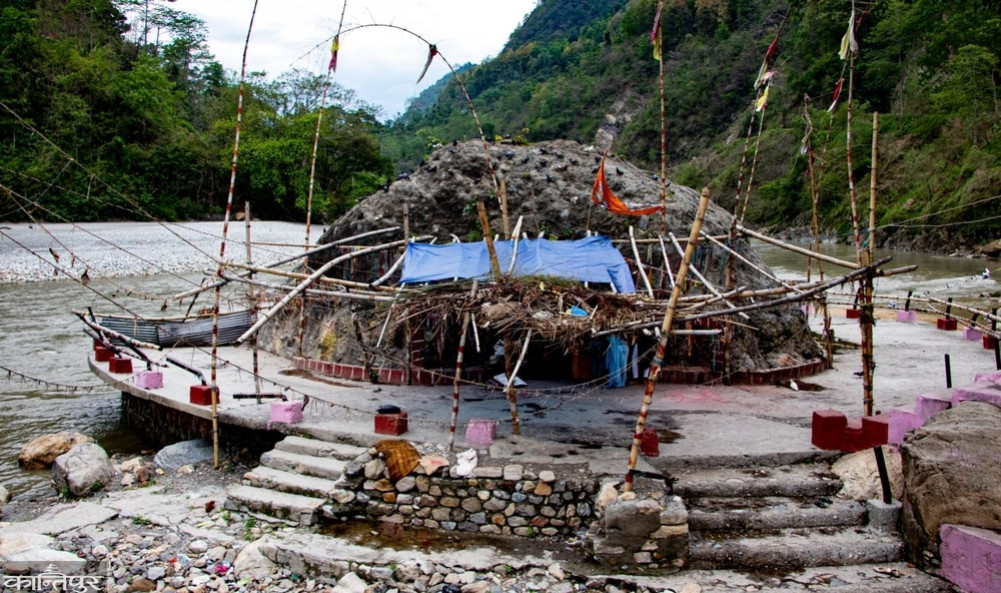
The water level in the river is increasing every year because of the gravel and sand piled up in the river on the dam built by the 'A' hydropower project in Kaligand.
We use Google Cloud Translation Services. Google requires we provide the following disclaimer relating to use of this service:
This service may contain translations powered by Google. Google disclaims all warranties related to the translations, expressed or implied, including any warranties of accuracy, reliability, and any implied warranties of merchantability, fitness for a particular purpose, and noninfringement.
The existence of the huge Shaligram stone at Setiveni, the confluence of Parbat and Syangja, is in danger. Due to Kaligand's 'A' hydropower project, Shaligram Shila is losing its appearance. The rocks on the banks of the Kaligandaki river are getting flooded with the onset of drought.
Due to the
project, the risk of flooding the entire Setiveni market has also increased . At a distance of 7 km from here, the dam of Kaligandaki 'A' hydroelectric project has been constructed. Big stones, gravel and sand are piled above the dam. This is increasing the level of the river," said Dilliram Bhusal of Syangja Setiveni, "The project is supposed to clean the river material that accumulates in Kaligandaki, but it has been neglected. Because of this, there is a danger that not only the Shaligram Shila, but the entire Setiveni market will be submerged.
Man Bahadur Basyal, Ward President of Bihadi Rural Municipality-6, said that although he pleaded in many places to protect the existence of the Shila, there was no response from anyone. The settlements near the river have been displaced. The people of the market are also living in the dredger," he said, "The water level in the river is increasing every year due to the gravel and sand piled in the river on the dam built by the project. The state should be able to create a source of income.'
Before the construction of the Kaligandaki 'A' hydropower project, the Shaligram Shila was flowing through the Gulmi road a hundred meters from the Kaligandaki river. The rock could be seen from the part buried in the ground,' said Basyal, the ward president, 'Now it is a situation where one does not believe that Virat is Shaligram . Only the upper part of the rock can be seen. It is not possible to circumambulate the rock not only in winter but also in winter.'
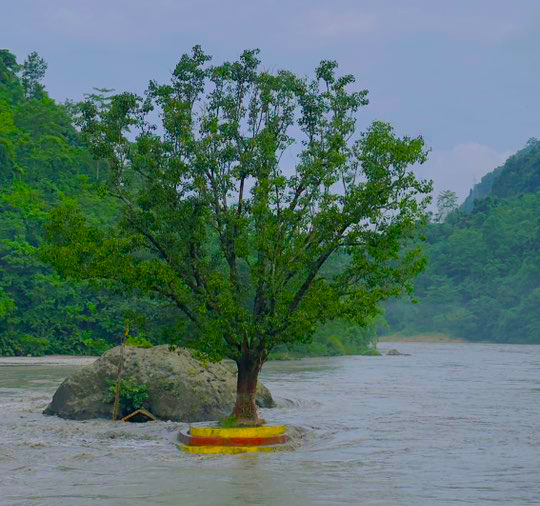 The head of District Coordination Committee Parbat Bishnuram Vick said that a meeting was held with the coordination heads and CDOs of the three districts and a discussion was held about Shaligram rock conservation. "Earlier, Kaligandaki river used to flow across the Gulmi road. Now that part is completely bogged,'' he said in the meeting of Parbat, Syangja and Gulmi, he said, 'When I proposed to dig the empty bogar of Gulmi and make the river flow and save Shaligram, Gulmi flatly refused.'
Along with Shaligram Shila, all the structures including Sattal in this area have been flooded . Even though embankments and gabion nets are being constructed every year for rock protection, they are becoming ineffective. There are more than 200 houses including schools in Seteveni market including Syangja and Parbat.
Shaligram Shila is crowded with pilgrims on Ekadashi and Vaishakhe Sankranti. There is a popular belief that if you come to the rock and ask for what you want, your wish will come true. Due to river erosion, it is not possible to circumambulate the stone even in winter. Devout devotees feel that the worship is incomplete if they cannot circumambulate the stone.
The Kaligandaki hydroelectric project operated by the Nepal Electricity Authority has been producing 144 megawatts of electricity. The project started construction in 2054 and has been producing electricity since 2059.