The Gandaki State Government registered the Dalit Bill in the Parliament on February 21, 2008. The bill is currently under discussion in the Social Development and Agriculture Committee.
We use Google Cloud Translation Services. Google requires we provide the following disclaimer relating to use of this service:
This service may contain translations powered by Google. Google disclaims all warranties related to the translations, expressed or implied, including any warranties of accuracy, reliability, and any implied warranties of merchantability, fitness for a particular purpose, and noninfringement.
Stakeholders have suggested 13 points on the bill which is being discussed in the Gandaki Provincial Assembly to regulate Dalit rights and empowerment.
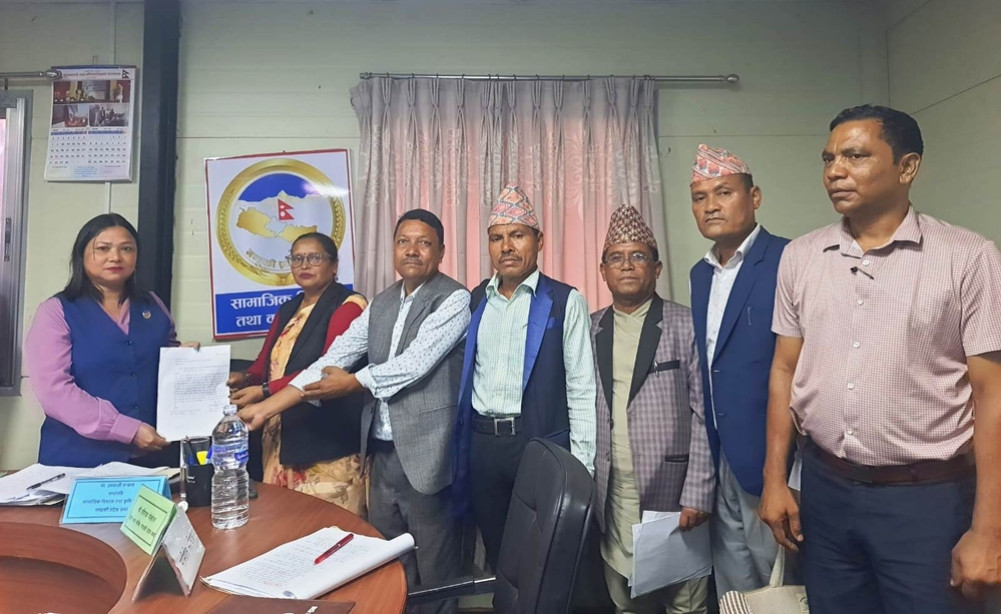
Joint Political Dalit Sangharsh Samiti Gorkha, led by Deputy Chief of District Coordination Committee Gorkha Leela Pariyar, has submitted a memorandum to Chief Minister Surendra Raj Pandey and Chairman of Social Development and Agriculture Committee Damayanti Ruchal on Wednesday.
Committee chairman Sher Bahadur Bishwakarma said that a memorandum has been submitted requesting amendments to the preamble of the bill, changing the name of the monitoring committee, appointment of the executive vice president, service-facilities, appointment of members, procedure of appointment of members, scholarships, etc. Section 3 of the
bill provides for the monitoring of caste discrimination and untouchability and the formation of Dalit Empowerment Committee. The Sangharsh Committee has suggested naming the Dalit Empowerment Development Committee against caste discrimination and untouchability. Provision has been made that the chairman of the said committee will be a minister. The Sangharsh Committee suggests that a person who has worked in the field of Dalit rights be a representative of the entire community and arrange an executive vice president. The
bill provides that 6 members can be nominated from the chairman by experts and rights activists to represent the Dalit community. The Sangharsh Committee has suggested that the Committee should be appointed by the Council of Ministers and not by the chairman. Also, it has been suggested to make the tenure of the nominated member 4 years . The bill provides that the term of office of the nominated member will be 3 years, except ex-officio .
The Sangharsh Committee has suggested that the member secretary should be a person who has contributed to the rights of the Dalit community and not a government employee. The bill mentions the matter of making the head of the department who looks after the related matters of the ministry as a member secretary. There is another suggestion in the bill that the meeting of the committee should be held at least twice a year. Section 5 of the bill provides that the meeting of the committee will be held as per the requirement. It has been suggested to cover the subject of studying cultural subjects in the work of the
committee. The bill envisages that the committee should study the economic, political and social conditions of the Dalit community and submit a report. In Section 9 of the
bill, it is mentioned that the state government can arrange subsidized scholarships for poor and wealthy Dalit students to study up to higher education. The Sangharsh Committee has demanded that the subsidized scholarship should be made compulsory by adding the phrase 'can be done' instead of making it optional by adding the word 'must be done'.
The state government registered the Dalit Bill in the Parliament on February 21, 2018. The bill is currently under discussion in the Social Development and Agriculture Committee. Damayanti Ruchal, Chairman of the Committee said that the final report will be prepared by including the necessary suggestions given by the Sangharsh Committee and other stakeholders in the bill.