By 2029, 25 percent of households will have electric stoves, with a target of reducing conventional fuel consumption by 25 percent
We use Google Cloud Translation Services. Google requires we provide the following disclaimer relating to use of this service:
This service may contain translations powered by Google. Google disclaims all warranties related to the translations, expressed or implied, including any warranties of accuracy, reliability, and any implied warranties of merchantability, fitness for a particular purpose, and noninfringement.
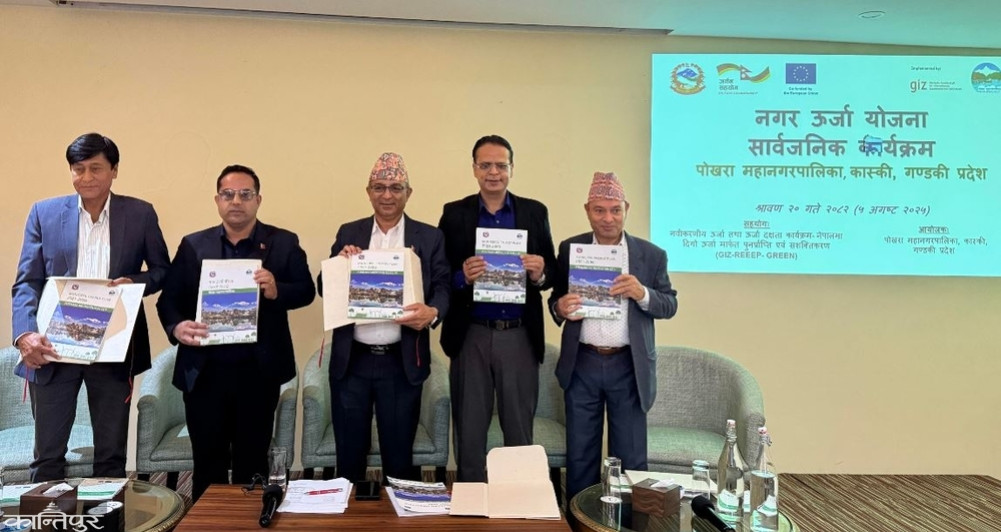
Pokhara has announced the City Energy Plan on Tuesday with the goal of providing access to electric stoves to 25 percent of households within the metropolitan city within five years. The estimated cost of the city energy plan (081-86) announced by the metropolis is 1 billion 33 million 33 million 82 thousand.
This urban energy plan has been prepared by the Urban Planning Commission of Pokhara Metropolitan Municipality with the support of German International Cooperation Agency (GIZ), Alternative Energy Promotion Center, Windpower Nepal and European Union. The metropolis has introduced a city energy plan to meet the goal of making Pokhara a carbon neutral city by 2100 (year 2043). The plan has the idea of 'Enhanced Pokhara through efficient and sustainable energy' and its goal is 'Creation of carbon neutral Pokhara through energy cleanliness and efficiency'.
According to the 2079 data of the secretariat of the Water and Energy Commission, the current energy consumption pattern of Pokhara has presented a challenging picture. Among the fuels primarily used for cooking, the share of LPG is 84.25 percent, biogas is 5.25 percent, firewood is 10.27 percent and electricity is only 0.23 percent. In the last two years, the number of users of electric ovens has increased somewhat.
LPG dependence has reached 98.45 percent at the household level, while this figure is 84.25 percent in the commercial sector. In the ward analysis, the highest number of people using firewood is 69.42 percent in ward number 28 and the lowest is 0.62 percent in ward number 9.
Nagar Urja Yojana has determined 4 goals, 9 objectives and 5 strategies. The goal of the plan is to make the production and use of renewable energy efficient and clean at the household level. The energy plan aims to increase the use of renewable energy while minimizing the use of traditional and imported fuels in business, increase energy efficiency by reducing greenhouse gas emissions from industry, increase public awareness in sustainable practices through renewable energy and energy efficiency policies and educational campaigns for environmental protection and economic prosperity.
Expansion of electric stoves, improvement in energy distribution The most important goal of the
plan is to ensure access to electric stoves in 25 percent of homes in Pokhara metropolis by 2029. For this, the metropolis plans to increase the 39 thousand 440 households that are currently connected to 5 ampere meters to 15 ampere capacity. By the year 2026, there is a plan of the metropolis to connect at least 15 ampere meters to 99 percent of the households in Pokhara Metropolitan City.
Likewise, there is a plan to collaborate with the Nepal Electricity Authority to add new infrastructure (transformers, distribution lines) for reliable electricity distribution that can accommodate 25 percent e-cooking load in the main urban settlements. According to the
plan, the aim is to replace about 11,893 households that currently depend on firewood for cooking with improved stoves . This will not only increase energy efficiency, it is also projected to reduce domestic air pollution. The
plan aims to install solar home systems in 20 percent of Pokhara metropolis. For this, there is a plan to encourage the implementation of net-metered rooftop solar in 20 percent of households, producing a total of 56 MW of solar energy (2 kW from each household). Arrangements have been made to provide a 10 percent discount on the building completion certification fee and financial incentives or tax exemptions for households investing in solar energy systems.
The goal of the energy plan is to increase the number of households using biogas plants by 1,300. For this, a source list for biogas feedstock has been prepared in each ward and a target has been set for 50 percent households to separate their household waste by 2025.
In order to improve energy efficiency in the commercial sector, the goal is to install net-metering rooftop solar in 20 percent of businesses. Likewise, there is a plan to install solar water heating technology in 200 businesses and install rooftop solar in all 33 ward offices of Pokhara metropolis. According to the goal of 'one cooperative, one product', by the end of 2029, renewable energy will be used in each cooperative to produce one product Plan to do.
The plan has an ambitious goal to reduce carbon emissions in the transportation sector. The goal is to reduce carbon emissions in the commercial sector by 50 percent within five years and to increase the use of electric vehicles in the commercial sector by 10 percent annually.
There is a plan to study the feasibility of bus rapid transport and collaborate with stakeholders including government agencies and private companies to plan and build at least 50 electric charging stations in the urban area of the metropolis in the next five years.
The plan has adopted a comprehensive strategy for clean energy transition in the industrial sector. The goal is to reduce the use of traditional fuels and technologies in the industry by 50 percent and to increase the consumption of clean and renewable energy by 25 percent. It is planned to start a pilot project of 1 MW based on solar energy and to start a pilot agricultural project based on solar energy. The goal of the metropolis is to establish an agricultural processing industry based on renewable energy technology. The
plan has placed special emphasis on energy education and awareness at the community level. 30 percent of the households in the low-income target communities will have electric stoves, while 80 percent of the communities will be aware of energy efficiency through the mother group and village development committee.
100 percent of schools in the metropolis will have programs related to renewable energy and energy efficiency. For this, it is planned to conduct an annual energy week in the schools of the city in collaboration with various associations and to develop a curriculum by including renewable energy and energy efficiency.
There is a plan of the metropolis to arrange financial arrangements from various sources for the implementation of the city energy plan. A strategy has been prepared to collect 25.58 percent from the Metropolitan Corporation, 7.60 percent from the Alternative Energy Promotion Center, 0.59 percent from the Nepal Electricity Authority, 62.71 percent from the beneficiaries and 3.52 percent from various non-governmental organizations. The
plan has adopted five main strategies. The strategy of the plan is to upgrade energy distribution infrastructure by implementing energy efficiency technologies to promote sustainable consumption, focus on grant programs for the adoption of renewable energy including access to solar energy and electric stoves, develop new initiatives to reduce fossil fuel consumption and promote energy efficiency, develop community initiatives for clean energy integration and industry-focused energy efficiency programs, and develop inclusive energy policies and regulations to support community energy initiatives. A monitoring and evaluation system has been established for the effective implementation of the
plan. The Energy Development Sub-Committee will remain as the main responsible body, while the monitoring and evaluation work will be conducted based on predetermined indicators.
Ward-targeted energy plan monitoring and evaluation will be done by the concerned ward office on a quarterly basis, while the Infrastructure Development Committee will submit the compiled quarterly report to the Metropolitan Municipality Monitoring and Evaluation Committee.
Announcing the city energy plan, Metropolitan Chief Dhanraj Acharya expressed his commitment to the effective implementation of the plan in cooperation with all concerned agencies. He said that the City Energy Plan (2081-86) has been prepared for Pokhara's carbon neutrality goal and identification of possible plans including the study of the overall energy situation for building a prosperous touristic Pokhara. said, "It will contribute significantly to the development of affordable, clean and reliable energy along with the integration of energy efficient technology in the metropolis."
This city energy plan of Pokhara Metropolitan City is a historic step in the energy sector of Nepal at the local level, according to Dr. Narayan Prasad Choulagai, senior energy expert of GIZ. "If implemented successfully, it will not only make Pokhara an ideal city but also become an example for other cities in Nepal," he said. "The success of the plan depends on the joint efforts of the local government, private sector, civil society and citizens."
Alternative Energy Promotion Center Deputy Executive Director Dr. Narayan Prasad Adhikari said that although this plan shows the possibility of making Pokhara the first carbon neutral city in Nepal, it also has some challenges. "High dependence on imported fuel, limited technical manpower and high cost of initial investment are the main challenges," he said, "but it seems that this plan will be effective in diversifying energy sources without relying only on hydropower."
Chief Executive Officer of Windpower Nepal Pvt. Ltd., Kushal Gurung informed that UNFCCC aims to limit the global temperature rise to 1.5 degrees Celsius by the year 2100 (2156) and to increase the global renewable energy use three times than the current level. "The growing demand for renewable energy, the possibility of international cooperation and collaboration and the opportunity to create local jobs will make this plan successful," he said.
During the construction of the city energy plan, three levels of stakeholders were discussed, i.e. major, primary and secondary. This plan, prepared with the participation of more than 70 stakeholders from Pokhara Metropolitan Municipality to Nepal Electricity Authority, Chamber of Commerce and Industry, and educational institutions, is said to have adopted a multi-faceted approach for the energy transformation of the entire city.
The energy development sub-committee of the metropolis was formed under the coordination of Jaiprasad Sapkota, a member of the Urban Planning Commission. The 13-member committee included Infrastructure Development Committee, Urban Development Division, Nepal Electricity Authority, Industry and Commerce Association and community representatives.