We use Google Cloud Translation Services. Google requires we provide the following disclaimer relating to use of this service:
This service may contain translations powered by Google. Google disclaims all warranties related to the translations, expressed or implied, including any warranties of accuracy, reliability, and any implied warranties of merchantability, fitness for a particular purpose, and noninfringement.
Govinda Adai was 52 years old. It has been twenty years that he reaches home only after taking turns during the festival. The rest of his time is spent in the sheepfold. They are climbing Dhorpatan at this time when they have fallen to escape the winter. In Doko there is a herd of 200 sheep, who are leading sheep with dogs carrying foodstuffs, utensils, blankets and goats.
He said that he started climbing the lake late because it has been raining continuously since Baisakh. Reaching Dhorpatan and Bukipatan in the summer season, he descends to the room of Nagbeli, Myagdi in the Tara River. They reach Galkot when there is heavy snowfall.
This year they didn't have to wear galkots since it didn't snow. But throughout the month of Baisakh, they stayed in Tara Khola, Nagbeli etc. He has been making a living with a flock of sheep for years. He is earning about 1 million a year from sheep rearing. So he has no interest in other professions. He has three sons, a daughter and a wife, and his main occupation is sheep rearing.
Adai from Dhorpatan Municipality-6 has been living a nomadic life for 30 years. For the first 10 years, he lived a nomadic life in his uncle's barn and after 20 years with his own flock of sheep. Adaiko Mamaghar is nearby . He used to go to his uncle's house since childhood. Mama walked with Khum Bahadur Bhandari to graze sheep many times . Dhorpatan and Bukipatan used to be close to each other in childhood. With that inspiration, he became a shepherd.
His daily life is his own choice. Adai, who has worked in his uncle's sheep farm for decades, has been rearing his own flock of sheep for 20 years . His business, which started with 25 sheep, has now reached 200 sheep. His herd now has 6 bulls that are 4 years old and 30 under 3 years old .
All others are sheep. Especially during festivals, bulls are sold from his herd . Therefore, one and a half years ago, the bull should be plowed . He said that he sold a bull for up to 40 thousand rupees. On Janai Purnima, those who sacrifice at Dhorbarah look for many bulls, while during other pujas, residents around Dhorpatan sacrifice sheep.
Hundreds of farmers around Dhorpatan are involved in sheep grazing. Some have raised only 10/20, while there are more than 50 farmers raising 100 to 400 sheep. They graze animals in Dhorpatan valley till Baisakh and take them to Buki in May, June, July and August. Bukipatan is higher than Dhorpatan of 3 thousand meters. Farmers graze sheep by making temporary sheds in places ranging from 4,000 to 4,500 meters.
Adai's three brothers and sons are in this profession . Jetho Prem, Milo Yuvraj and Sailo Devendra live in the barn with Babu . Younger Diamond and wife Bhimkumari are at home . Sometimes Milo's son Yuvraj comes home to take food expenses . Govinda also comes to the house when there is death in the neighborhood and during festivals. The sons left school after their basic education and joined their father's profession .
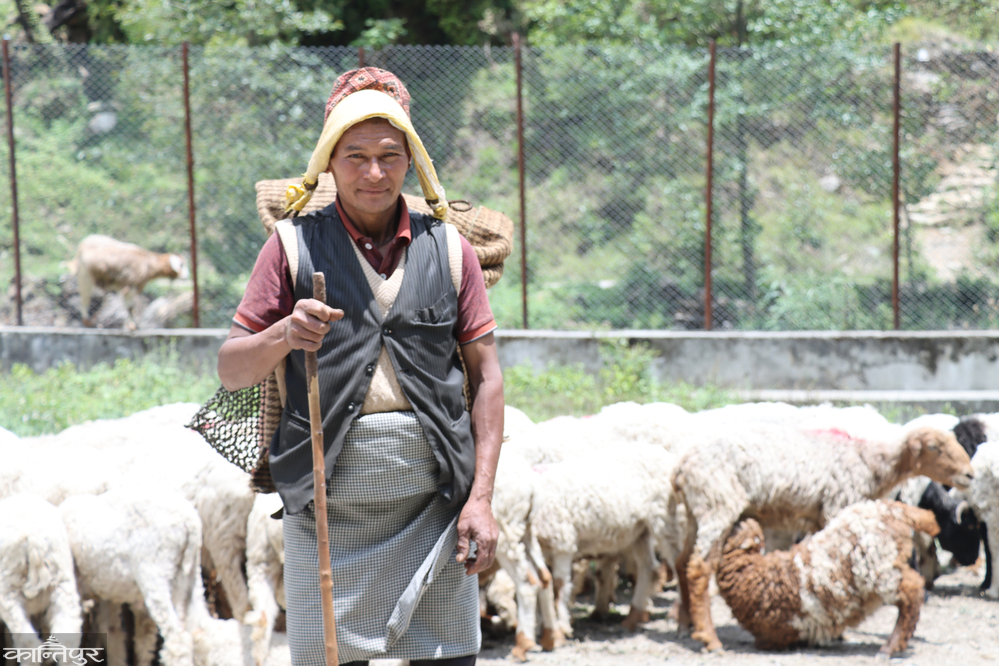
That's why Adai didn't have to hire another worker . He often does not leave the sheep . He said that because he is afraid of leopards, he grazes without leaving the sheep. Also, he has four dogs. Those dogs protect the sheep . A leopard has never attacked his sheepfold at night . He said that there is no problem at night because four dogs are waiting in a circle .
Instead, his sheep has been eaten by a leopard during the day . He said that dogs become less careful during the day, and because they give food by tying them separately, the cheetah covered that opportunity . "In Chait, one of my sheep worth 20,000 was eaten by worms," he said, "Leopards are active when there are no dogs." His dogs also attack humans if they come near the sheep. That's why they can't even come close to what they got.
He said that the dog did not allow the sheep of one group to mix with another group. "Most of the sheep in a herd graze in their own group, so there is no fear of getting lost and being replaced," he said, "the dog that finds the machine while grazing will bring it back to the herd". He said that after leading the original dog out of the four, it would follow the grazing sheep. "They start to graze when they see that we have left the bag, then they follow after carrying the bag," he said. Otherwise, they will not become obese. Unhealthy and lazy. After taking it to a place where there is a source of water to feed the salt, they sprinkle salt on the stone and keep it . Sheep eat as much as they want. Then they return after drinking water. Sheep sometimes need medicine and treatment. There is a shortage of pastures in summer. Heat hurts . At that time, hair cutting, millet taps or wheat husks should also be collected and fed.
costs more at that time. Wool can be spun from hair. That's why there is a tradition of weaving kamlo in the homes of the farmers here . Some of them are making regular income by weaving Kamla . Sheep herders have to walk with enough grain or food for 15 days to 1 month. They carry baguettes and umbrellas, umbrellas and plastic and one or two dishes on their heads. While walking, they cook and eat and sleep wherever night falls.
Ras Bahadur Gurung, another sheepherder, said that when they reached Buki, many people would make a camp and stay together. Gurung Baglung of Rukum rural municipality-1 reaches Dhorpatan and Buki through border crossing. He also said that they used to graze sheep in Chungri Lake in Rukum . When it gets cold, they fall down and climb the lake when it gets hot .
Sheep and goats have more problems with PPR and diarrhea. Therefore, the Veterinary Hospital and Animal Services Expert Center has reached Dhorpatan and vaccinated the herd of sheep and goats. According to animal technician Keshav Sharma, only 10,556 sheep and 10,579 goats of Dhorpatan have been vaccinated against PPR this year.
2 thousand 527 goats and 2 thousand 117 sheep of Tamankhola and 11 thousand 715 goats and 5 thousand 11 sheep of Nisikhola, which are taken to Dhorpatan and Buki, have been vaccinated. Head of
office Dr. Rishiram Sapkota says that sometimes he holds a health camp for sheep and goats. "Many farmers are rearing goats and sheep for income, that's why we keep camps," said Sapkota, "if the sheep and goats die due to occasional diseases, the farmers' investment will sink millions." Because of this, Baglung's sheep, goats and other four-legged animals have also been selected for the government's goal of exporting meat.
The campaign to make Baglung a disease-free district of cattle-footage is also going on. Paudel informed that no disease has been found in the 250,000 cattle in the district. If the district is declared 'disease-free', he told the plan to build a 'mega slaughterhouse' of cattle in Baglung and export it. "Since Korla is a disease-free district, meat can be exported quickly," said Paudel, "that's why the pada padi expansion campaign has also been started in Baglung." The hospital has also made preparations so that it can be exported alive if it is goat and if it is meat it can be exported.

