We use Google Cloud Translation Services. Google requires we provide the following disclaimer relating to use of this service:
This service may contain translations powered by Google. Google disclaims all warranties related to the translations, expressed or implied, including any warranties of accuracy, reliability, and any implied warranties of merchantability, fitness for a particular purpose, and noninfringement.
Even though the price and demand of the cloth produced from silk thread is high in the world market, there is no silkworm cultivation in Nepal. Cultivation of silkworms in Tanahun is limited to exhibitions only.
According to Bhavnath Devkota, Acting Head of Commercial Insect Development Center, Bandipur, farmers are not interested in silkworm cultivation, which has been dubbed as white gold. By the year 2079, there was commercial silkworm cultivation in some places of Gandaki province. But since then the farmers have left . The office has been cultivating itself for seed protection .
Devkota says that due to environmental sensitivity, lack of structural preparation and lack of local market, farmers are not attracted to this cultivation. Silkworm cultivation is very sensitive compared to other crops. As the environment, pollution and even a small change in temperature will affect it, a special structure is needed for this', he said, 'But since such infrastructures could not be built, farmers have started withdrawing from silkworm cultivation.'
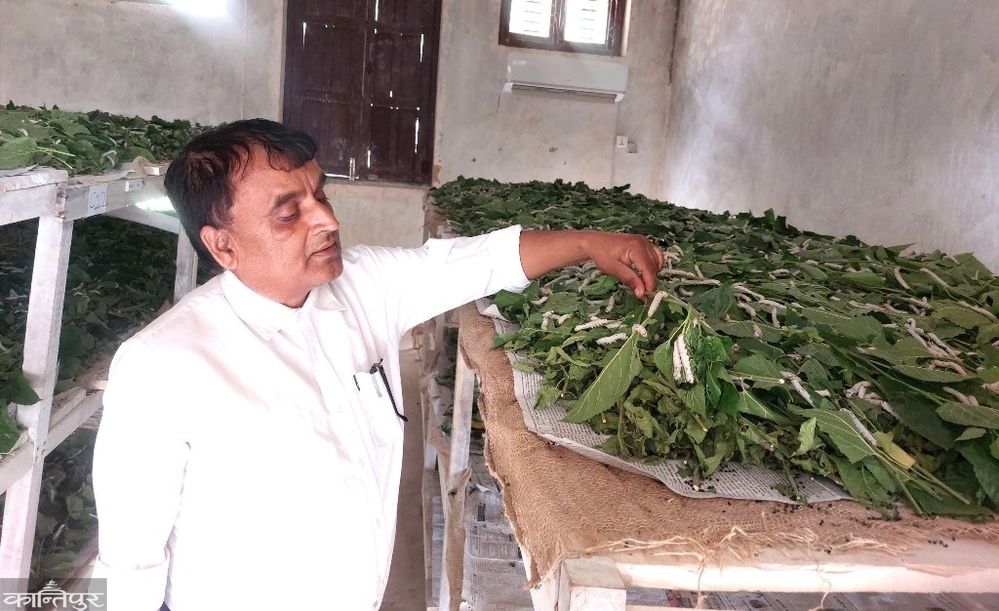
He said that the farmers of Gandaki province have stopped silkworm cultivation since the financial year 2079/80. Silkworm cultivation is a very sensitive cultivation. The kimbu grass required for this cultivation should have been planted in the land like Pakho or Kharbari', he said, 'Farmers were encouraged to cultivate kimbu grass in the fields they were cultivating which was wrong . By doing this, other food production decreased . And silkworm farming was not easy either. As a result, the farmers left the silkworm cultivation and returned to the old farming.
When compared to the production and sale of vegetables, rice, and fruits, when there was a problem in the marketing and income of the silkworm cultivation, the farmers cut down the kimbu plants and started planting vegetables, fruits, and rice again. "Until 2079 years ago, farmers who cultivated silkworms were found sporadically", he said, "now this insect is cultivated only in the development center". But this is also limited to the exhibition.
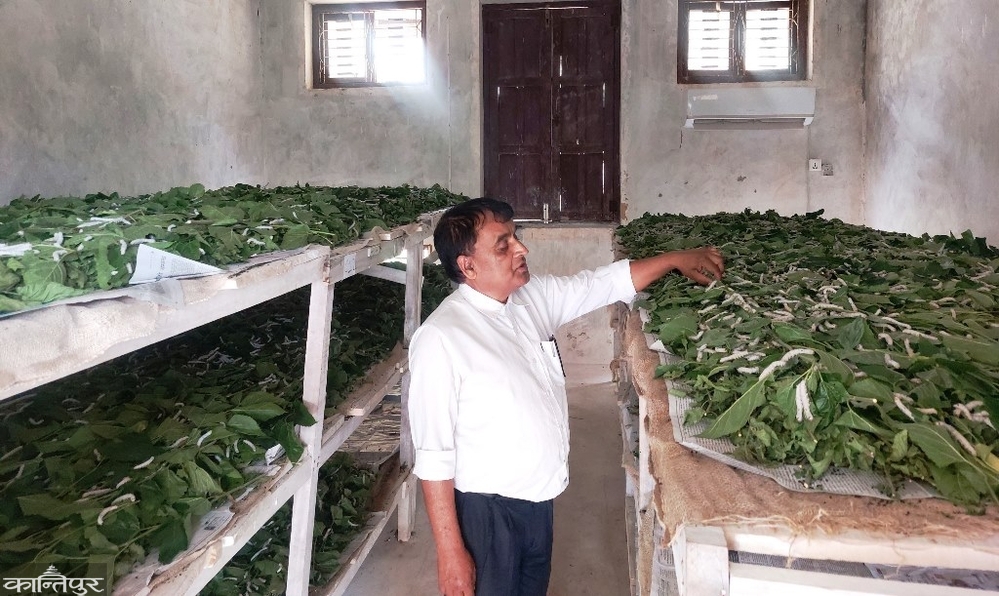
Foreign tourists visiting Bandipur, students from various schools, domestic tourists come to see the cultivation of silkworms, he said. According to him, eggs are brought from Silk Development Centre, Khopasi Kavrepalanchok. He said that the eggs will be kept at a temperature of 27/28 degrees Celsius to hatch small worms.
``Give those insects kimbu leaves for food . After hatching, the worm passes through the third and fourth stages at a gap of two/three days . It takes 9 to 10 days to pass the fifth stage,' he said, 'After reaching the fifth stage, the worm makes a cocoon by extracting saliva and from that cocoon the silk thread is extracted.'
He said that about 800 meters long silk thread comes out of a good cocoon. In Khopasi, after cutting the cocoon, 2 eggs (C12 and J12) are taken out and other eggs are produced by mating. Eggs produced after mating will be distributed to commercial farmers in Dang, Itahari, Biratnagar and other areas. He said, 'This center of ours has not been able to produce anything other than seed protection every year.'
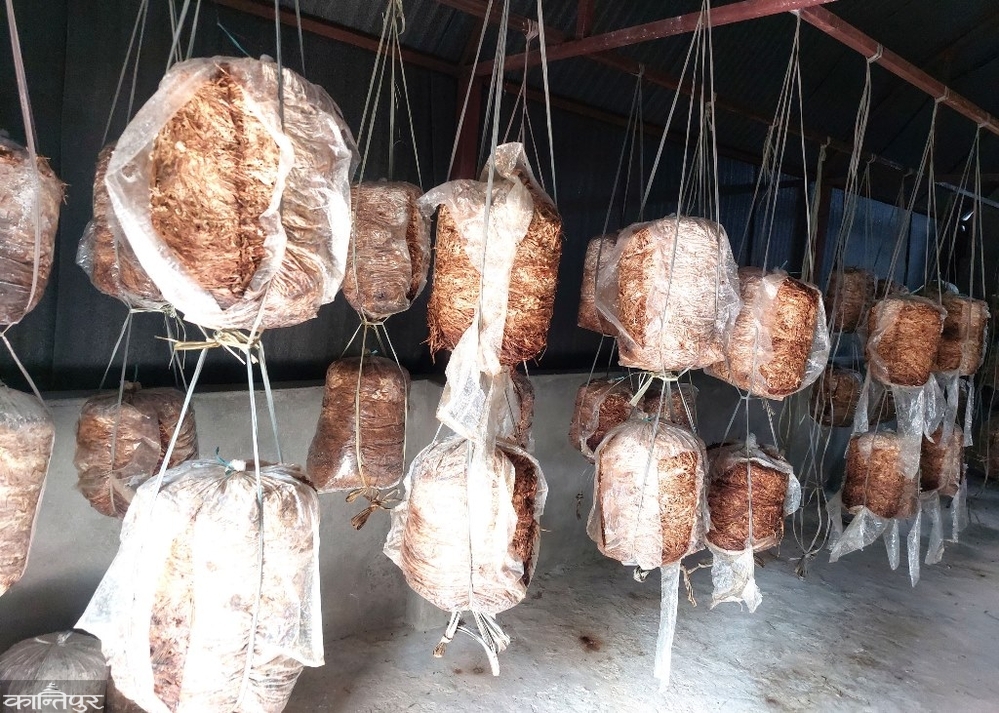
center is now cultivating 120,000 eggs and it is said that about 90 kg of cocoons will be produced. He said that although there is a suitable environment for silkworm cultivation for two seasons in a year, if the necessary physical infrastructure and environment can be adapted, it can be produced for 4 seasons .
In the commercial insect development center in Bandipur, which is spread over an area of 7 hectares, along with silkworms, mushroom cultivation and beekeeping are also being done. This office under the provincial government has been serving 11 districts of the province. According to the office, they are providing seeds to farmers who raise mushrooms and bees commercially.
Although there is a vacancy of 10 people, only 9 people are available, he said. "It is a problem to provide services in all districts due to the availability of manpower", Acting Chief Devkota said, "From next year, there is a plan to establish a service area only in Tanahun district and cultivate according to the demand and needs of this commercial pest development center as an exhibition". The center is planning to increase the revenue by taking some fee from those who come to observe the study.'

