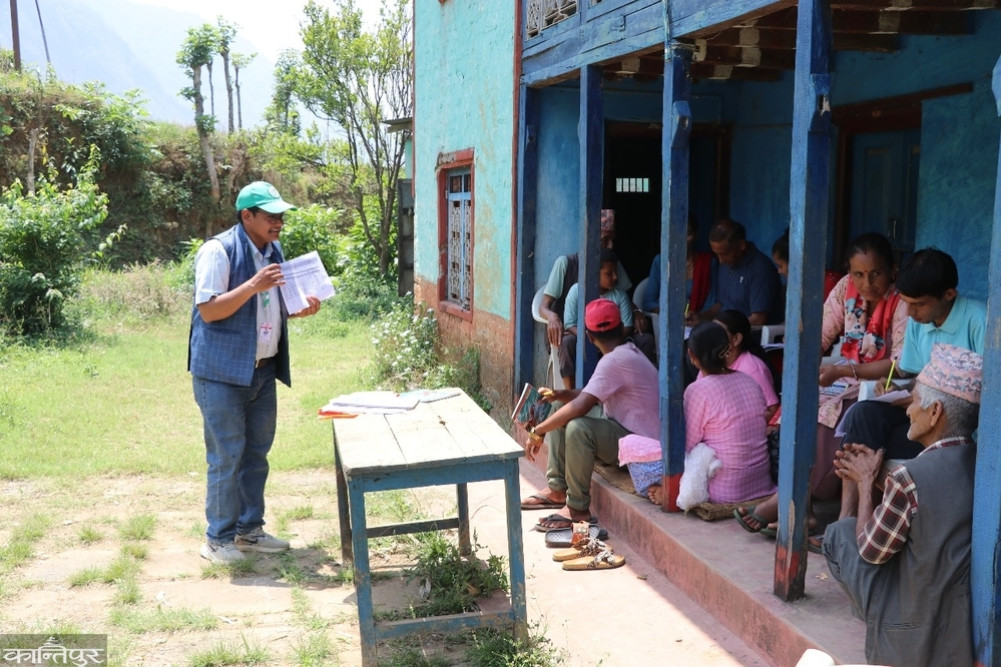
After returning from Malaysia, Rishiram, who was a 'full-timer' worker of the Maoists, has now become a full-time farmer with technical knowledge.
We use Google Cloud Translation Services. Google requires we provide the following disclaimer relating to use of this service:
This service may contain translations powered by Google. Google disclaims all warranties related to the translations, expressed or implied, including any warranties of accuracy, reliability, and any implied warranties of merchantability, fitness for a particular purpose, and noninfringement.
46-year-old Rishiram Bhusal of Vihadi Rural Municipality-4 Wahakithanti did not do anything in his life. They did not join the people's war or went to work in India. He didn't go to Malaysia to earn or join politics after the peace process. Since 2068, Rishiram has left active politics and engaged in agricultural work. Rishi Ram, who is growing vegetables in 21 plastic tunnels on his own 15-plant land, sees his future in this.
Until some time ago, those who saw him used to say, 'Now the leader has come, what will he gossip about?' Because Rishiram has become a full-time farmer with technical knowledge as he works.
Before reaching the road of one and a half decades of agricultural work, Rishi Ram has taken many twists and turns. He was 16 years old when the Maoists started an armed war named Jan Yudho in 2052. He did not become a full-time fighter, but he secretly did the work of finding shelter, showing the way, and doing suraki for the underground Maoists.
As the armed war was reaching its climax, he entered India in search of work . After two years of working in India after 2054, he did not stay in his country. "I went to Malaysia again in 2057, after coming back to Nepal in 2060, I worked full-time in the Maoist," says Rishiram, who is currently engaged in full-time agricultural work, "It is not that the Maoist party has left". But I believe that politics should be connected with production.'
In the first Constituent Assembly election of 2064, he became the personal secretary of Constituent Assembly member Gunakhar Basyal elected from Parbat 2 for four years . After the dissolution of the Constituent Assembly in 2068, he returned to his home village from Kathmandu. After that, his mind was not drawn towards active politics . Huthooti, who wanted to do something in the village, started agricultural work .
In the year 2068, he started by registering a progressive agricultural firm. ``Father planted 4 plants on the land and the corn had already grown. I planted corn in three bamboo tunnels.' It was only natural to say so, because the locals did not know much about tunnel farming .
After the tomatoes planted in the tunnel grew and ripened, some told - there is no market in the village, tomatoes Who buys ? Rishiram, who had jumped into tomato production after tearing up the corn field planted by his father, was worried at that time. He said, "For three years, my father, mother, wife and I carried tomatoes on our backs to Bhanjyang, Pokharachaur and Lauke Bazar. We sold it from house to house.'
In 2071, he took a rented land in Bhusalchowk. Made a small camp . And started selling the vegetables produced in the tunnel. Gradually he became accustomed to agricultural work . Rishiram forgot about using new things and finding ways to expand the market.
In the year 2071, Rishi Ram took a loan of 8 lakh rupees from the Agricultural Development Bank at 3 percent interest. And made an iron tunnel by displacing the bamboo. Now he is cultivating cauliflower, cabbage, cucumber, capsicum, bitter gourd, gourd and ghiraun along with tomatoes as the main crops in the tunnel. He said, 'The profit from off-season vegetables is also high and it is easy to sell.'
With vegetable cultivation, he has not only learned new agricultural skills, but is also making good ways of earning money. Narrating that 700 kg of tomatoes are grown from one tunnel, he said, ``Vegetable farming is earning 5/6 lakh rupees annually.''
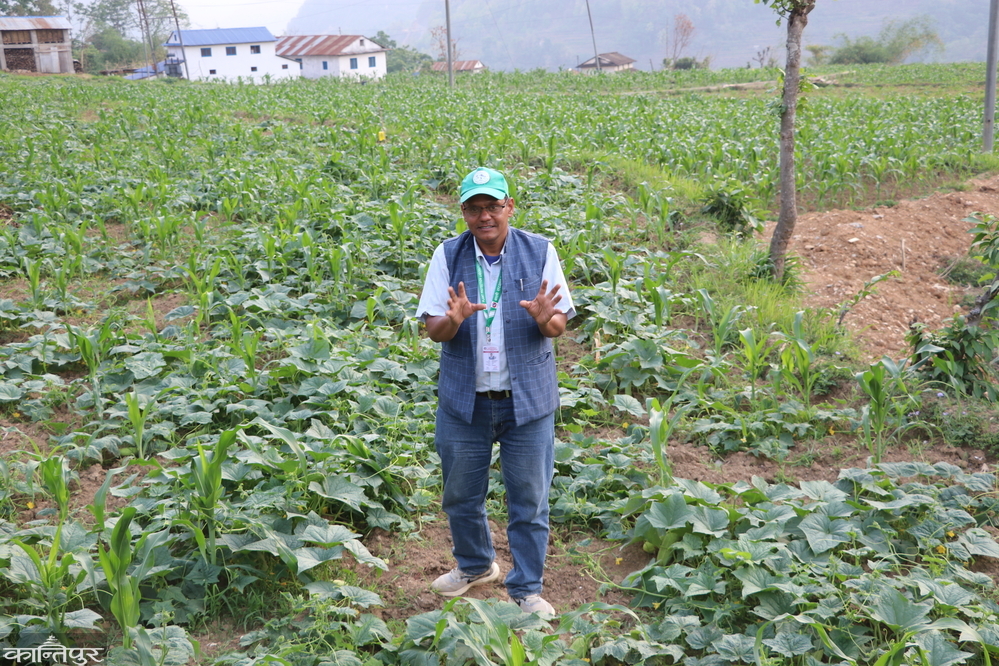
Agricultural work is not only continuity but also new technical skills. He believes that learning is a profession. In 2071, he learned the skills to study and practice Integrated Pest Management (IPM). Now he is the facilitator of 6 IPM Pathshalas from Gandaki Provincial Government and Bihadi Rural Municipality. He teaches the farmers how to farm using organic methods instead of chemical pesticides and fertilizers.
Rishiram prefers to call himself a nomadic catalyst, speaking for the rights of farmers sometimes from the agricultural knowledge center of the district to the ministry of the Gandaki state government. His main concern and interest is how to engage rural farmers in sustainable agriculture and how to connect their products to the market.
Rishi Ram, who goes to the houses of farmers teaching the skills he knows, believes that farmers can get a lot of benefits from agricultural products if they can build a cold store at the local level. He said that if a cold store of 500 tons can be made for Bihadi Rural Municipality, the entire village can be connected to agricultural production. He said in his experienced voice, "If there is only a moisture center, the market price of local products will be high."