We use Google Cloud Translation Services. Google requires we provide the following disclaimer relating to use of this service:
This service may contain translations powered by Google. Google disclaims all warranties related to the translations, expressed or implied, including any warranties of accuracy, reliability, and any implied warranties of merchantability, fitness for a particular purpose, and noninfringement.
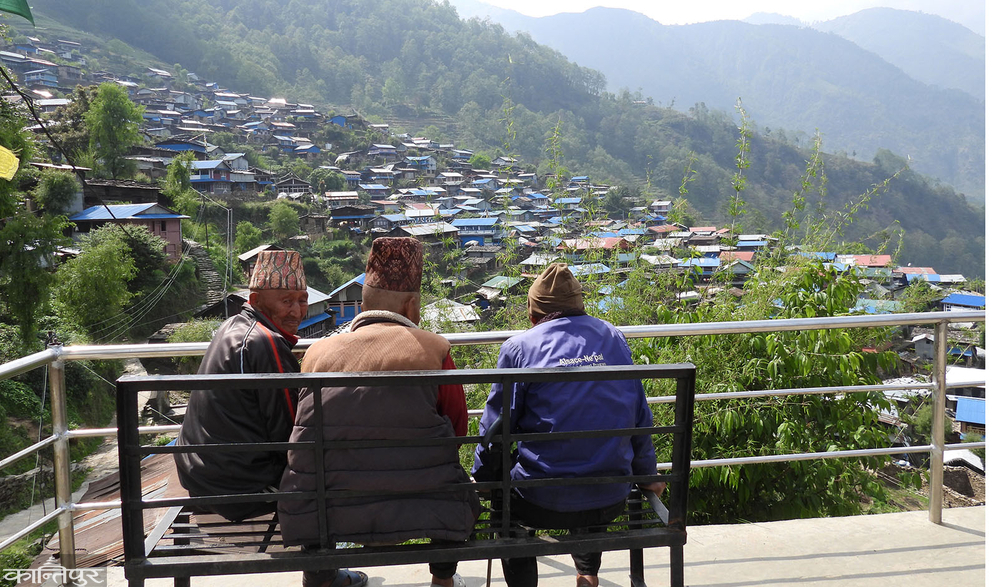
Three old men were sitting on an iron bench in the square next to an old walnut tree and were talking to each other. In front of them was the village of Laprak, full of houses covered with colored zinc. When I reached Laprak after 10 years after the earthquake of May 12, 2072, the locals seemed busy with their daily lives. After starting the conversation, they would say, "Hey, it's been 10 years."
Laprak, which is in Dharche rural municipality-4 of Gorkha, faced the risk of landslides before the earthquake. A big landslide happened here on June 19, 2056. Another landslide occurred in October 2063, causing the land to collapse. After that, the geologist made a 40-day on-site study and recommended shifting the settlement. But the settlement did not move and an earthquake occurred in 072.
The earthquake destroyed 600 houses in the village. 18 people of the village died after falling into the collapsed house. Kisan Gurung, the Ward President of Dharche-4, says that 24 Laprak residents were killed by the earthquake, including 6 others from the same village. 91-year-old Hasbal Gurung, one of the three old men sitting gossiping at Chautaro, says, 'I was saved when I went to the cowshed, many of them died.' Sant Bahadur Sunar had gone to the forest to cut grass that day. When the ground began to dry up, he ran towards the village with a heavy load. There was a dust circle in the village. He is afraid of family/children. Fortunately, no one was at home at that time, they survived. "One goat and one sheep in the cage have died by bursting," 55-year-old Sant Bahadur is now living in his old village with his family.
Remembering earthquakes and landslides does not leave fear in the hearts of Laprak residents . But most of the villagers are here . This walnut tree is older than me, it is still standing. Bajebaraju all sat here, stayed here . It's time for us to die too. After life is here, why should we go elsewhere?' said 83-year-old Vival Gurung. 86-year-old Lalman Gurung also supported him.
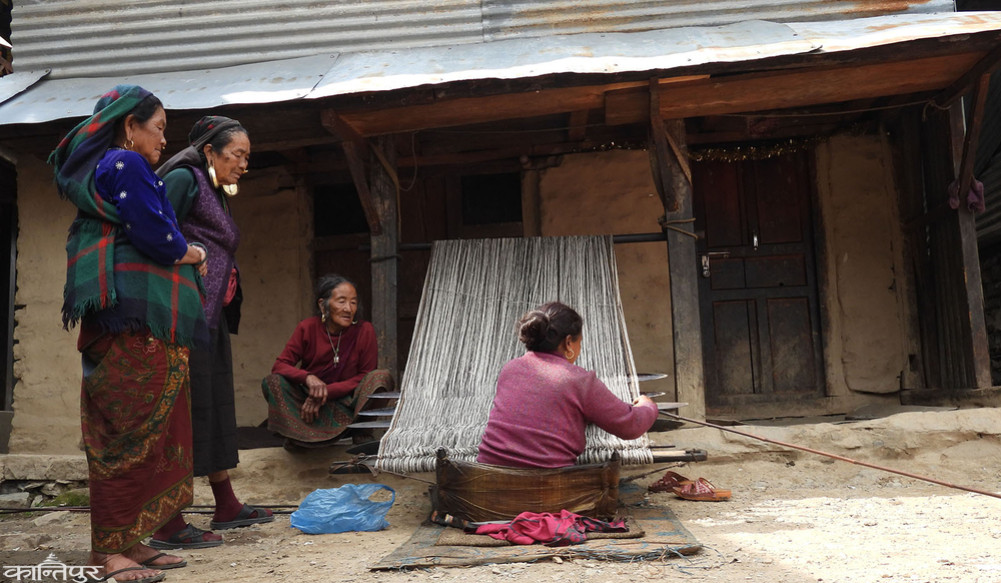
In the village, some people were carrying manure for farming, some were spinning wool, and some were weaving bakku . Someone was doing business by opening a shop . There was no shortage of people sitting on the square of Laprak village and making jokes and ticking. It seems that everyone has forgotten the terrible situation of the earthquake 10 years ago. While there was such a bustle in Laprak, the new village of Gupsipakha, which is two hours away from there, was deserted. There are 603 houses in Gupsipakha in Dharche-4. All were prepared after the earthquake. The form of these houses is identical. But there are only 60 families who regularly live in these houses, Ward President Gurung says. Those houses are prepared for earthquake victims of Laprak . But as most of the residents of Laprak do not leave their old place, the door of the house of the new settlement seems to be closed .
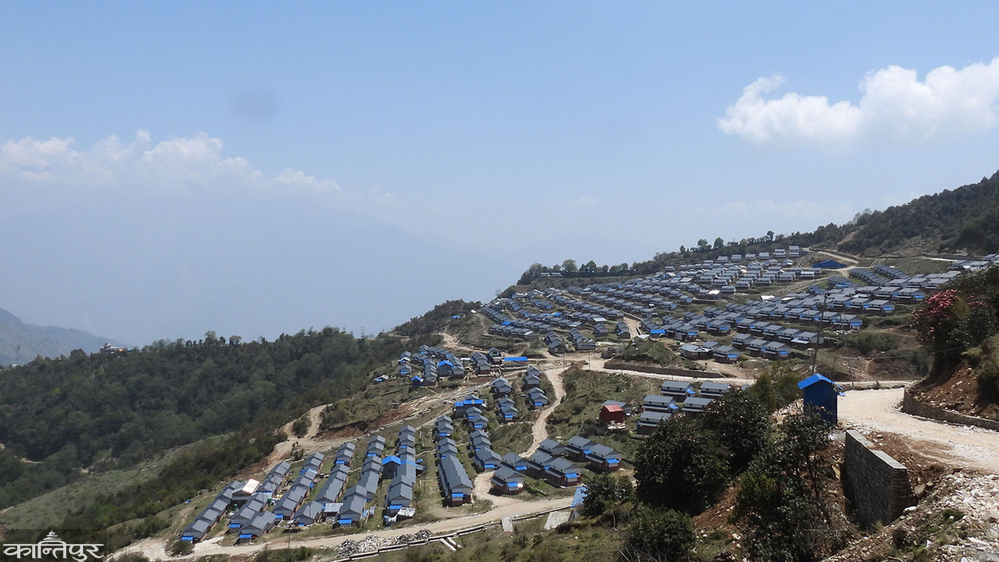 Houses built by NRN in Gupsipakha to house vulnerable Laprak residents. Photo: Ramesh Kumar Paudel/Kantipur
Houses were built in Gupsipakha with the help of Non-Resident Nepali Association (NRN). According to records, 57 crore 66 lakh 4 thousand rupees have been spent. The old people found in Chautari like Biwal, Masbal and Lalman are also attached to the ancient thatathalos because the people of Laprak do not show interest in living in these houses built by NRN by spending crores of rupees . Ward president Gurung adds, 'Four/five people would rather die here, they did not agree to come up even during the earthquake to see why they would leave the place.' It is confirmed that NRN will build the house. After the house was built, all the villagers living in Pakha returned to their old place. The villagers who returned with all their belongings did not want to climb to a new place again . At that time, if they were building houses and keeping half of them here so that half of them would go down, would they have stayed here? Everyone was told to go down . He went down, and after repairing the broken house there, he refused to come back until the house was built," said Ward Chairman Gurung. He is a resident of Laprak. He also often lives in old settlements.
Old people sitting on the square and gossiping and Laprak village . Photo: Ramesh Kumar Poudel/Kantipur
 Residents of Laprak do farming . Wheat, potato, corn are the main crops there. They also keep sheep and goats. In the new settlement of Gupsipakha, there is only a three-ana house. Where a small family can fit in. There is no other thing to cultivate, raise chickens and goats, and not even farming. "How can you drive two hours to do farming and arrive?" Carrying grain to a new settlement would be the same,' said the elderly Lalman Gurung.
Ward president Gurung says that lack of drinking water is also the reason why people are not living in Gumsipakha. The cold is the same . In Pus, Magh, the pipe that brought water from the spring burst after the water froze. Due to the lack of water, it is difficult to live here," said Ward President Gurung. He said that since the old settlement is surrounded by the risk of landslides and earthquakes, it is not suitable to live there, so it is necessary to move to Gupsipakha. ``What makes the locals feel better, people will come if that is arranged . "Sitting down is a risk," he said. In the house where NRN has invested heavily, the locals have also worked hard. "In the dangerous old settlement, the locals have built their own houses and lived there." Considering all these aspects, the state has to take some concrete steps immediately to keep the locals safe,' says Ward President Gurung.