We use Google Cloud Translation Services. Google requires we provide the following disclaimer relating to use of this service:
This service may contain translations powered by Google. Google disclaims all warranties related to the translations, expressed or implied, including any warranties of accuracy, reliability, and any implied warranties of merchantability, fitness for a particular purpose, and noninfringement.
He enjoyed the pleasure of 'Mughlan' for two decades. Worked in hotels and restaurants in various places in India. With that experience, he also ran a restaurant himself. Earned some money during that period. But the villagers were oblivious to his progress.
The corona epidemic that plagued the world did not allow him to stay in India.
Within 5 years of his return to Nepal, there is talk of his hard work in the village. Why not, he returned from India in 2077 and got success in agricultural work within 5 years.
This is the success story of 43-year-old Lal Bahadur Khatri from Galkot Municipality-2 Bajini.
He is now known as the best farmer of Galkot. Every day he reaches in front of the villager's house - with milk and vegetables .
During his stay in India for 20 years, he spent a lot of time working. Recently, he started earning some money by opening a restaurant, but it was closed due to the corona infection. He was encouraged by the success of two buffaloes in Sarwat and started adding more animals. His neighbors doubted that since he lived in India for a long time, he would eat by working in the village. He didn't even agree to give a loan. But he says that the work he started with a small investment has reached 4 million investment in 5 years . The farm that started with two buffaloes has now become attractive.
Since the village house was far from the road, he started a farm in the valley. He has raised not only cattle but also goats and chickens in the field near Narethanti. Fresh vegetables have been grown in the garden . He said that he has spent 40 million so far to do this work.
Now Khatri and his wife Rita are not busy with work . Lal Bahadur himself is engaged in sending the milk of cattle to the market. He has launched the 'Rihatilak Integrated Agricultural Farm'. The farm now has a dozen buffaloes, 40 goats, and 100 local chickens.
They produce 50 to 70 liters of milk daily and deliver it door-to-door in Hatia, Narethati and Dandakhet markets. He also sends seasonal and off-season vegetables to the market along with milk. Chickens and chickens are also sold from time to time. He has also reared local breeds of chickens and Boer goats .
He said that he sold live khasiboka and local chicken at 700 rupees per kg from home. Today, he is known as a farmer who brings vegetables and milk home to Doko. Some consumers arrive at the bar while others ask for help. Khatri said that doing this work will earn up to 3 lakhs per month. 'Earnings up to 35 lakhs have been made in a year. We have been able to save up to 10 lakhs,' he said. There is no problem in the market if it can be produced. 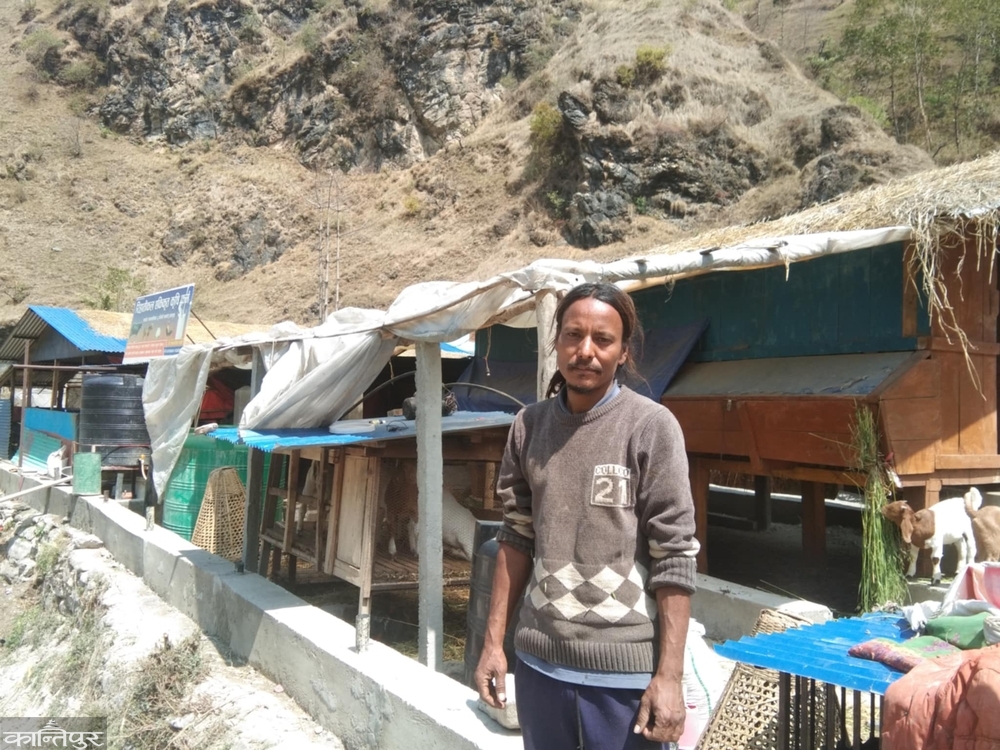 Vegetables and eggs are still being imported in Galkot. Pooja Regmi, head of city agriculture branch, said that local people should increase production. "We have set a goal to increase production by giving subsidies to farmers," she said, "fresh vegetables and eggs are still being imported from outside."
Him Bahadur Bhandari, president of Galkot-2, said that by encouraging farmers like Khatri, the initiative has been taken to make them self-sufficient in the agricultural sector. "Lal Bahadur is a hardworking farmer of the city, so we have also given subsidy on animal husbandry to make them happy in agricultural work," said Bhandari, "facilitating the sale of milk, management of stalls by the municipality for selling vegetables."
The municipality has already established a hot market a year ago for the storage and sale of farmers' produce. Apart from that, he said that the storage is being managed according to the needs.
According to Chintamani Sharma, Head of Animal Health Branch, there is a daily requirement of 113 thousand liters of milk in Galkot, but now only 91 thousand liters are being produced. He said that since 24,000 liters have to be imported, there is no option to encourage the farmers more. In Galkot, there is a daily shortage of 1,000 eggs and they have to fetch them from outside.
Since meat has to be imported up to 2 lakh kgs annually, Sharma informed that a program has been made to encourage farmers in raising Khasibo. In Galkot, only 480,000 kg of the annual requirement of 600,000 kg of meat has been produced. He says that since Madhyapahari is on the edge of the highway, incentive programs have been added to the farmers so that they can increase the production and send it out.

