We use Google Cloud Translation Services. Google requires we provide the following disclaimer relating to use of this service:
This service may contain translations powered by Google. Google disclaims all warranties related to the translations, expressed or implied, including any warranties of accuracy, reliability, and any implied warranties of merchantability, fitness for a particular purpose, and noninfringement.
Famous singer Tilak Bam Malla sang in the year 2055 - 'Snow water of Modi ko asla...' In this same Modi river, where he sang, even fish do not flow today. Due to his song, the fish of Modi River became famous at that time.
Singer Malla remembered, "On our way from Pokhara to Baglung, we stopped at Ambot, Veerethanti, Nayapul to eat fish in Modikhola. There used to be a crowd of people coming from outside to eat Modi's fish.' Why did the Modikhola, which used to flow even during the dry season until a few years ago, dried up?
is the answer, hydropower .
Only in Modikhola, there are four projects under the Nepal Electricity Authority, 14.8 MW Modikhola Hydropower Center, 15.8 MW Madhyamodi Hydropower Limited and 20 MW Lower Modikhola Hydropower. Out of which three projects are in operation in Modi Rural Municipality and one in Kushma Municipality. According to Nepal's hydropower and water resources policy, there is a legal provision that the project should continuously release at least 10 percent natural flow into the river. But its practical implementation is not visible.
Modi Khola Hydropower Center is the first project operated in Modi Khola in 2057. Its water dam reservoir is located at Betheni while the power plant is located at Patichour . Madhyamodi Hydro's water dam reservoir is at Veerethanti and power plant at Betheni . Similarly, the dam reservoir of the Lower Modikhola hydropower project is located at Patichour and the power plant is located at the paradi of Kushma.
The dam reservoir of the 10 megawatt lower Modikhola hydropower project located at Chuwa in Kushma municipality is tied up in Paradi . Its hydroelectric power house has been built in Chuva's Suitebaur.
Modikhola Hydropower Center . Photo : Suman Jung Thapa 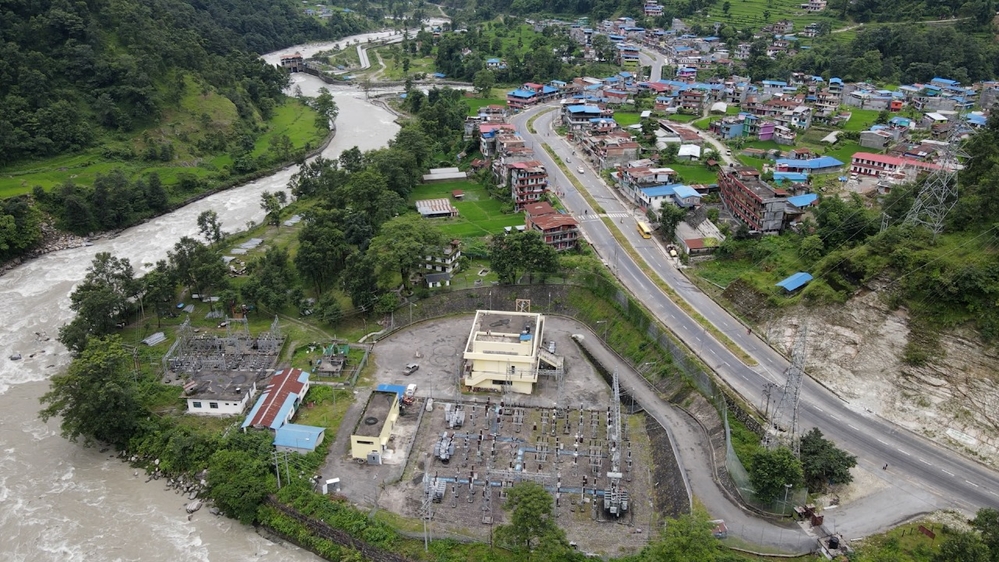
All the four hydropower houses are in a state of flux. The water released from the water dam reservoir of one hydroelectric power house gets mixed in the dam of another hydroelectric power house without being able to flow into the river. Due to this, there is a water crisis in Modikhola.
When the drought started, Modi rural municipality called the responsible staff of the hydropower house and requested them to release the water in the river as directed by the law, but it was not implemented . Pravin Pokharel, the information officer of Modi Rural Municipality, said, "There is a danger that the settlements in the coastal area will be affected if the hydroelectric house does not release water into Modikhola. We have held a meeting from the executive committee and have done correspondence and monitoring with the concerned hydro operators many times, we have asked them to release water according to the standards, but they have never failed.
He said that even though the operators came to the meeting called by the municipality, they argued that they are releasing water according to the standards. He said, 'On the other hand, the operators say that we have left the water without you seeing it.'
rural municipality received a royalty of Rs. In the same year, even if the unit fee was raised in the meters of the consumers within the municipality, the municipality itself paid the amount by assuming 30 units per month in Damasahi. Pravin Pokharel, the information officer of Modi rural municipality, said that an amount equal to 2 million was spent for that. But from this year this plan has been removed .
In the name of electricity production, the locals have demanded to stop the long-term impact on the environment. He warned not to play with nature for the interests of the company saying that ants have started walking in the river where water should flow. "Irrigated agriculture dependent on river water has been affected." There is a problem in the source of drinking water,' says Ramakant Kshatri, a farmer of Tilahar, 'The fish in this area have disappeared, the habitats of birds and wild animals have also been destroyed, who will listen to the exploitation of nature?' It is also done by calling the employees of the hydropower house and having a discussion. But not implemented . "We called last year and told them to release 10 percent of the water in any case, but we were not able to do the work that would affect the environment by drying it up," Assistant Chief District Officer Ganesh Prasad Paudel said, "Did the village council say that we could not regulate it? Should we deploy the police, what should we do ? That should be said. Now we will call the Hydro staff and discuss soon.'
Surendra Karki, center head of Modikhola Hydropower Center under Nepal Electricity Authority, said that because their power plant is old, even if the water is not released from the dam, it flows into the river through leakage. "When the water comes from our dam to the hydroelectric house, there is leakage from three or four places, so the water is not 10 percent, but it has reached Harhari," he said.

