We use Google Cloud Translation Services. Google requires we provide the following disclaimer relating to use of this service:
This service may contain translations powered by Google. Google disclaims all warranties related to the translations, expressed or implied, including any warranties of accuracy, reliability, and any implied warranties of merchantability, fitness for a particular purpose, and noninfringement.
Byas municipality ward no. 10 The cow protection center which has been operating for five years in Shishuwa Bhateri has become a gathering place for vultures. As farmers are increasingly abandoning old, diseased, and udder-drained cows, the municipality has run a cow protection center to systematically manage stray cows. But recently, vulture carcasses are found in this place.
Village Protection Center has been operated since 2076 with the initiative of the municipality after loose chaupaya started eating the crops of the farmers, causing accidents by blocking the roads, littering the roads and settlements. When the dead cows in the center began to be dug and thrown away, the number of vultures around increased.
Vultures, an endangered bird known as nature's scavengers, are gathering in large numbers around the center. Tulsiram Sapkota, the former ward president of Vyas-10, says that around 200 vultures appear in this area waiting to eat food.
He said, 'On the day a cow dies, more than 200 vultures are seen around the cowshed eating something, some in the square and some sitting in the tall trees of the forest across the river.' There is a cow protection center on the banks of the Madi River, which is about 6 km from the headquarters Damauli. The Madi River flows on the fifth side of the cowshed, and across the river is a forest with tall Simal trees. To the east of the gaushala are the poles of Midim Hydro Power's Vorletar-Damauli 33 KV transmission line.
Electricity poles in the cow protection area have become traps for vultures. Former ward chairman Sapkota says that vultures die from electrocution while resting on poles. According to him, last week a vulture was electrocuted and died. In January 2078, 3 vultures died in one day and one vulture was electrocuted.
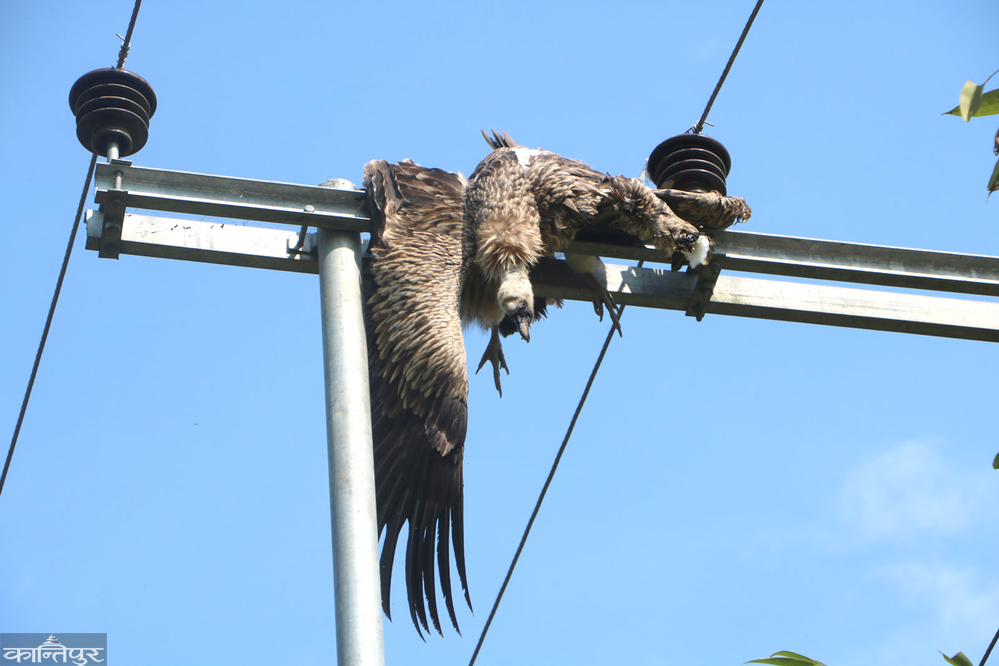 Byas Municipality-10 of Tanahun, the vulture was electrocuted in Shishuwa Bhateri. File Image : Remember/Kantipur
"The vultures are electrocuted while trying to sit on the wires and poles of the transmission lines that have been extended along the cowshed and are electrocuted while flying," he said. Local Ram Prasad Sapkota claimed that 3 vultures were electrocuted this year. He said, "Without studying the long-term effects of hydro power, expanding the high-tension line is like setting a trap for a vulnerable vulture." Even though the number of vultures coming to the cowshed for food is increasing, the number of people dying due to electrocution is also increasing.' Sapkota said that although it is sad to see vultures dying like this every day, which play an important role in making the environment free from pollution, odors and diseases, Sapkota said that he could not do anything. According to him, more than 200 vultures come to the gaushala when 2/3 old cows die in one day. However, when they are looking for a high place to rest after eating, they end up bumping into an electric pole or wire.
In this way, when a vulture tries to sit on a pole or wire, it gets electrocuted and gets injured. He said that despite the fact that the director of Midim Hydro and the electricity authority Tanahun have been writing to Tanahun several times regarding the incidents that happened on the transmission line, there has been no hearing.
Local Sapkota says that due to the silt in the Madi river near the cow conservation center along with the power transmission line, it is now becoming an obstacle to vulture conservation. He said, "Tippers and trucks make a loud noise every day from 4 am to 8 pm from the Gaushala area. There is a problem that the vultures get scared due to the noise coming out from the big saws and they do not even eat properly. is Shyamji Bhandari, the head of the project, said that under the wildlife protection and public awareness plan, a vulture resting place has been built at the cow protection center to prevent the vulture habitat from being affected.
"The project has installed five telescopic poles in the premises of the center using local resources", he said, "Each pole has an iron arm for the vulture to sit on." Due to the iron arm, the arm has been covered with wood to protect the vulture from any negative impact.
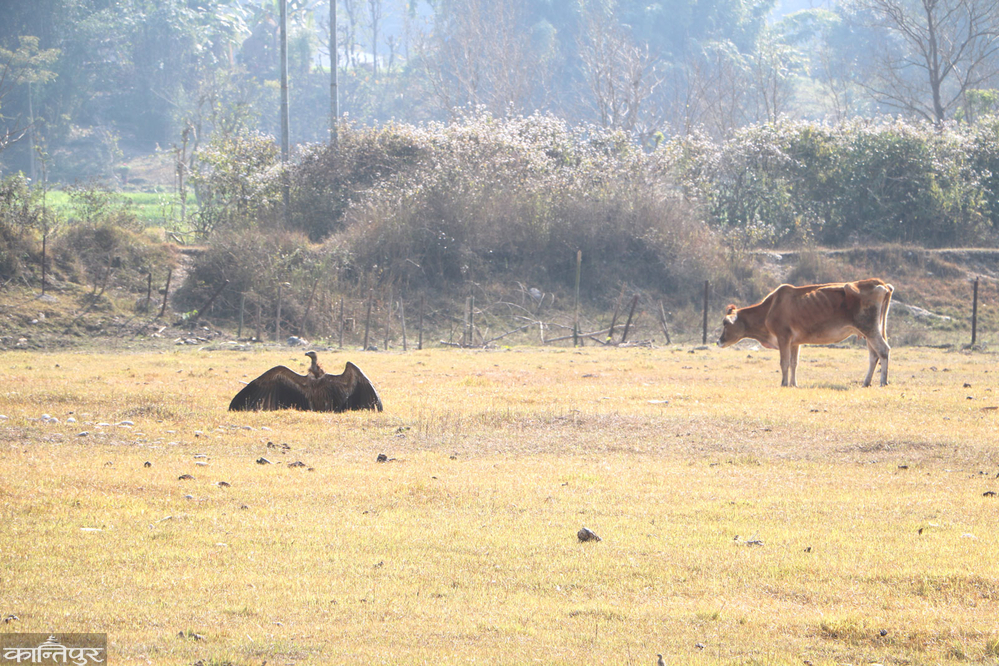
Former ward president Sapkota said that 7 species of vultures such as pure black, white, with thick hair on the neck, open neck, long ears, and Raj have appeared around the cowshed. "Unexpectedly, because of the gaushala, it has become a center for vulture conservation and vulture observation," he said, "but the problem of balancing it with management and security has begun." tell He said, 'We are trying to create a breeding environment to keep records of vultures. He said that since the vultures need tall trees to live, a letter has been sent to the Division Forest Office, Tanahun not to cut down the simal trees in the surrounding area and they have also been requested not to cut the simal trees on private land.
According to him, in 2079, about 20 simal plants were planted in this area, 8 plants have grown. Ornithologist Krishna Bhushal says that there are 9 species of vultures in Nepal. He said that 6 of these species of vultures make nests in Nepal and hatch their young, while the remaining 3 species of vultures migrate and come here. Among those who have migrated to the conservation center, the royal vulture breeds in Mongolia and Asia, while the gray vulture breeds in Europe and Central Asia. Called Batuwa Giddha, they return with the onset of summer.
Vultures were abundant in Nepal until 2045/046, said ornithologist Bhushal. Around 2050, after the vulture declined sharply, conservation work began. Vulture monitoring has been started in Nepal since 2002. In 2006, drugs that harm vultures were banned. After knowing the reason for the decline of vultures, conservation work started.
According to him, in 2008, a vulture breeding center was opened in Chitwan and breeding of vulture babies was started. Since 2009, conservation work is being done by making a vulture conservation action plan. Many efforts are being made in Nepal to protect endangered vultures. He said that Nepal's vulture conservation efforts are considered as an example in the world. The vulture, which prefers to live in tall, large simal trees, is found in dense habitats in the lowland and mid-hill forests of western Nepal.