We use Google Cloud Translation Services. Google requires we provide the following disclaimer relating to use of this service:
This service may contain translations powered by Google. Google disclaims all warranties related to the translations, expressed or implied, including any warranties of accuracy, reliability, and any implied warranties of merchantability, fitness for a particular purpose, and noninfringement.
48-year-old Ganga Bahadur Thapa does not forget to say this to those who often come with a camera at the Rahul Agricultural Farm in Goundakot, Baglung Municipality-3. "If I'm not a hero, why are so many of your cameras pointing at me?" he also asks.
Many people come not only to see the harvest, but also to learn about his hard work. Sometimes a large group of cooperatives come and sometimes a small group of farmers come to study their crops. Farmers do not have cameras in their hands, but many of them take photos of Thapa with their mobile phones.
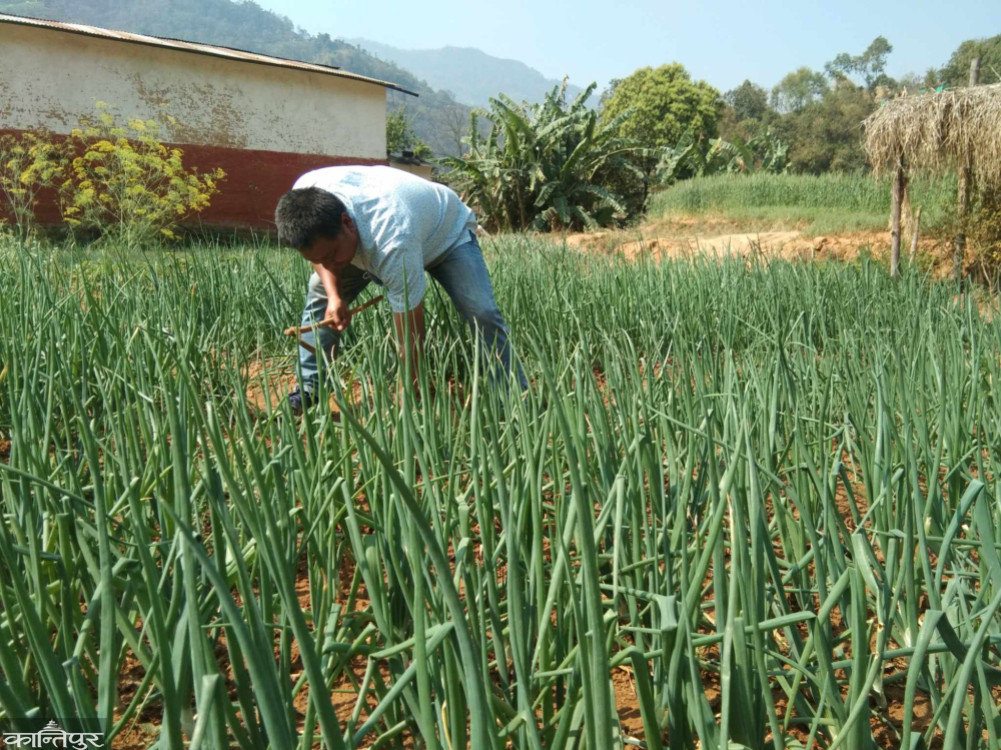
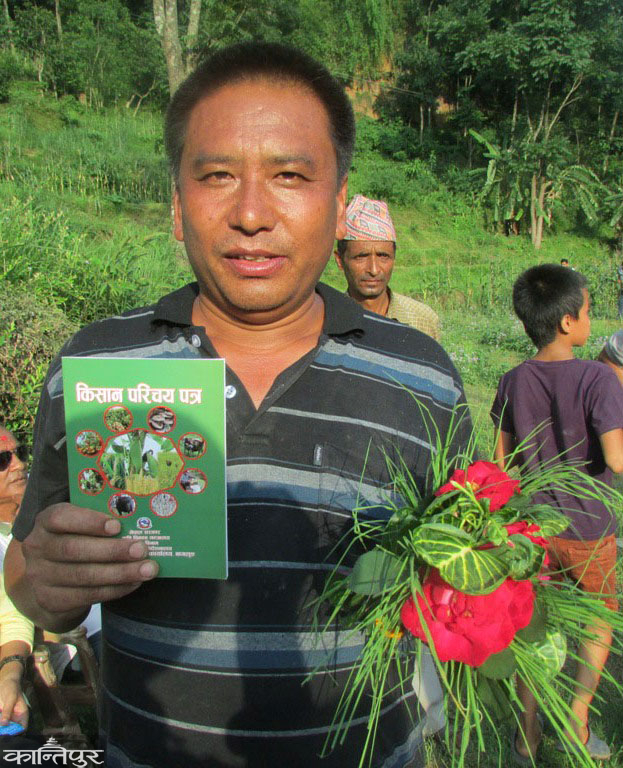
Eight years ago in 2072, the then Chief Secretary Lilamani Paudel also gave Nepal's first farmer's identity card to Thapa. Leaving the crowd of leaders who planted rice in pots and took pictures, he reached Poudel Thapa's field and plowed the field. Farmers were given time.
The Chief Secretary was not dragged by Goundakot. There, Ganga Bahadur Thapa, who was producing agricultural crops by leasing land, and the Mirmire Agricultural Cooperative Society he was involved in, caught the attention of the government. Chief Secretary Paudel did not just play in the mud when he came to the farmer's field, he plowed the field himself and encouraged the farmer. Thapa was given the first farmer's identity card prepared by the Nepal government.
Some people engaged in agriculture have left the business after taking subsidies. How many were sent abroad? But Thapa neither farmed for rewards nor planned to go to foreign lands.
Rahul Agricultural Development Firm in Baglung Municipality-3 is his main meeting place. Apart from that, he is doing agricultural work in different places individually and in partnership. He has a habit of always wearing dry clothes to work. He tries to change the society that sees farmers as nothing more than garbage. "We are going to be heroes playing with soil," said Thapa, "being a farmer does not mean you have to be dusty all the time."
Thapa, a resident of Jaimini Municipality-9, Paiyunthanhap, has been engaged in commercial agriculture since 2057. Even before that, Ganga, from the Thapa family who practiced traditional farming at home, planned to embrace commercial agriculture. After renting land for 3 years in Kushmisera Bazar, the headquarters was built.
When he was looking for land near the headquarters, he liked the Kundule area of Ward 4 very much. But there was a lack of irrigation. Then he reached Goudakot in Ward 3. In Goudakot there was only the old shed of Ramchandra Sahu of Bazar.
After the closure of the Kathekhola hydropower project built in 2036, people did not visit this place. The big moneylenders of the market only used to plant paddy during the rainy season. Goudakot fields were barren throughout the winter. It looked like Gaucharan.
Ganga Bahadur tried to rent 12 ropani land at once. The moneylenders did not believe. But after he cultivated and used the barren land, other moneylenders also tried to lease the land. In 2060, when Ganga Bahadur was 28 years old, many people laughed when they saw that he was doing commercial farming. "Initially, I paid 25,000 rent and got 10 ropani land," said Thapa, "After the production started increasing, I increased the land the next year." Neighboring youths were also invited here.
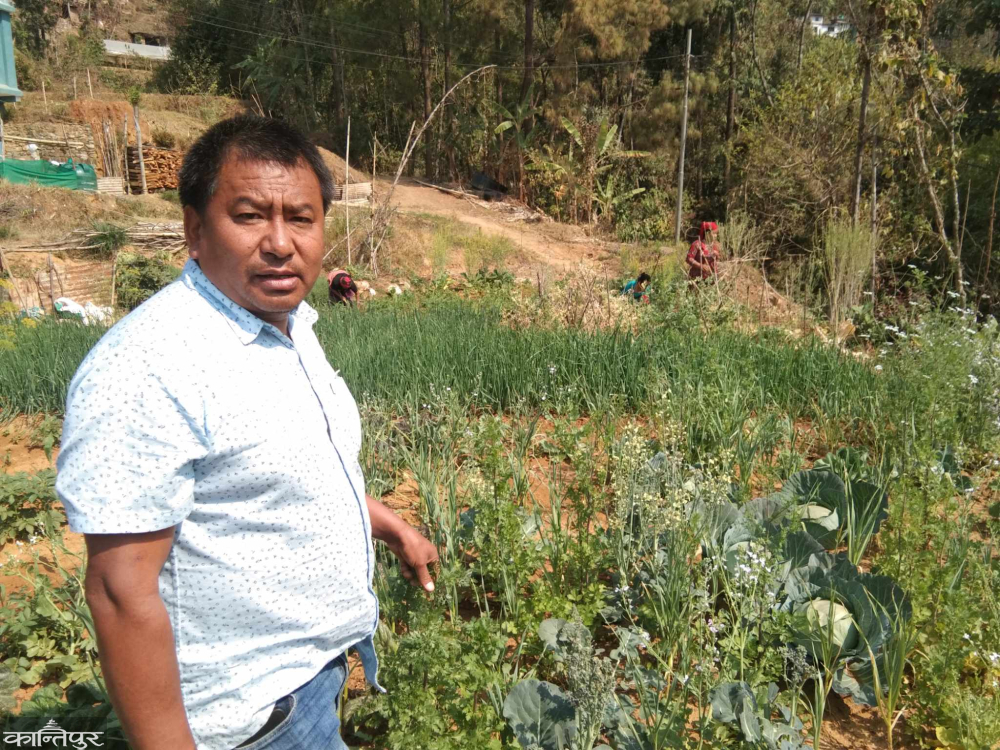
Thapa rented the land of local Bhupendra Shrestha, Teknarayan Shrestha, Indraraj Pant and others and started cultivating seasonal vegetables. Thapa's hard work turned the barren land green. Thapa succeeded in making a green revolution in plastic tunnels. As a result, it helped to reduce the import of vegetables in Baglung market.
When Thapa started doing well, the moneylenders increased the rent of the land. Thapa was not afraid. Instead, he earned money and started buying some land in his own name. Even though the price was high, he continued to farm by paying the rent. Brother Anil came down from the village to the headquarters to support the work of Ganga. After getting his brother's support, Ganga Bahadur did not have to focus only on production. He started working on the agricultural planning of the district including the entire Goudakot. Ganga's wife Lakshmi also started the work of taking agricultural crops to the market.
Due to his hard work, farmers from Goundakot spread over nearly 1,000 plantations and nearby Bukeni, Bokse, Tityang to Boludhunga have joined the production. Young people from other villages also started coming to the agricultural profession. Local Narayan Upadhyay started farming vegetables and fish on his barren land.
Chandra Bahadur Chantayal of Damek also fell here. Farmers from Dhamja, Bhakunde, Tityang and Rayadanda came here and started farming, fish farming and Rayo Saag. Started work for all types of agricultural crops.
Under the leadership of Thapa, the farmers joined the "Mirmire Krishi Sahakari". In the market, the members of the cooperative have run a store of agricultural crops. The collection center and marketing work was started through this cooperative. "At present, more than 300 farmers have joined our cooperative," he said, "most of them do commercial production, while some sell the same products." From the farmers who take them to Baglung market in the morning, the vegetables reach the shops from here. He said that some of the dry season vegetables came from Pokhara and Tarai. But at other times, the market is occupied by the vegetables of Goundakot, Tityang, Bhakunde, Rayadanda, Dhodeni and Kundule around the market. Large poultry farms have opened in Ratmata and Goudakot. There is no need to import eggs and meat. Kathekhola, Kundule and Balewa milk occupy most of the market.
The municipality has also taken a policy to make it self-sufficient in vegetables, milk, eggs and lamb. To fulfill this policy, the municipality has a program to support farmers in marketing, advanced seeds and fertilizers. Basant Kumar Shrestha said. Agricultural Knowledge Center has started conducting training on mushroom and green vegetable cultivation in Goundakot.
Ganga Bahadur's parents thought that Ganga Bahadur would have been recruited into the army because of his sudden death. But Thapa did not like the job. After studying up to IA, Thapa also dropped out. Instead, after continuing in the agricultural profession, he passed the CITIVITY Technical Matriculation Examination. Farmers who have cultivated land on rent have also named Goudakot as 'New Agricultural Cooperative Village'.
The success of members of his cooperative including Thapa has attracted the attention of cooperatives, leading farmers, agricultural development office, and media workers across the country. Visitors come to Goudakot to see. Thapa said, "Even if you play on clay after hard work, you can become a hero. Now even journalists come to interview me every day."
Now, Thapa is making plans for the development of the agricultural sector. Local levels, knowledge centers and non-governmental organizations call him as an expert from time to time for advice. The Siwaisi Savings and Credit Cooperative has set a goal of creating 10 environment-friendly model agricultural villages within the district.
also has Thapa as an expert member. "We also supported Thapa in making him an agricultural technician, even now we have asked him for time as an expert," said Chandi Prasad Sharma, president of the cooperative, "Another name for hard work is Ganga Bahadur."
There are many other farmers working in Goundakot. Thapa said, "It is not beneficial to do seasonal farming only. "Even while producing agricultural crops, we should choose ways to earn more profit." To earn profit, they have not used chemical fertilizers here. According to Thapa's data, there are 92 farmers who work by making hi-tech plastic products. There are more than 300 people who regularly grow vegetables and take them to the market. 90 percent of them are from villages.
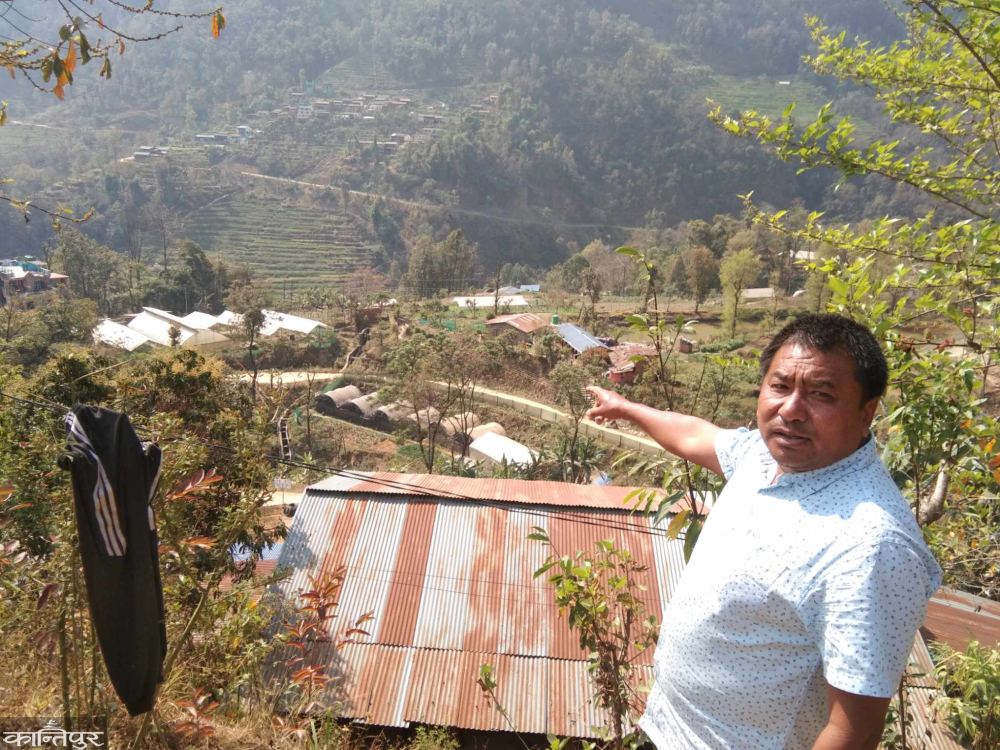
Under the leadership of Thapa, kiwi has been cultivated on 100 plants of land in Bhakimli of Beni Municipality 3 of Myagdi. Apart from that, Laksh Thapa told about the goal of using 1,000 plantations of land to grow fruit. There are 19 farmers in this campaign. Tarasingh Pun of Myagdi, Gumansingh Bhandari of Galkot and others have also joined the group.
They are farmers growing vegetables in plastic tunnels like Thapa before. By keeping 4 workers in Bhakimli, they are also preparing kiwi, vegetables and other fruits. We have made a big plan to put the consignment on the truck and send it to the market, and it has been successful. Let's do it' Thapa said, 'So far more than 3 crores have been invested.' He said that Thapa alone has invested nearly 1 crores in this campaign.
He told the plan to develop agriculture tourism not only for income. After seeing their big plan, some private banks have also tried to invest. But they have tried to work with the investment of farmers and entrepreneurs as much as possible. He is suffering from not being able to grow vegetables on time without getting a loan of 25,000.
"I made agriculture a business from the 30,000 that my father gave me after he failed me," says Thapa, "Now I have my own income, I will show it to the state by producing it." He said that he worked to show the young generation that there is a future in agriculture. He explained the goal of creating 'agro tourism' for those who come to see the fields and labor of farmers.
'Now even those who come to see the farmers' fields run hotels in Baglung,' says Thapa, 'This is not an imagination, it is a demonstration.'
Krishi Gyan Kendra conducts mushroom production training from time to time to Thapa's firm. Apart from that, the center has also cooperated in the nursery operation of fresh vegetable production. "Rather than teaching him, we only give information about technology in his nursery," said Rajendra Silwal, head of the knowledge center, "We have used Thapa's hard work and nursery to encourage new farmers." . Thapa has arranged time to teach technology to some village farmers.