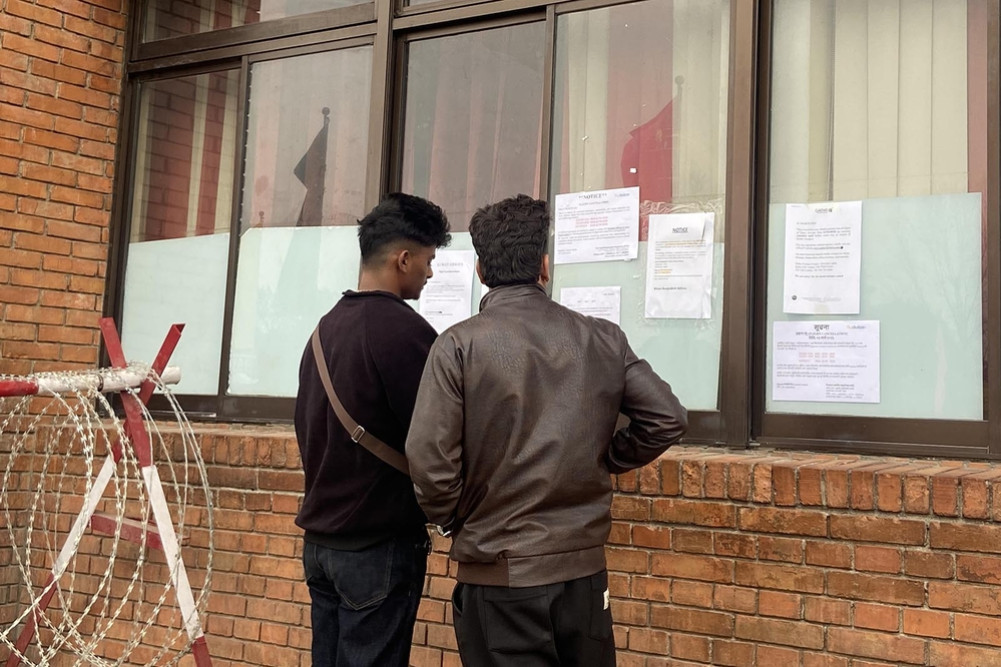
Tamang, who has been working in Romania, is about to return home after a two-month leave. He has been rushing to the airport for four days after his flight was canceled due to the effects of the war.
We use Google Cloud Translation Services. Google requires we provide the following disclaimer relating to use of this service:
This service may contain translations powered by Google. Google disclaims all warranties related to the translations, expressed or implied, including any warranties of accuracy, reliability, and any implied warranties of merchantability, fitness for a particular purpose, and noninfringement.
The country is on the verge of elections. More and more people are returning home from Kathmandu with enthusiasm to vote, but Santosh Tamang from Itahari has been circling the Tribhuvan International Airport for four days with his passport and air ticket in hand. He reaches the airport every day, but returns disappointed when he receives the news that his flight has been canceled.
Tamang, who has been working in Romania, is about to return there after completing a two-month home leave. He has been running to the airport for four days after his flight was canceled due to the effects of the war.
'As the flight is uncertain, there is no way to return home. We have to check the flight status every 24 hours. In such a situation, we can neither go home to vote, nor fly. I am in a lot of trouble,' he complained.
Pradeep Rawal from Tikapur, Kailali, has a similar fate. His mother and grandmother had come to the airport four days ago to bid him farewell. 'When my son was saying goodbye abroad, my mother cried, I am here,' he said. 'He says he will return home, he wants to vote, but he is also afraid of missing the flight.'
Rawal, despite his desire to exercise his natural right to elect the country's representative, has been stuck in Kathmandu due to circumstances. 'First I voted abroad, now I don't have the opportunity to vote when I am at home. I am very sad.'
Not only Tamang and Rawal, many Nepalis going to the Gulf countries in the Middle East have been affected after the conflict between the US, Israel and Iran. Nepalis abroad are stressed about how they will be safe, while those preparing to go abroad from Nepal are worried about whether or not there will be flights.
Kul Bahadur Bishwakarma of Bhojpur was supposed to reach Dubai on Monday, but it is not yet clear when he will reach there. On the one hand, he has not been able to reach his workplace, and on the other hand, he is stressed out even though he is in the country and cannot vote. 'I wanted to vote, but it takes two days to get home. I am saddened after everyone went to their respective homes to vote,' he said.
Bhuwan Kumar Gurung, president of the Nepal Foreign Employment Association, said that some flights have been canceled indefinitely due to the war and there is no possibility of them opening immediately, so he urges them to return home. 'The flight will not be immediate, they will return home after a while,' he said. 'However, you should keep in touch with your company.'
According to the information of the Civil Aviation Authority of Nepal, airports in the Middle East region of Qatar, UAE, Kuwait, Iran, Iraq, Israel, Jordan, Lebanon, Bahrain have been closed. According to the data of the Nepal government, the number of workers going to work in the Gulf countries is 1.9 million, of which 357,913 are in Qatar. There are 25,000 in Oman, 6,500 in Israel, 6 in Iran, and 175,000 Nepalis in Kuwait.
Similarly, there are 28,000 in Bahrain, 384,865 in Saudi Arabia, 700,000 in the United Arab Emirates, 1,500 in Lebanon, 30,000 in Iraq, and 17,000 in Cyprus.