Although numerically insignificant in the past, the participation of women in the Foreign Service has been increasing significantly in recent years. According to data from the Nepal Public Service Commission, 27 out of 67 officers have been recommended for this year's officer ranks.
We use Google Cloud Translation Services. Google requires we provide the following disclaimer relating to use of this service:
This service may contain translations powered by Google. Google disclaims all warranties related to the translations, expressed or implied, including any warranties of accuracy, reliability, and any implied warranties of merchantability, fitness for a particular purpose, and noninfringement.
Asmita Sedhai from Lalitpur completed her Chartered Accountancy studies from the Institute of Chartered Accountants of India in India. After her studies, she worked in a private company in India. A CA job is considered attractive in terms of income and opportunities. But after returning to Nepal, her interest turned to government service. This field was not new to her as her parents and relatives were also in government service.
She started preparing for government service after remembering the hardships of private companies. Initially, she was preparing to become a revenue officer. While taking an online class, an advertisement for a foreign officer caught her attention. When the exam schedule was a little further away, she got more time to prepare. ‘I came here after seeing the hardships of private company jobs up close, and government service seemed safe and easy,’ she says.
Although a government job may not seem like a lot of money from the outside, Asmita understands that this field has long-term career potential. Asmita completed her studies while raising a five-year-old child. English and general knowledge were her strong points during her preparation for the public service.
She says this helped her make a name for herself in a short time. She said that although it was difficult to understand foreign languages and vocabulary, she now finds the job enjoyable. She said, ‘Banking could also have been an option, but the child’s future, social prestige, and career security drew her towards this service.’ She was appointed as a foreign officer on 23 December.
Currently working in the Ministry's Europe Division, Asmita is responsible for coordinating various issues related to Nepalis in the UK, from meeting the ambassador, to arranging appointments. Understanding that the Foreign Service is actually a mediator, she says, 'Foreign service is an important medium to play the role of mediator between two countries.' She understands that her current job makes it easy to travel to different countries of the world, see new things, and gain international 'exposure'.
Pradishi Koirala joined a preparatory class for government service after completing her BLLB. Her field of interest was foreign service. She was recommended as a foreign officer on her first attempt. Being a law student, she wanted to understand international law and foreign relations closely. She said, 'This service seemed suitable for me because it allows me to understand both international law and foreign relations simultaneously.'
Entering the government service was also her family's dream. She says that the Foreign Service was her choice in Nepal, as her father was in the civil service, with the aim of making a career in this field. According to Pradishi, regular and disciplined studies are the reason for success. She did not attend any institute, she studied at home.
She easily passed the first paper as she was good in general knowledge and English. Since the fourth paper was a special subject of the Foreign Service, she focused on international relations and English. She continued her studies by making a schedule. She says that the moment she was appointed as an officer was an unforgettable moment in her life.
She is currently working in ‘Cultural Diplomacy’ under the Public Diplomacy of the Ministry of Foreign Affairs. ‘I have got the opportunity to introduce Nepal to the world,’ she said, ‘After coming to the ministry, the Foreign Service is very different and busy from what it looks like from the outside.’ She feels proud to see the increasing participation of women in this service. The feeling of working for Nepal while staying in Nepal is becoming a matter of great satisfaction for her.
Durapada Sapkota, who was promoted to Joint Secretary last year, is also the first female Director General of the Consular Department. The Consular Department is a department directly related to the problems of Nepalis who have gone abroad for employment, document verification, rescue and service delivery. She says that this department is challenging because the pressure of service recipients is high. ‘People come to this department when they have problems abroad,’ she said, explaining her responsibilities. ‘I have prioritized the token system to make the service easier and coordinated with the local level for reform work.’
The different geography and situation were a big challenge for Durpada, who has worked as a Political Counselor at the Delhi Embassy, First Secretary in Malaysia and Acting Ambassador to Australia. She considers the Malaysia experience as a life-changing experience. She felt the pain and struggle of Nepalis who have gone abroad for employment there up close. She was the only female employee at the Malaysian Embassy.
‘Once, when I saw Nepalis sleeping under a bridge, I was able to understand the reality of life more deeply. Malaysia has taught me to observe happiness and sorrow closely,’ she said. Her experience in Australia was different. Where the number of Nepalis is large. But she kept wondering whether Nepal could not take advantage of the opportunity from Australia.
She had the opportunity to understand the relationship between the two countries for about 10 months in Delhi, but when she took on the responsibility, she found it difficult to manage her family. She said, “You have to blend in with a different culture and society, which is both an opportunity and a struggle. You have to face difficult situations like being away from your family and having to prove your ability because you are a woman.”
Durpada says that social prestige and career are the reasons for the increasing attraction towards the foreign service in the latest generation. She said, ‘The main attraction of the Foreign Service is the charm and social prestige and the opportunity to travel abroad, which is why women are the main choice for this service.’ Believing that the recent increase in the number of women in the Foreign Service will bring inclusivity and new ideas, she added, ‘Women have a greater sense of responsibility, patience and passion for work,’ she said, ‘Women have the ability to overcome challenges and problems and manage them easily, which sends a positive message in diplomatic relations.’
Sujana Aryal, who was recommended as Deputy Secretary this year, is also getting immersed in the Foreign Service. Having started her career as a Foreign Service Officer in 2076, she initially thought of not going abroad, but now she is going abroad to represent the country. Aryal, who is currently working as a director in the Consular Department, says that working in the Foreign Service is challenging. She served as Financial Secretary and Deputy Chief of Mission in Bahrain for two years.
This was her first experience working in an embassy abroad. ‘Since it is a Muslim country, the social perspective on women is somewhat different, so we had to hire local staff to work,’ she shares her experience. Although the presence of women seems positive, Sujana feels that there is still a compulsion to prove that we are capable by working.
According to the Public Service Commission’s data, 27 out of 67 officers have been recommended for this year. In 2075/76, the total number of women working abroad was 57 Now the number of women working abroad has reached 100. Of which, 5 are joint secretaries, 23 are deputy secretaries, 45 are branch officers and 27 are deputy sub-district officers. According to the Ministry of Foreign Affairs’ data, 253 male employees are working. 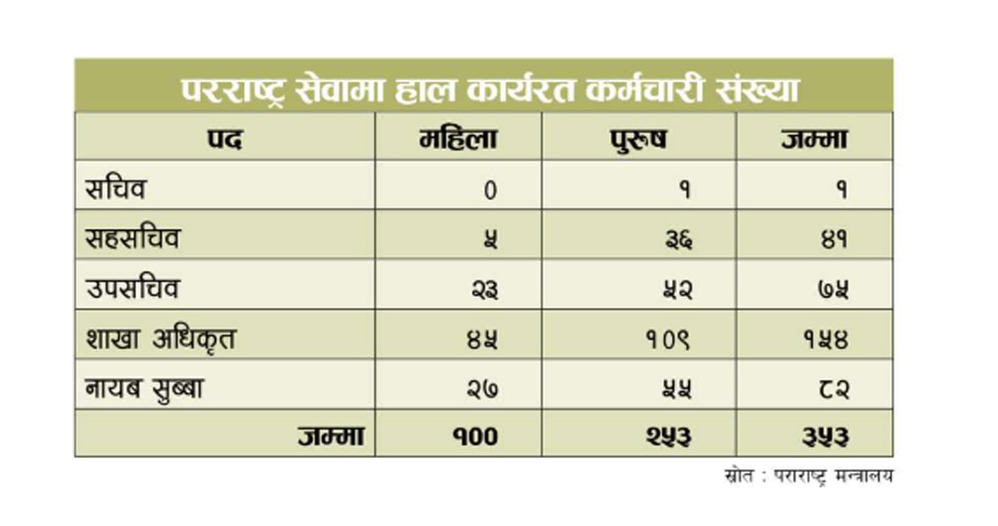
Political analyst Indra Adhikari says that the increasing participation of women in the foreign service is a positive aspect. Although there are currently few women in the post of ambassador, Indra says that they are performing effectively. ‘The foreign service includes responsibilities such as passport and consular services that directly relate to service recipients. Many women start their service from this area.
The softness, humility and sensitivity seen in women while handling service recipients seem to have a positive impact,' Indra said, 'That is why women's service delivery and diplomatic service delivery have been evaluated positively.' Looking at the effectiveness of their work, she said that women are working hard with determination to establish their identity in any way they can.
Although the foreign foreign service is challenging, Indra believes that women have a deep passion for work because they have entered this field with the purpose of serving, clear dreams and high motivation. 'The gentle nature of women, sympathy and ability to understand the suffering of others have also sent a positive message from service delivery at work to women's work performance in the diplomatic field,' she said.
Former Foreign Secretary and Chief Secretary Shankar Das Bairagi said that although the participation of women in the foreign service was numerically low in the past, it has increased significantly in recent years. He says that the presence of disciplined, responsible and loyal women in the foreign service is notable. According to Chief Secretary Bairagi, women are commendable in every field as they are thoughtful, diligent and dutiful.
‘Women have been seen as more effective in the foreign service, especially on sensitive issues such as women, children and human rights,’ he added, ‘Women are clearly presenting their skills according to the social environment and structure.’
Claiming that they are also demonstrating their skills efficiently in the international arena, Bairagi adds, ‘If we move forward at this pace, women leaders will reach high levels within the next 10-12 years, which will also send a positive message in diplomatic relations.’ Bairagi says that the message has been received that women’s work is being appreciated in various dimensions, including diplomatic trilateral relations and regional cooperation.

