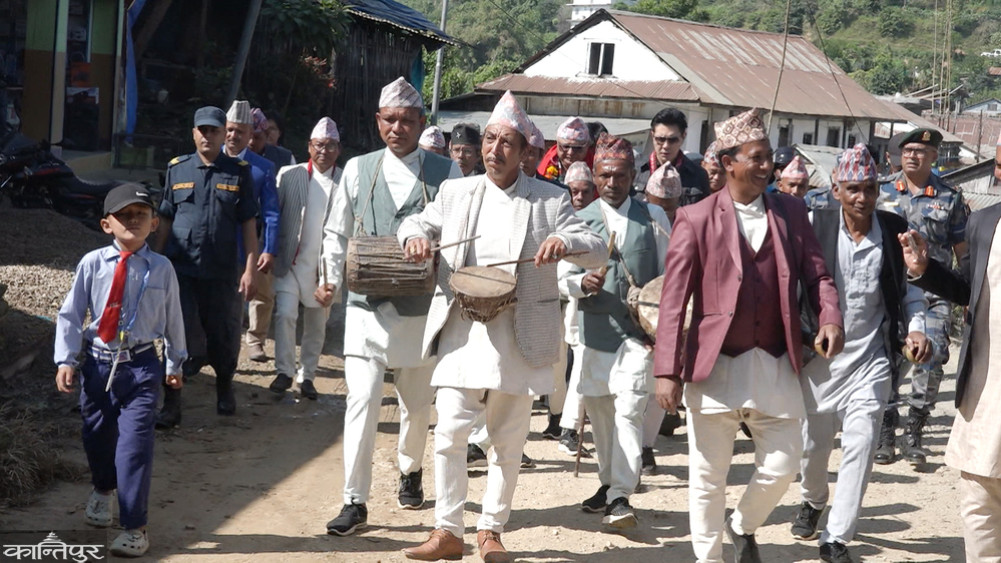
The sound of the Panchebaza, which resonates at weddings, engagements, bethis and festivals, is becoming rare these days. This tradition has been sustained by the old, as the new generation has not been attracted.
We use Google Cloud Translation Services. Google requires we provide the following disclaimer relating to use of this service:
This service may contain translations powered by Google. Google disclaims all warranties related to the translations, expressed or implied, including any warranties of accuracy, reliability, and any implied warranties of merchantability, fitness for a particular purpose, and noninfringement.
At the forefront of the Lashkarai group is the panchebazaar group. The leader of the group is Lakh Bahadur Pariyar, who is over 75 years old.
Gyan Bahadur Pariyar, who is of the same age group as him, and his friends, Sahanai and Narasimha, are playing the panchebaja.
The atmosphere is filled with music with the sounds of cymbals, dholak, tamko and damaha. Following the group of musicians are foreign volunteers, the Chief Minister, the District Security Chief, dignitaries, parents and students who have come to inaugurate the new school building in the village.
In Aankhisalla village of Dhankuta Sahidbhumi Rural Municipality, the locals welcomed the foreign volunteers who had come to inaugurate the school building a few days ago, including the Chief Minister of Koshi Province, Hikmat Kumar Karki, by playing the panchebaja.
The sound of the panchebaja, which is heard at weddings, weddings, bethis and festivals, is becoming rare these days. The tradition of playing the panchebaja in the village has been retained by the elderly due to the lack of attraction of the new generation. ‘Our grandchildren didn’t learn, we are old,’ Lakh Bahadur Pariyar said, stopping Sahanai, who was playing the instrument with force, when asked about the traditional skill of playing the panchebaja, ‘It’s time to take charge, but no one is ready.’
He said that the new generation has not shown interest in adopting this profession. ‘It’s not enough to eat by playing, it’s not enough to run a house, it’s not enough to cultivate the fields, how can we even adopt it?’ he said.
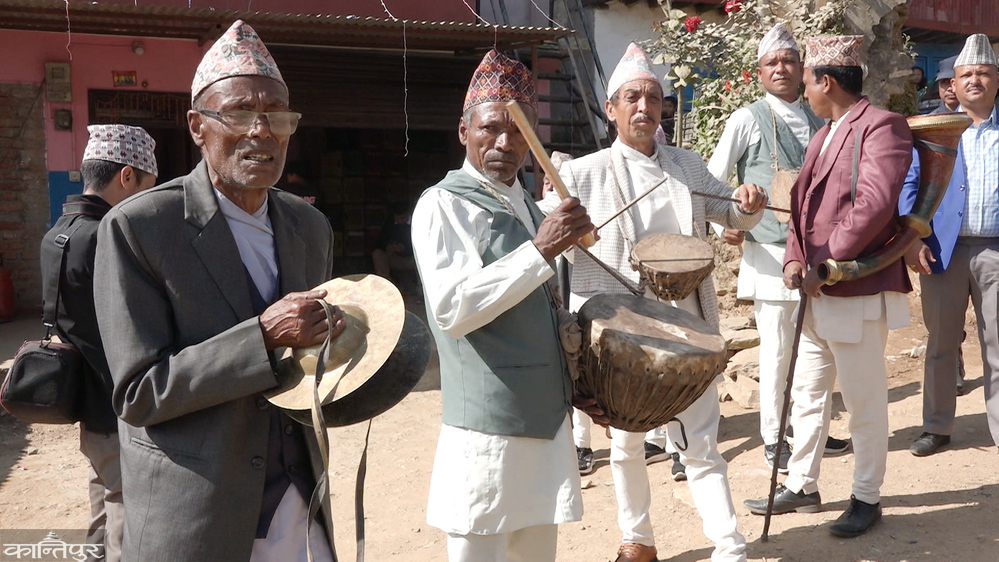
He said that the new generation has not shown interest in the profession of their ancestors after seeing that they cannot make a living by playing the instrument.
Panchebaja, which is a combination of instruments such as Sahanai, Narasimha, Jhyali, Dholak, Tamko and Damaha, is not only considered a music and profession, but also a symbol of auspiciousness and traditional unity.
Panchebaja is usually played at weddings, wedding ceremonies, pujas, festivals and celebrations. But now this tune is rarely heard in the villages, says Manoj Rai, the chairman of Sahidbhumi Rural Municipality. He said that the rural municipality is providing instruments and costumes to preserve the tradition of Panchebaja.
The Mangaldhun played at weddings signifies the beginning of a new life, the Devdhun played at festivals and festivals fills the participants with energy and enthusiasm, says Gyan Bahadur Pariyar, a member of the instrument playing group. He says, ‘The tune of Panchebaja drives away evil forces and brings family happiness.’
Due to the changes taking place in the social and cultural structure and the influence of modern music, the custom of playing Panchebaja in socio-religious celebrations is fading. The number of people who search for Panchebaja and know how to play is also becoming limited. According to Gyan Bahadur, there used to be a majority of people in his community who knew how to play the instrument. He says, ‘Now the older generation is dying, even those who are alive will not be able to play the instrument.’
Dhan Bahadur Pariyar, a young man from Ankhisalla, says that the older generation alone is not in a position to carry on this tradition. Dhan Bahadur says, ‘This work comes only occasionally, the family does not run by doing this, there is interest but the stove does not light at home.’
Dhan Bahadur said that after seeing that the income of the panchebaja player could not support his livelihood, the younger generation was not able to dedicate themselves to this profession. ‘The panchebaja player is our history and original identity,’ says Dhan Bahadur, ‘Only with the joint efforts of the state, community and the younger generation can the tunes of the panchebaja player resonate again in the villages and cities and in the minds of the people.’