What to compare the life of a soldier who did not get the rank of VCI? Can war, bravery and bravery judge the dreams that have disappeared?
We use Google Cloud Translation Services. Google requires we provide the following disclaimer relating to use of this service:
This service may contain translations powered by Google. Google disclaims all warranties related to the translations, expressed or implied, including any warranties of accuracy, reliability, and any implied warranties of merchantability, fitness for a particular purpose, and noninfringement.
Nepali bravery is discussed as much in the Nepali Nationalist Jamaat as it is among foreigners who know a lot about Nepal. The difference is that heroism is discussed around the Sugauli Treaty among Nepali nationalists, while Gurkhas (Gorkhali Nepalis who joined the British army) are discussed more outside Nepal.
Gurkhas (hereafter Gurkhas) have been discussed in many dimensions, but their bravery is mostly discussed through the Victoria Cross (VC), the highest military medal of the British Army. So far, 13 Nepalis (including one from Sikkim) have obtained VC . The more they are discussed outside Nepal and in the Gorkha community, the less these 13 people are discussed within Nepal.
The limitations of both these discussions and the colonial power hidden in them and the story of the struggle with it are happening in one place . But in this article, rather than the theoretical conflict of colonization or heroism, I will discuss an anonymous Gurkha in the middle of the conflict.
While searching for old photos and documents on the British National Army Museum website during my studies, I found this photo above in 2020. The caption of the photo was written in English, the Nepali translation of which was roughly as follows- 'Photo, India, 1945 . A Gurkha Victoria Cross (VC) winner showing his rank to his relatives and the family of other Indian Army VC winners on 19 December 1945.'
During my feminist analysis of Gorkha military recruitment and migration, I came across many such documents and photographs that allowed me to learn about the emotional stories, sorrows and pains hidden beneath the layers of Gorkha bravery. I am drawn to this photograph as I am studying the stories and experiences of the British and Indian Gurkha forces, mainly the female members of their families.
In this photo, there are at least 10 people looking at a VC form . The emotion on the faces of the two bejeweled women with Takma Bok's VC also made me curious about the story behind this photo . Every time I look at this photo, I feel like pride, fear, and sadness are mixed in that woman's face . However, how could they understand exactly what was in their hearts!
As the name of the Gurkha soldier bearing the rank of VCI was not written in the caption of the photo and his face was not seen in the shadow of the photo, it became even more shocking .
In many wars, including the First and Second World Wars, Nepali lost a large number of lives like other Indian and colonial forces. In this way, millions of people died and some of them were decorated by the British Army with Victoria Cross and Military Cross. Even two years after I found the
photo, I still couldn't get the exact answer.
At some point I posted a photo on Twitter to see if anyone knew anything about the photo and asked the Gurkha Museum in Winchester, UK for help in identifying the photo. Needless to say, Brad Hall and Doug Henderson, who worked very hard at the museum, identified the photo and sent me a detailed description.
The following paragraphs are about their findings on how they identified the VC in the photo.
Since the photo is from the year 1945, it has been assumed that it belongs to a Gurkha who received a V.C. in the Second World War. A total of 10 Nepalis received VC in World War II: Lakshiman Gurung, Bhanbhagat Gurung, Thaman Gurung, Sher Bahadur Thapa, Agansingh Rai, Netra Bahadur Thapa, Tul Bahadur Pun, Ganju Lama (Gyamtso Sangdarpa), Gaje Ghale and Lal Bahadur Thapa .
Since Thaman Gurung, Sher Bahadur Thapa and Netra Bahadur Thapa were killed in the battle, it was assumed that they were carrying this VC . Similarly, since Lakshmiman Gurung lost his right hand due to a grenade explosion during the war and (as there are two hands in the photo) it is certain that he is not the person in the photo . Remaining 6 VCs: Bhanbhagat Gurung, Agan Singh Rai, Tul Bahadur Pun, Ganju Lama, Gaje Ghale and Lal Bahadur Thapa .
Again, the two black ends of Lahure's cap bearing the VC were cut off by Brad Hall and Doug Henderson of the Lakh Gurkha Museum that he belonged to the 5 Gurkhas (5th Gurkha Rifles). Out of the remaining 6 VC Gorkhas only Agansingh Rai and Gaje Ghale were 5 Gorkhas .
But since these two VCs were given the title before December 19, 1945, Brad and Doug cut off the lakhs that they could not be. If the caption of the photo is to be believed correctly, this title was given on December 19, 1945 . Also, since Agansingh Rai's family had reached India (currently Pakistan) at the time of VSI taping, it was assumed that the Gorkha Agansingh Rai might not be the Gorkha holding the VSI in the photo, even though their photo is different from that of the Nepalese seen here.
Now again, signs were found around Gaje Ghale, but since he got the VCI rank on January 23, 1945, either the date given in the caption of the photo must have been wrong or it was speculated that this is not Gaje Ghale's photo.
Now there is a big problem . It was hard to say directly that the caption was wrong because Brad and Doug knew that it was somehow taken from a certified archive. They were very confused .
What I found out while searching for the photo was that Rifleman Thaman Gurung was posthumously given the exact date of 19th December 1945 . But since Gurung has died, he took the title. Caption It turned out to be wrong again. I did not have access to photos of Thaman Gurung's family who went to India to get the VC title.
On the other hand, Brad and Doug, according to the date of the photo, went to the archive to find out whether the person holding the photo is Thaman Gurung's family but someone else. They found this other photograph of the Thaman Gurung family in the archives dated 19 December 1945, which was not put on the internet until now.
In the first photo, the person with a slightly scared face looks different and happy in this photo.
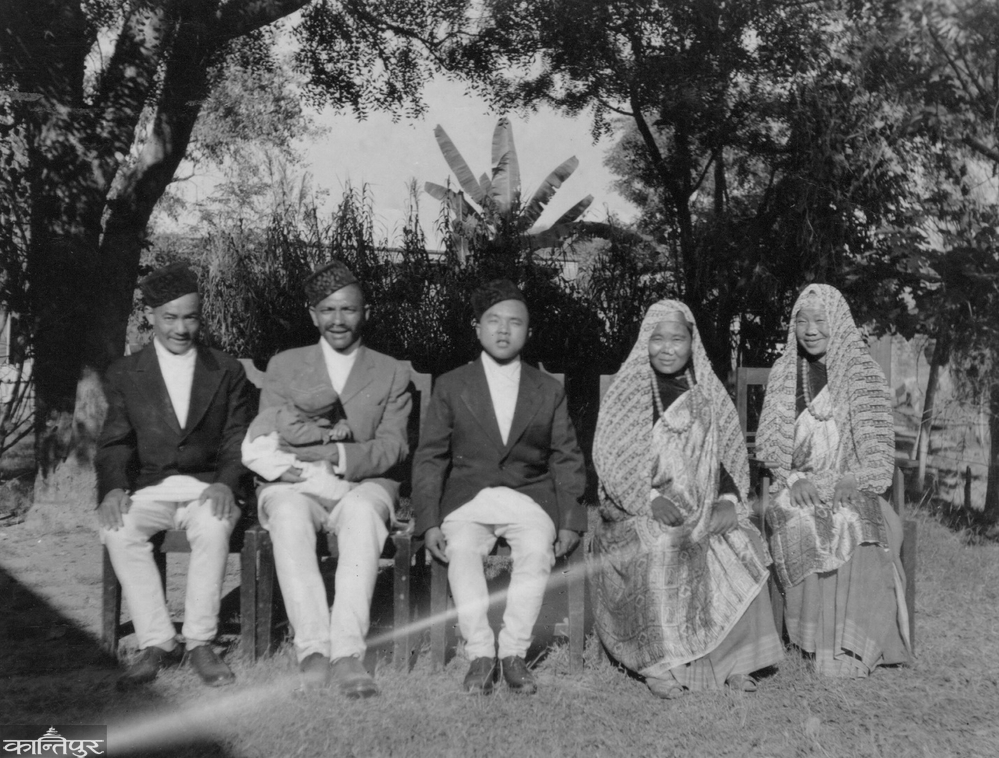
The three people on the right side of this second photo were also seen in the first photo, so Brad and Doug were convinced that both photos belonged to Thaman Gurung's family. And then Brad and Doug said that the face of Agansingh Rai and Gaje Ghale, the survivors of 5 Gurkhas (5th Gurkha Rifles) and the first photo above, is Gaje Ghale, the man who caught the VCI. The date 19 December 1945 mentioned in the caption of the
photo was also correct . As the VC winner was also Gaje Ghale, that The fact was that even though that VC title belonged to Thaman Gurung . The mistake in the caption was that the VC winner was showing his talent . Brad and Doug from the Gurkha Museum put my mind on the right track, which had been wandering for two years due to so many mistakes.
In this way, the British called the Victoria Cross the highest award given to a man who showed 'extraordinary' bravery during their war and celebrated it in their own way, but they did not seem to care much about the Gurkhas or the colonial army who received it. Thaman Gurung, who received V.C., disappeared in anonymity.
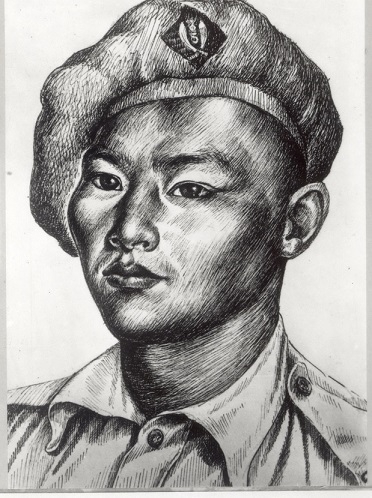
Now let's go to Thaman Gurung. Thaman Gurung of present Gandaki zone, Gorkha district, Dharche rural municipality, Singla died at the young age of 20 while fighting on behalf of the British in World War II on 10 November 1944 in Italy. His photograph was not taken until the time of his death. At that time, cameras were not as accessible as they are now. But after getting the V.C., the family found out that his brother's face would match his, and made a picture of Thaman Gurung using his brother as a model. When you search for 'Thaman Gurung' on the internet, the picture that comes up is the same picture made by looking at that brother.
There is very little information about Thaman Gurung, who achieved heroism at the young age of 20 years. Whatever can be read about him, it is only in the newspaper called 'London Gazette'. Where he fought bravely against the German army on 10 November 1944.
Who was he, how did he get recruited, did his parents allow him to be recruited before being recruited, or did he run away from home like many other young men, how did he reach Europe, what did he see in Europe apart from the war, did he gossip or fall in love with a European youth or did he end up traveling to Europe and ending the war only among the British Indian Army? These and similar questions remain unanswered.
How skilled was he to fight when he reached Europe in the war? How much did he fear death? Who did you remember when you died? He could have run away from that place to save his life ? What would be his future if he ran away? Would we know her name ? Is being famous for fighting bravely and being famous is the greatest reward for a soldier ? Why did Thaman Gurung and many other people like him fight a war that had nothing to do with them? They were allowed not to fight that war ? If they wanted, the war would have gone somewhere else ?
Because Thaman Gurung fought bravely, he got VC and his name is read and heard by people like us and me . How many Gurkhas or colonial troops were there, who died while fighting, did not get any medals, and no one remembers their names . Since they died in the war at a young age, their chances of having children became less and with the death of their old father and mother who remembered them, their stories were also mixed in the soil, turned into ashes.
Can a VC medal buy Thaman Gurung's life? What to compare the life of the soldier who did not get the title? Can war, bravery and bravery judge the nameless dreams? Remembering Thaman Gurung and other known-unknown people, I ended this article here .

