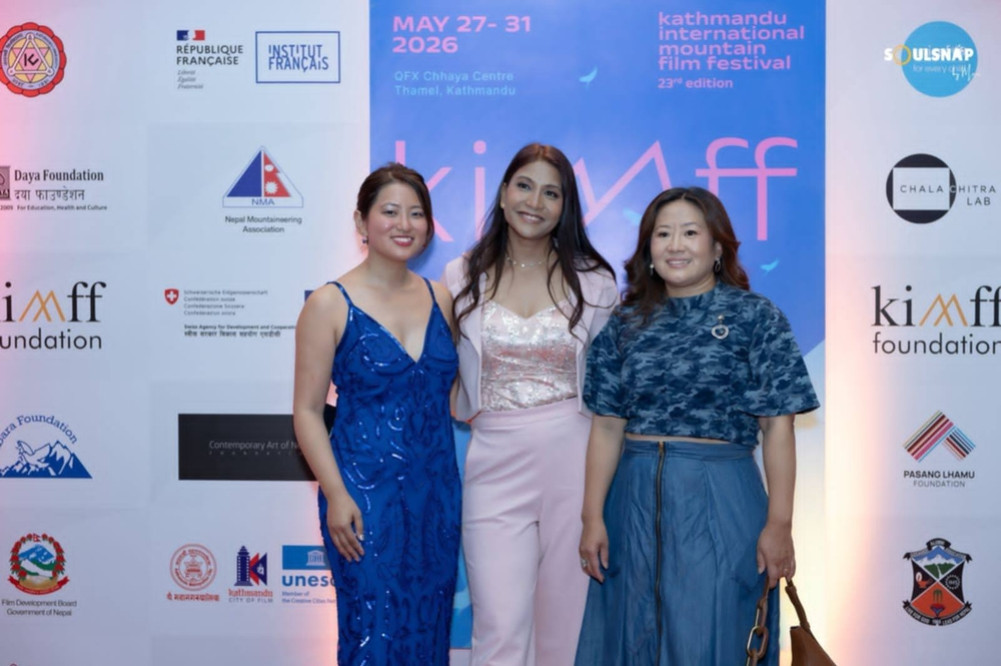
In the film 'Shape of Momo' directed by Triveni Rai, actors Gaumaya, Pashupati, and Janaki star in a story that challenges women's existence and social reality.
We use Google Cloud Translation Services. Google requires we provide the following disclaimer relating to use of this service:
This service may contain translations powered by Google. Google disclaims all warranties related to the translations, expressed or implied, including any warranties of accuracy, reliability, and any implied warranties of merchantability, fitness for a particular purpose, and noninfringement.
Do you regularly visit any momo shop? If so, one question – is the shape of the momo your first choice or the taste?
The film ‘Shape of Momo’, directed by Sikkimese Nepali director Triveni Rai, has the answer of the character Vishnu – taste. Compared to other members of the family, Vishnu never knows how to match the prescribed size of Momo. That is why his sister and mother keep expressing sarcastic intentions, ‘Is there a Momo with such an irregular shape?’ But, Vishnu’s stance says, ‘If the taste is right, it will be enough, what difference does the size make?’ The name of this film, which was shot in January 2024, was initially ‘Chhorasat’. Later, during the shooting, it became ‘House Full of Women’. During the editing, the name finally took a definite shape – ‘Shape of Momo’. Its meaning is as meaningful as the story of the film.
Vishnu never wants to mold himself into the fixed size set for women by society. The fight for survival of women in a patriarchal society is no less challenging. ‘Shape of Momo’ is a film that examines the story of a character who does not want to lose among women who have no choice but to accept the norms of society.
The main character of the film, which has participated in more than 20 festivals and won awards, is Bishnu – actress Gaumaya Gurung. So, ‘Shape of Momo’ is different and broader than the role she has played in Nepali films and the space she has received. How did she get involved in this film? Gaumaya returned to those days in a meeting with Kantipur.
Gaumaya had previously acted well in films such as ‘Kabaddi 4: The Final Match’, ‘Rajaganj’, ‘Abhimanyu: Chapter 1’, ‘Mahajatra’, ‘Phoolbari’ and others. She had a desire to work on a story woven from a woman's perspective. She had also told the film director Prateek Gurung. The same Prateek connected Gaumaya with Triveni Rai around 2023. Triveni was keen to do a new film. She seemed positive with Gaumaya. One night, Gaumaya started reading the script that Triveni had sent her, 'I was very happy when I read it. Because it was our story,' says Gaumaya. Gaumaya also watched Triveni's previous short films. 'I was also impressed by the way he used to capture the small humor (jokes) in those films,' she adds.
Gaumaya entered this project, imbibing the character of Vishnu. Gaumaya also brought along artist duo Pashupati Rai and Janaki Kathayat. However, Pashupati was initially not willing to play the role of a mother. Pashupati, who felt that similar characters were being repeated lately, did not accept Gaumaya's offer. Pashupati's acting in the film 'Gaun Vaa Bato' was also being discussed a lot at that time. Gaumaya agreed to audition after asking her repeatedly. However, she was not selected in the audition. 'I had auditioned just to keep her heart. I didn't want to work,' said Pashupati, who was sitting at the cafe of Mandala Theater in Anamnagar and recalling those days, looking at Gaumaya who was nearby. At that time, others were also offering Pashupati the role of a mother. 'After becoming an artist, it is frustrating to do the same thing all the time,' she says.
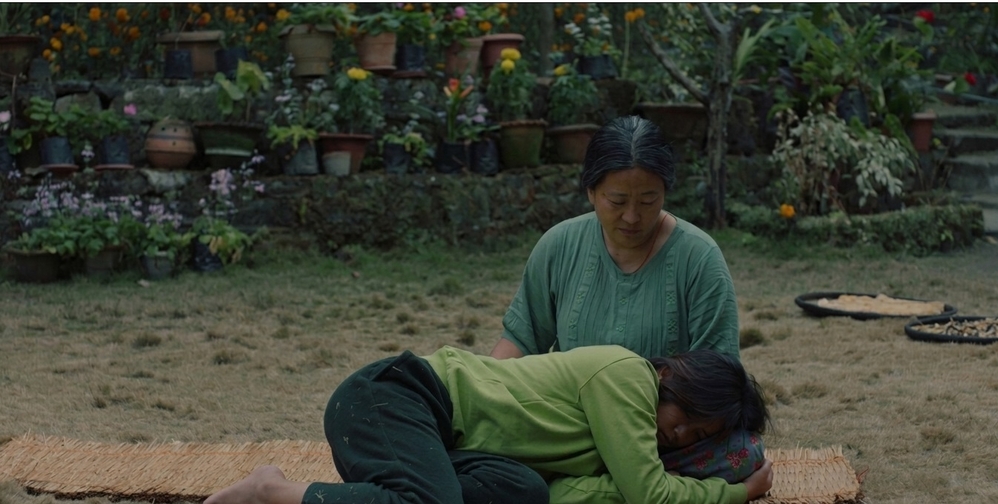
She was looking for something different. However, the audition that did not allow her to be selected did not leave her behind. In the second audition, Pashupati was given a scene. It was a scene of a fight between a mother and daughter. By the time she reached the heart of that scene, Pashupati was already enamored with the story. ‘When I read the whole story, this was not the character I was playing, but rather a different character I wanted to play,’ says Pashupati. While reading, some scenes felt so natural that she felt like she was watching a documentary in her own home. ‘The interesting things that do not often come to our cinema, but are fun at home, made me laugh a lot,’ says Pashupati.
Janaki Kathayat, who entered the project as a costume designer, had been interested in acting since the film ‘Rajaganj’. Her closeness to Gaumaya increased during the shooting of ‘Rajaganj’. Director Triveni needed a costume designer for ‘Shape of Momo’. Gaumaya recommended Janaki. Janaki went to Sikkim for this. At that time, Gaumaya told Janaki, ‘A Nepali character was needed. Please audition for this.’ Janaki, who has been interested in acting lately, accepted this offer. She accepted with enthusiasm. The character she auditioned for was Saili. Her family had come to Sikkim from the far west of Nepal. Saili’s character is meaningful in the film. Janaki followed ‘method acting’ for this character. She compared this character to her own life. The responsibility of poverty and deprivation was close to her experience. ‘On top of that, my mentor made me work hard. Having to eat sitting on the floor, begging for food on a plate, living by what my character is,' she recalls those moments.
Janaki's challenge was not only in acting, but also in costume design. How do colors tell a story? 'In the film, the transition from Vishnu's red anger to the green of nature had to be shown through the clothes,' she says. She also took on the responsibility of makeup artist. After the film was released, Janaki watched it for the first time at the opening of Kimf on June 27. The response from the audience who liked Saili's work made her more emotional and responsible. 'Some people who know me didn't even recognize that I played Saili's character,' Janaki says.
Gaumaya, on the other hand, already had Vishnu's rebellious nature. She felt it during the shooting. This story is related to the life of director Triveni. Moreover, the shooting was done at his house in Sikkim. ‘We got so close to the story that it felt like we were in the process of method acting,’ says Gaumaya.
Pashupati and Gaumaya had a challenge with the Sikkimese tone. Janaki, on the other hand, is from the Far West, so her tone was suitable for the character. ‘My tone was a bit harsh. Mentor Dinkar Sharma made me sing a ‘lullaby’. When I sat in the field at night and watched the stars and sang lullabies, a kind of softness came into my body and speech,’ she says. ‘I had observed Triveni’s mother’s walk and speech by wearing her saree and lungis.’ Gaumaya also had to work hard for the tone.
The film had a pleasant journey at various festivals. Viewers from different countries were also able to relate to this story. ‘Surprisingly, viewers in Spain came crying and said, “This is my story.” Even though the humor may vary from place to place, the mother-daughter relationship and struggle are universal,’ says Gaumaya. Later in the film, Indian film directors Zoya Akhtar, Reema Kagti and Payal Kapadia were also added as producers. This contributed to the film’s further growth.
This film gave Janaki more encouragement for her acting career. The character she initially did not want to do gave Pashupati a new height in his acting career. ‘And I got the strongest character I ever wanted to do,’ Gaumaya adds, more happily.