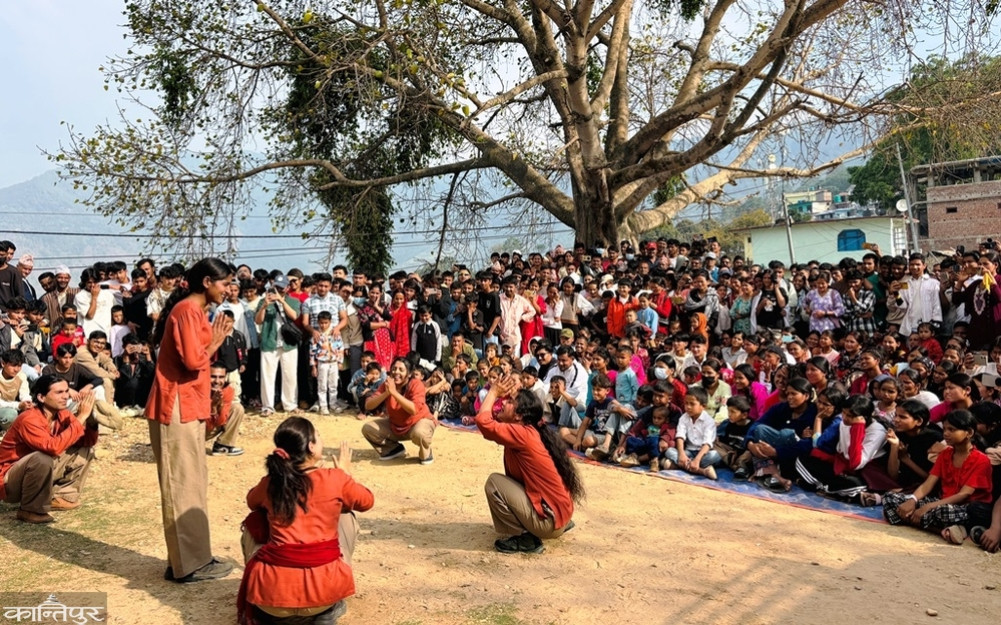
The play, staged on the open stage of Mangalsen, conveys a strong message about Chhaupadi, gender discrimination, and female entrepreneurship, highlighting the struggles of the character Parvati.
We use Google Cloud Translation Services. Google requires we provide the following disclaimer relating to use of this service:
This service may contain translations powered by Google. Google disclaims all warranties related to the translations, expressed or implied, including any warranties of accuracy, reliability, and any implied warranties of merchantability, fitness for a particular purpose, and noninfringement.
On Friday at 3:30 pm, a hot wind was blowing on the open stage in Mangalsen, the headquarters of Achham. When the team of ‘Katha Ghera’ theater started staging the street play ‘Bathi Bato’ on the stage, hundreds of eyes were fixed on it. That scene was a perfect mirror of their own home and society. The central character of the play was Parvati. A courageous woman, who starts a small tea shop in the village to improve the financial condition of her family and establish her identity. For 6 months, she brews tea without missing a day and serves customers. However, one day, there is a commotion and people start shouting that she is impure. When they find out, Parvati did not close the shop even when she was in a hut, nor did she stay in a cowshed. ‘Did anyone get hurt by drinking the tea I brewed when I was in a hut for 6 months?’ Whose misfortune has happened? Did she become a deity?’ When Parvati questioned the narrow-minded thinking of society from the stage, there was a moment of silence on the open stage. For many women, this play was not just a dialogue, it was the voice of rebellion that had been buried deep in their hearts for years.
The most powerful aspect of the play was seen when Parvati’s husband stood as a shield in this rebellion. When society tried to boycott Parvati for doing business despite being a woman and not wearing a chhaw and pressured her to close her shop, her husband stood firm. ‘My wife has worked hard and eaten, she has not stolen. Having a chhaw is a natural process, not a sin,’ said the husband character in the story.
When the husband himself challenged his wife’s point in front of society, accepting her as right, the voices of the villagers gradually began to soften. Ultimately, society was forced to give in to Parvati's arguments and her husband's support. Gradually, those who criticized Parvati became regular customers of her tea shop. This touchingly revealed how decisive it is for a woman to fight alone for social change with the support of men. The
play did not just leave Parvati as a rebel character. It also established her as a successful entrepreneur. The small tea shop she started despite the ridicule of society was shown to have turned into a big business. Parvati was not just a woman selling tea, she became an inspiring businesswoman and a guide for other women in the village. The message of the story was, 'Until women are financially strong, they cannot dare to fight for their rights.' Only when Parvati had her own earned money in her hands did she gather the courage to challenge the ugly rules of society.
Sitting in a corner of the crowd watching the play, 50-year-old Mansara Damai's eyes watered repeatedly. She works as an assistant in a government office. The scorn and humiliation that Parvati, the character in the play, faced when she opened a tea shop reminded Mansara of her own past wounds. 'When I started my government job, Parvati in the play had to face exactly the same things that society looked at and talked about,' she said emotionally. 'The suffering that women face when they leave the house is still the same. But only if you fight like Parvati and get the support of your husband can you win.' She says that the woman from Achham sees a shadow of her own life in Parvati, the character in this play.
Journey from the Far West to Karnali and Koshi
Team leader Akanksha Karki considers women's entrepreneurship to be the main link for social change. ‘We have not only talked about Chhaupadi and gender discrimination. We have tried to give the message that the perfect solution to it is women's entrepreneurship,’ says Karki, ‘Our goal is to bring the message that work and sweat are never impure to the hearth of every home.’
This team of ‘Katha Ghera’ has already narrated stories in various districts of the Far West. After this staging in Achham, the team is starting its journey to Karnali Province from Dailekh on Sunday. The team will then head towards Koshi Province, raising the issues of Chhaupadi and women's rights in the ups and downs of Karnali through art.