The 'Chittoun Courthouse' was organized by an organization called Better Chitwan and co-organized by six different organizations, including Narayani Kala Mandir and Tharu Kalyankarini Sabha Chitwan.
We use Google Cloud Translation Services. Google requires we provide the following disclaimer relating to use of this service:
This service may contain translations powered by Google. Google disclaims all warranties related to the translations, expressed or implied, including any warranties of accuracy, reliability, and any implied warranties of merchantability, fitness for a particular purpose, and noninfringement.
The third series of 'Chittaun Kacheheri', which began on Thursday evening at the Narayani Kala Mandir in Narayangadh with poetry and ghazal recitations at the 'Kavita Kacheheri', concluded on Saturday evening with poets from India and Nepal performing in the session 'Poetry, Consciousness and Weapons of Resistance'.
In the 15 sessions held between them, more than 50 people brainstormed on topics ranging from the Gen-G movement to indigenous people, cinema, politics, citizenship, and marginalized communities.
Journalist Basant Basnet debated the leaders of the Gen-G movement, Raksha Bam and Shiva Yadav, along with Nepali Congress youth representative Sabin Timilsina and Rastriya Swatantra Party (RSWP) central member Krantishikha Dhital, under the title ‘Gen-G movement, end and ideology’.
While the debate was going on on Saturday morning, Basnet said, ‘It is said that there were no leaders in the Gen-G movement over there in Kathmandu, and there was a situation without ideas. But coming here, it was confirmed that there are leaders and ideas in the Gen-G movement.’
In the debate, Raksha Bam said that ‘It is necessary to have a debate on how to further strengthen the constitution. Many issues are linked to the constitution. It should not be considered a piece of paper.' Similarly, Shiv Yadav said that even after raising the issue of amendment when the constitution was promulgated in 2072 BS and being detained for five days, he has now reached a point where he is raising the issue of protecting the constitution. 'But this constitution should make arrangements to accept and include diversity and make the country belong to everyone,' he said.
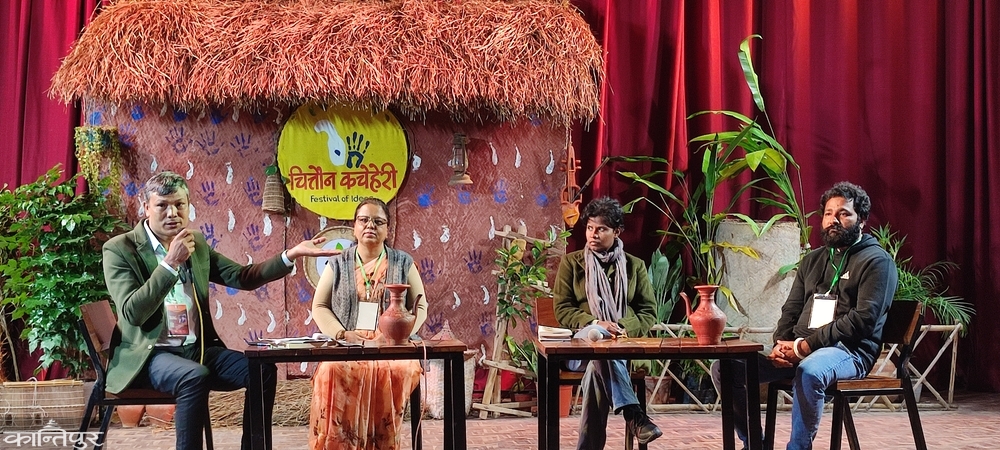
Immediately after that, a debate took place on the state of youth and the country in the 'Movement and Political Change, Intergenerational Dialogue' session. After this session, focusing on the Gen-G movement, Usha Titikshu had a dialogue with Indra Adhikari, Ashish Sapkota and Majid Ansari on the topic 'Who is responsible for Bhadau 23 and 24?'.
'Chittaun Kacheheri' was organized by an organization called Better Chitwan and co-organized by 6 different organizations including Narayani Kala Mandir and Tharu Kalyankarini Sabha Chitwan.
In the third series of ‘Chittaun Kachehari’, which has been going on for three years, the issue of the Genji movement was at the center, but the issue of indigenous people also received priority. ‘Chittaun Kachehari’ has been named after the language of the indigenous Tharu community of Chitwan.
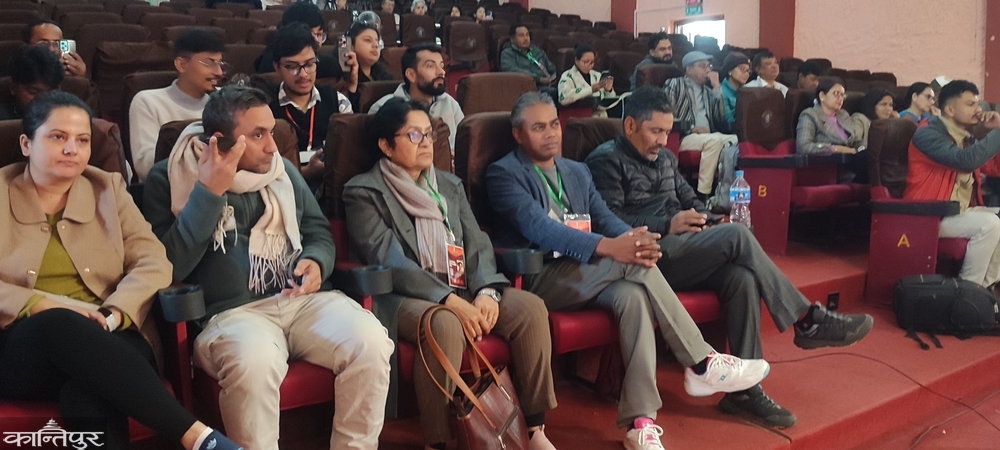
Similarly, this time, the main speaker of ‘Chittaun Kachehari’ was Jacinta Kerkatta, a poet and journalist from the indigenous community of Jharkhand, India. Her scholarly discourse began the debate sessions of ‘Chittaun Kachehari’ on Friday.
Along with the same Indian poet and journalist Jacinta, another poet from India, Arif Raja, and Nepali poet Sarita Tiwari, who came from Nepal, had a conversation with Manoj Bogati, a Nepali-speaking poet and journalist from India, about the meaning and power of poetry, and the third series of ‘Chittaun Kachehari’ ended.
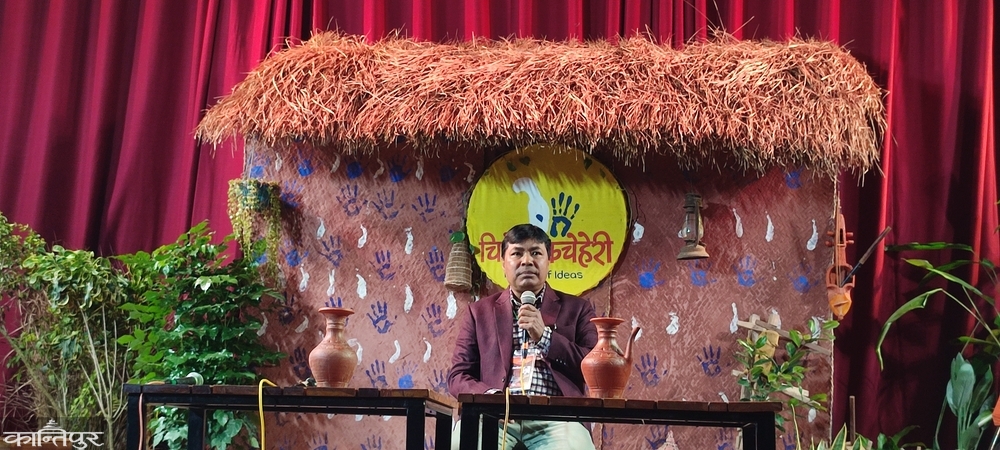
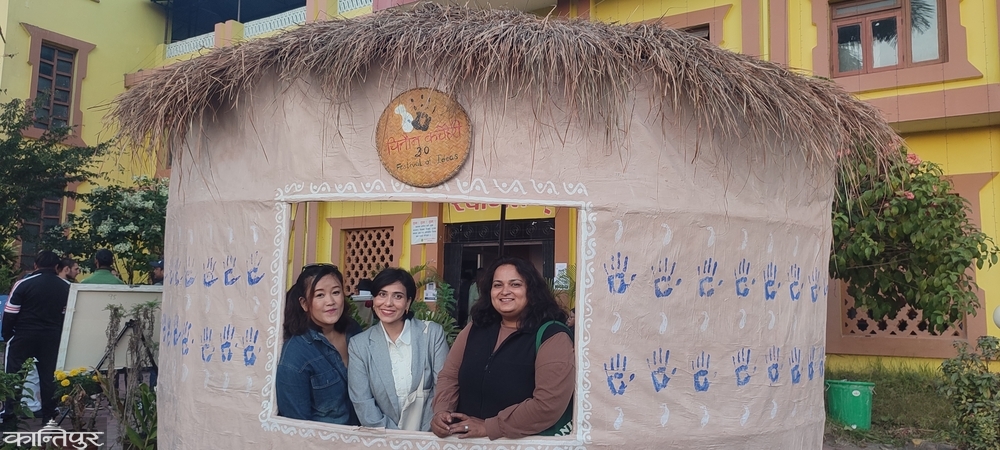
Before the session began on Saturday, Kari Mahato had spoken about the art and myth of 'Muthiya', which is prevalent in the Tharu community. After closing a fist and dipping the part towards the little finger in soaked rice flour, a mark is made on the wall.
He said that such a mark, called 'Muthiya', is a cultural identity of the Tharu community. He said that many songs have been composed about the religious stories associated with it. 'Such a mark is made on the walls of houses during the Sohrai festival celebrated by the Tharu community during Tihar,' said Kari.
On Friday, Chitwan journalist Tulman Gurung had debated the Tharu community in the session 'Bahiskaranma Tharu, Sakas, and Nikas' with Rukmini Chaudhary and Krishna Hatechhu. Similarly, on Saturday, a debate was held with Sauraha hotelier Gunaraj Thapaliya, Chitwan National Park Conservation Officer Avinash Thapa Magar, and Tharu community leaders Lalit Chaudhary and Sanjay Chaudhary under the theme 'Tribal Culture and Tourism Enterprises, Community Benefits'.
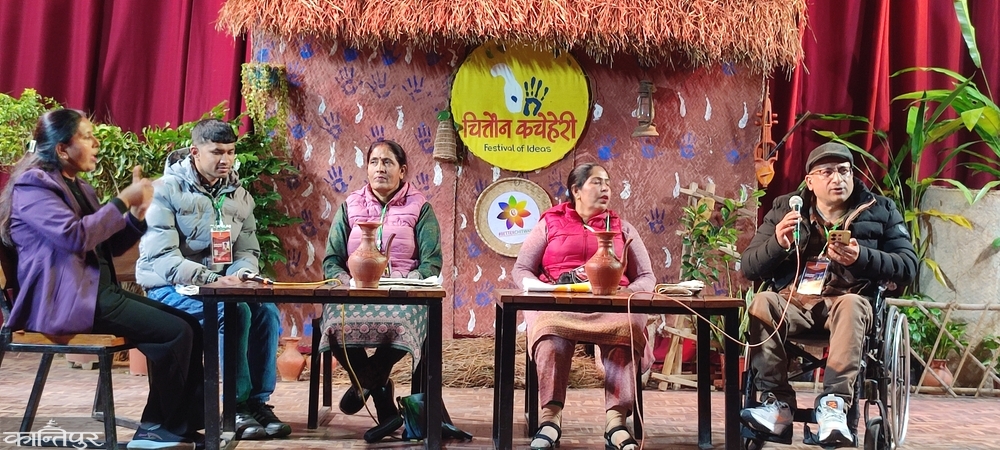
Participants in the debate session titled 'Disability Issues in Political Change' said that the constitution, laws, and political parties do not understand people with disabilities. The question of why people with disabilities should go to the polling station to cast their votes in the upcoming elections was raised in the debate.
The organizers have been calling 'Chittaun Kacheheri' a celebration of ideas. They claim that issues that others do not understand will be raised in 'Chittaun Kacheheri'.

