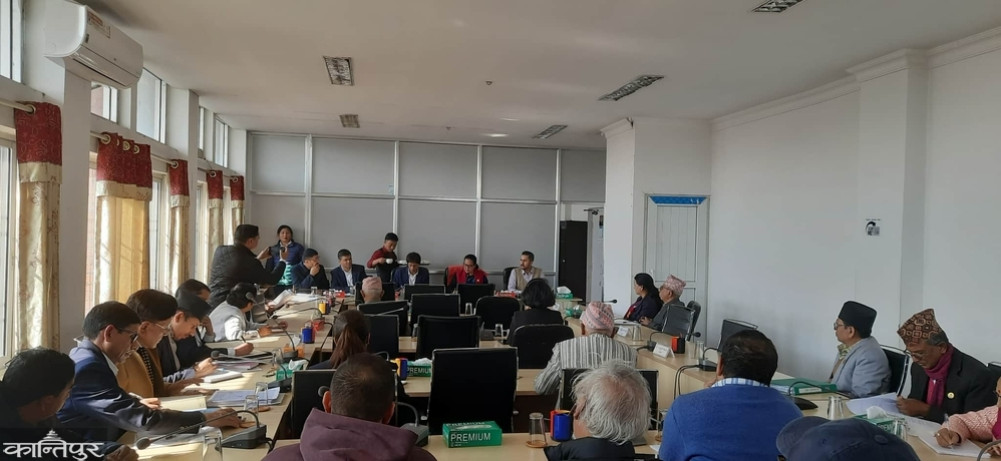
The committee members themselves have proposed 199 amendments to the bill, which was introduced in Section 53.
We use Google Cloud Translation Services. Google requires we provide the following disclaimer relating to use of this service:
This service may contain translations powered by Google. Google disclaims all warranties related to the translations, expressed or implied, including any warranties of accuracy, reliability, and any implied warranties of merchantability, fitness for a particular purpose, and noninfringement.
Should the bill to amend and consolidate the film-related laws be withdrawn or should it be amended and moved forward? This is the topic of discussion in the film industry for the past few weeks. As a theoretical discussion on this issue is currently underway in the Legislative Management Committee.
What is the use if the bill is not progressive, does not become progressive, does not become modern? - Minister for Communications Jagdish Kharel The discussion has heated up even more after Minister for Communications and Information Technology Jagdish Kharel said that the bill is not timely and that the government is ready to withdraw it if necessary. In the two-stage discussion in the committee, representatives of film-related organizations also expressed their disagreement with the bill. Like Minister Kharel, they have been demanding the bill to be withdrawn from the ministry to the committee.
Why do filmmakers want to withdraw it when the committee wants to move the bill forward? A tripartite meeting was held on Tuesday between the committee, the government and stakeholders to find an answer to this question. At the beginning of the meeting, there was a discussion on whether to withdraw or move the bill forward. Minister Kharel said at the beginning of the meeting, "What is the use if the bill is not progressive, does not become progressive, does not become modern? We are trying to make an act after 56 years. That is why discussions are ongoing in the committee. If it is understood that a good law can be made from this discussion, then I will not withdraw the bill.'
MP Beduram Bhusal said that a long process has to be completed before the draft law prepared by the government reaches the National Assembly and suggested that instead of withdrawing it, we should move forward by amending it. He said, 'The bill is discussed in the committee only after a very long process. We take the advice and suggestions of the stakeholders seriously. We will make maximum amendments as much as possible. All the clauses can be changed by withdrawing them.'
Director Manoj Pandit was present in the discussion as a stakeholder. He said that since the bill repeats the same old clauses and structure of 2026 BS, it can be moved forward with extensive amendments only if it is made in the interest of filmmakers. He said, 'This bill seems to have been made by the ministry's bureaucracy with the aim of controlling the film sector. The bill has ignored the different dimensions of films. There is no vision for the future of film, there is no way to develop film as an industry.'
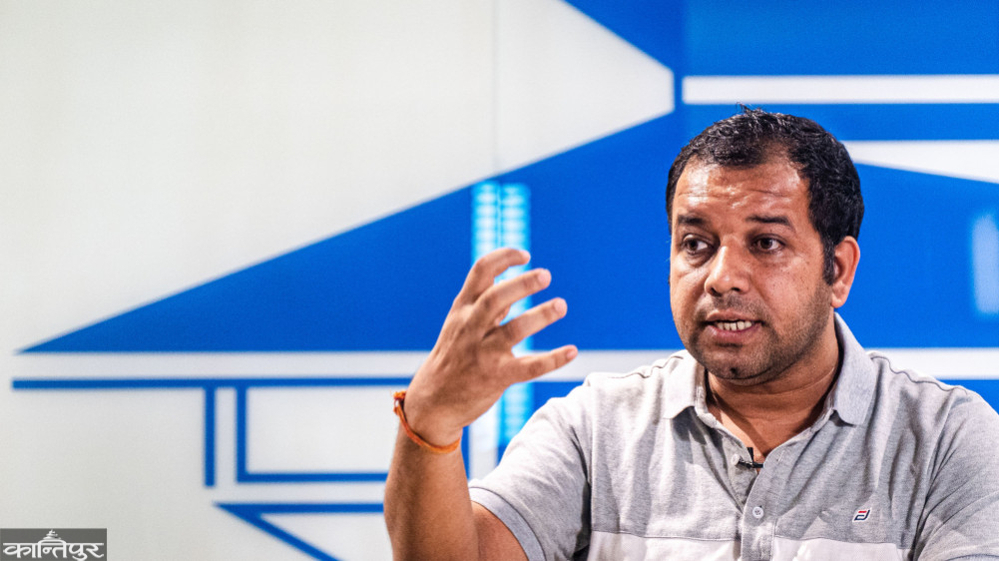
Stating that the revised 'draft' will be submitted to the committee by Sunday with the addition of amendments to cover the problems of the film sector, Pandit said that they are committed to making the film law. 'We also want this bill to become a law. We are not trying to reject the decision of the committee and the ministry. However, we are giving the draft so that the new bill covers our problems and represents us,' he said.
The committee's MPs have proposed amendments to the bill in 199 points in Section 53. Therefore, the committee chairperson Tulsa Kumari Dahal said that they are ready to make the bill relevant to the times. She also said that the committee cannot discuss a separate draft prepared by filmmakers while taking advice and suggestions from stakeholders. 'We will make necessary amendments to the bill brought by the ministry,' the chairperson said. She said that they are ready to discuss and amend each section for which suggestions are received.
Eleven filmmakers, including Manoj, were present in the committee's discussion on Tuesday. Film Development Board Chairman Dinesh DC also argued that the bill should be improved and moved forward rather than withdrawn. 'I completely disagree with withdrawing the bill from the filmmakers' perspective. This bill should be improved as much as possible,' said DC, 'It should be written in a precise manner, not words like development and promotion.'
 Producers' Association General Secretary and artist Khagendra Lamichhane said that if the amendments are not made according to their wishes, they have considered the option of going to the streets. 'Our job is to make films. You were elected and sent to make laws for us,' he said, 'We will present our concerns by Sunday. If you can implement it, we will move towards that, otherwise we will be confused, there is no option but the streets.'
In the discussion, Technical Association Chairman Pushkar Lama said that the bill should include issues that strengthen the rights and privileges of technicians. They demanded that the bill address issues ranging from a certain percentage of Nepali technicians being involved in foreign films to capacity building. Film Association President Narendra Maharjan said that a bill should be made to determine the future of the film sector, saying, “Filmmakers are angry because the draft bill submitted after 8 months was not included in it.”
Film Directors Society President Jandeep Parajuli said that the aspect of film production in collaboration with foreign filmmakers was not included, and demanded that the bill be filmmaker-friendly. “The bill of Section 53 does not envisage the AI era. How can the issue of joint ventures be included? We want all film work to be done through a single-door system through the board,” he said. Conflict Artists Association President Narayan Pradhan demanded that the board be made autonomous.
The issue of making the board autonomous had been raised in the committee earlier as well. The reason is that Section 5(4) of the bill provides that “the government can remove the chairman and the ministry can remove the members at any time.” The point of reducing the board in this way has put filmmakers in favor of autonomy. Chairman Dahal said that there is no objection to making the board ‘more regulation-oriented than control-oriented’. Minister Kharel also said that the board should be given autonomy but ‘checks and balances’ are necessary. ‘Policy and leadership should be autonomous, but the government should facilitate and regulate, not control,’ he said.
Should films be taken to the Ministry of Culture or Communication? Discussions are also underway in the committee on this issue. Minister Kharel has been saying that films are an audiovisual genre and since technology is involved, they should come under the Ministry of Communication. But filmmakers are demanding that films be kept under the Ministry of Culture, saying that films are cultural products. Director Pandit also made the same argument and urged ‘to respect our feelings’.
But Minister Kharel is adamant that films should be kept under the Ministry of Communication. ‘Cinema is media, it is a performance. It conveys a message. It needs technology, it needs a camera. "From production to performance, everything falls under the ambit of communication," he said, "Where did the term culture come from?"
Minister Kharel says that the government is not confused about amending the bill and moving it forward. "The government is not confused about this bill. It has participated in principled discussions to move it forward. The government is ready for clause-by-clause discussions," he said, "There is no ambiguity in the amendments. Comprehensive amendments can be made. The government does not want to withdraw the bill."