We use Google Cloud Translation Services. Google requires we provide the following disclaimer relating to use of this service:
This service may contain translations powered by Google. Google disclaims all warranties related to the translations, expressed or implied, including any warranties of accuracy, reliability, and any implied warranties of merchantability, fitness for a particular purpose, and noninfringement.
After the promulgation of the constitution in 2072, along with the administrative structure in the country, political parties also moved towards the implementation of federalism. As envisioned by the constitution, the parties amended the constitution and established the provincial structure. But due to the continuity of centralized mentality and behavior, the provincial structure of the party has no role.
Due to the interference of the top level leaders, the party's state offices and state committees have become powerless and useless like the state government. Provincial offices of major parties have been set up in Birendranagar with their own buildings.
Although there are regular gatherings, meetings and conventions, the role of these provincial structures remains secondary in the decision-making process at the provincial level. The latter can be taken as an example - ticket distribution of local level by-elections .
Major parties Nepali Congress, CPN-UML and Maoist Center's statutes mention that the relevant district and state committees will distribute tickets for the local level . But like in the past, in the last by-election, the provincial committees of the political parties did not get the right to distribute the tickets. So much so that the parties even decided the ticket of the ward president from the center .
There is a provision to appoint the ministers participating in the Karnali state government, the officials of the state assembly by the respective state assembly parliamentary party. But the Provincial Assembly Parliamentary Party and the Provincial Committee of the three main parties cannot select and recommend ministers by themselves.
Political analyst Pitambar Dhakal says that since 2074 political appointments including provincial ministers are made from the top level. "According to the law and jurisdiction, the leader of the parliamentary party and the provincial working committee are not able to fulfill their responsibilities," he says, "We are seeing a situation where we have to wait for the decision of the center even when appointing a chief minister, a minister, or even a general political appointment."
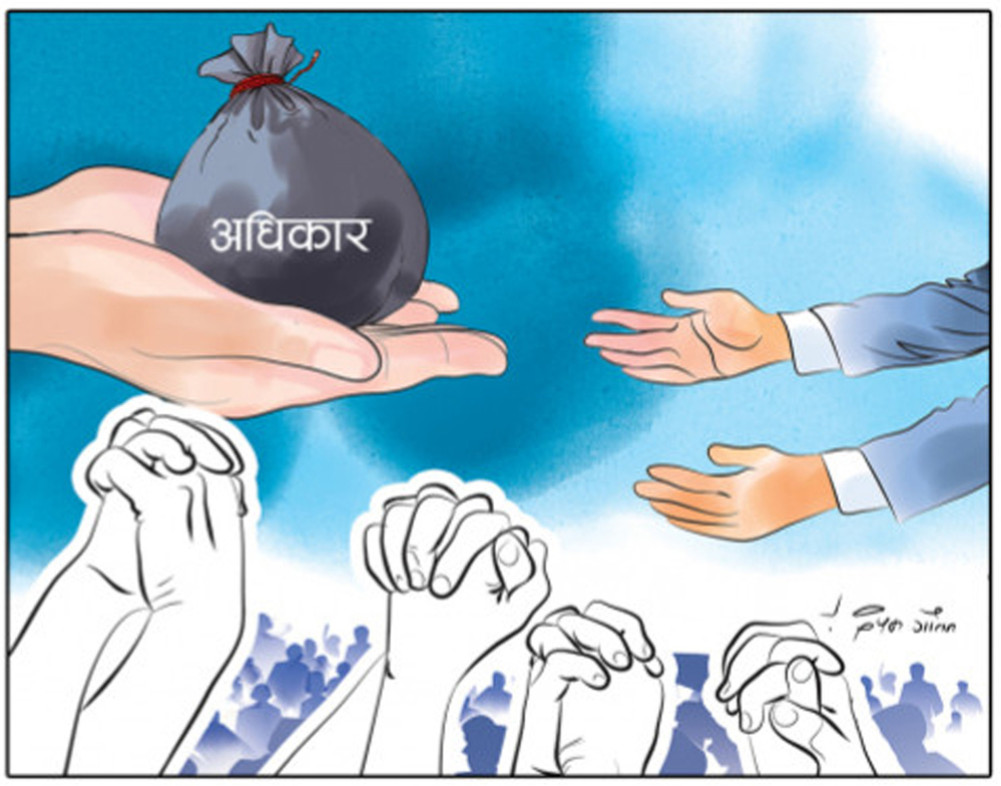
Dhakal says that even though the political parties have created a law suitable for the state structure according to the constitution, they have not been able to implement it in practice. 'The state structure has been made useless from all angles, just as the federal government is not ready to give the states the authority, similarly the parties have delegated the authority in the statute. On the contrary, he has limited himself,' he said.
When the state structures of the party cannot practice according to the statute, the leaders of the state committee are forced to go to Kathmandu even to take general decisions. Due to the tendency of state committees to work only with the permission of the party center, the district and state level leaders are also increasingly running at the center. Although the provincial office and provincial committee are active, ultimately all decisions are made by the central leaders . The civic leader, who is also the former dean of the Midwest University, comments that the parties have failed to make their provincial committees autonomous, like the Dhaka provincial government.
Provincial President of CPN Maoist Center Vimala KC says that the provincial structure of the party should be strengthened to empower the provincial government. "The centralized mentality is also present in the government, it is also present in the parties in the government, as much as the rights in the constitution are not used. However, it has become a habit to depend on the centre,' she said, 'Provinces have been given autonomy, but they have to rely on the center when taking decisions, the provincial structure has been made nominal.' She claims . Having gathered the experience of a provincial minister, she says, "We are not satisfied with ourselves, the structure of the party is in shambles." There is no situation where the province can make a separate decision and implement it, the party structure itself has become unable to work.' When it comes to party discipline, following the policy instructions of the center should not be understood as interference by the center or taking away one's rights,' says Shah, 'like the provincial government, it takes some time to strengthen the party's provincial structure, it becomes possible with practice.' -break Chairman of the Congress State Working Committee Lalitjung Shahi admits that the state committees are not functioning fully according to the constitution of the party. He says that it will take some time for the party leaders to change the centralized mentality.
According to the constitution of the Congress, the Provincial Working Committee has the right to record the details of the active membership received from the district and send it to the center. Apart from this, the District, House of Representatives, State House and Local Municipality Committee have the right to give instructions, enforce the party's code of conduct and maintain discipline.
Likewise, the provincial working committee has the authority to form departments, recommend candidates and make decisions, and decide whether or not the party will participate in the provincial government. But the state working committee of the Congress cannot take any of these decisions on its own. Every time the top leaders of the province reach Kathmandu to ask their party chairman or top leader.
UML's problem is no less than that of Congress. If the leaders of the province take any decision, they turn to President KP Sharma Oli and General Secretary Shankar Pokharel.
Provincial committee has been given powers such as leadership of party work within the province, internal elections and nominations, elections under the province and relations with the government, organization building, monitoring and guidance, division of labor, organization of conventions and meetings, and resource management.
According to a state official of UML, the state committee cannot work without asking the party president Oli and general secretary Pokharel even in difficult decisions like the nomination of department members of the state committee. In the constitution of the CPN Maoist Center, the authority to execute the directives of the Central Committee, to form departments, to recommend people's representatives related to the provincial assembly and the provincial government, and to make political appointments, etc. are mentioned.
Like the Congress-UML, the state committee of the Maoist center cannot be autonomous and take decisions at the state level . The state committee cannot take a decision without asking the president Pushpa Kamal Dahal as well as the leaders representing the state at the center, Janardan Sharma and Shakti Basnet.
It has been found that the provincial structure of the party is not able to implement the rights according to the law, and even the leaders of the local level and district level depend on the center . Every week, local people's representatives and district party officials go to Kathmandu to meet their top leaders and take permission to make their own decisions. Arjun Bahalur Aydi, an associate professor of political science at Midwest University, says that it is understandable that local and district level leaders do not trust their own party's provincial structure due to the centralized practice of
parties. He said that for the full implementation of federalism, first of all, political parties should be ready to transfer the limited powers of the center to the provinces.
'The tendency to give written authority but tighten it in practice is fatal, according to the constitution, the provincial structures of all parties are strong,' he said, 'but instead of using the authority, there is a tendency to take it to themselves under various pretexts, it cannot be a strong implementation of federalism.'