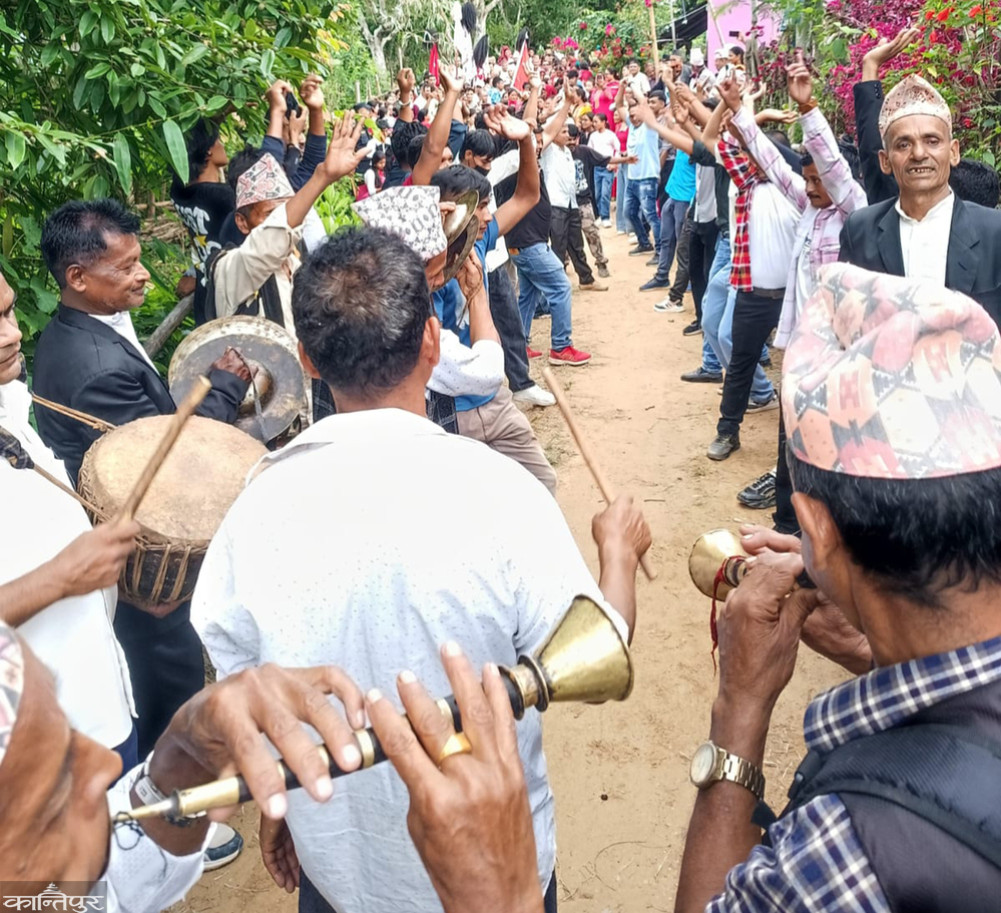
In Arghakhanchi, Sarai Nach is danced at Khanchi Darbar, Malarani, Rangamare, Thada, Maidan, Sandhikhark, Bhandarthum and other places. After Arghakhanchi, it is believed to have expanded to Gulmi, Pyuthan, Palpa.
We use Google Cloud Translation Services. Google requires we provide the following disclaimer relating to use of this service:
This service may contain translations powered by Google. Google disclaims all warranties related to the translations, expressed or implied, including any warranties of accuracy, reliability, and any implied warranties of merchantability, fitness for a particular purpose, and noninfringement.
A red spot on the forehead, a garland of dhaja or jamra on the neck. In a crowd of hundreds of people in new clothes, in one hand a glittering stick, sword, spear and in the other hand a shield or handkerchief. At first acting without weapons, then dancing to the beat of sanai and bazaa chanting "Wakkhai Ho, Wakhkhai Ho" while chanting.
Sarai dance that looks like a war After the beginning of Dasain, from Ekadashi to Kojagrata Purnima, the splendor of Sarai has started in Kotghar and Kalika Mandir . On the day of Ashtami, after the Kalaratri Puja, Sarai dance is started in the Shaktipeeth . On Friday, a grand Sarai dance was held in Bhagwati Temple of Malarani Rural Municipality-7 Bamruk, Bhumikasthan Municipality-5 Asurkot and others. Where from children to senior citizens have danced.
Alam decorated with colorful flags is considered as a symbol of God . Sarai dance is considered as a fun culture where hundreds of devotees in line look like one group attacking another group. After the victory of Satya in the battle with Rakshasa, the priest of Satya began to dance sarai in Kot and Durga Bhagwati and Kalika temples as a victory festival. It is religiously believed that dancing like this will please the goddess.
The elders say that it started when King Bhure did not perform the Sarai dance in his Kot when he was in the Baisechoubise kingdom. According to history, Sarai Dance started from Argha Palace. Districts of Argha Kingdom were started by Rai Raja in the medieval period. According to Sanskrit scholar Rajendra Kumar Acharya, in the medieval period, in the then Argha Rajya of the present Arghakhanchi district, Raja Zilla Rai, on the occasion of his conquest of the Argha Rajya, started to dance Sarai Nachai, dahikera and boxis on the Kojagrat Purnima day of Vijaya Dashami as a victory festival. Dharmaraj Pokharel, the priest of Argha Bhagwati Temple, said that the Sarai dance, which came into vogue from Takura in Argha, has spread elsewhere.
Sri Argha Mahakali Bhagwati Temple and Guthi Management Committee Chairman Saroj Bhusal according to V.S. In 1381, Zilla Rai Raja came from Delhi, India with an army and settled in Argha. Along with him came Gandharva who sings songs, Purohita who performs prayers, Pariyar who sews clothes, Vishwakarma who makes weapons and an army with weapons . Gurung was the king of Argham at that time. After fighting with him, he captured 17 mouzas . He said that there is a history of taking out an inn as a victory festival on the full moon day of Badadasain.
In Arghakhanchi, Sarai Nach is danced at places like Khanchi Durbar, Malarani, Rangamare, Thada, Maidan, Sandhikhark, Bhandarthum etc. After Arghakhanchi, it is believed to have expanded to Gulmi, Pyuthan, Palpa. Dang, Kapilvastu, Rupandehi and Nawalparasi who have migrated from the hilly districts have established temples of the goddess there and started Sarai dance. Jitgarhi, Devichoupari and other places in Butwal of Rupandehi There is a Sarai dance.
Gulmi's Dhurkot, Arje, Chandrakot, Pipaldhara, Naya Village Purkotdah, Pyuthan's Okharkot, Vijuwar, Bijjikot, Palpa's Rainadevi, Rambhadevi, Kusumkhola, Mathagadhi and many other places.
People who come from home and abroad to celebrate Dasain return to Karmthalo after dancing in Saray of Kojagrat Purnima. Government holidays are also till full moon . Lately, the young generation is also starting to protect the inn culture .
'Sarai dance is our traditional culture,' Ganesh Bhandari of Asurkot said, 'Those who live in the village and have jobs in the country and abroad, those who are in various professions also go to Kotghar for darshan, and perform Sarai dance from puja. This is a fun culture.' He said that now the goddess temples are also being protected. "On the one hand, dancing without arms is fun and on the other hand, culture is awakened," he said, "After a long time, friends also meet."