We use Google Cloud Translation Services. Google requires we provide the following disclaimer relating to use of this service:
This service may contain translations powered by Google. Google disclaims all warranties related to the translations, expressed or implied, including any warranties of accuracy, reliability, and any implied warranties of merchantability, fitness for a particular purpose, and noninfringement.
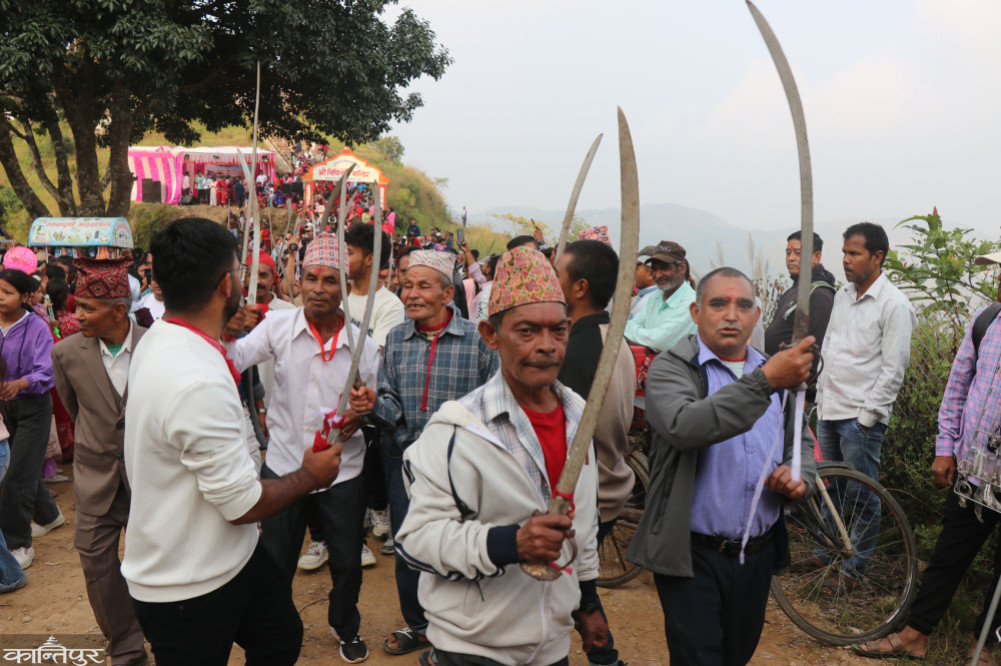
Sarai dance is disappearing in Palpa in recent years due to lack of transmission. It is customary to dance Sarai from Ekadashi to Purnima after tika on Dasain. But in recent years, it is gradually disappearing due to lack of transmission.
Due to lack of protection of the weapons in the temple, lack of interest from the young generation, and lack of importance to these cultures in the local community, they are disappearing. Ashtami in the east of Palpa, in the west from Ekadashi to Purnima is an old custom of Sarai dancing. But Ramesh Khatri of Ribdikot rural municipality Palungmainadi said that Sarai dance has been gradually decreasing for the last 20 years.
has come to a situation that cannot be seen in some places in recent years . Apart from the Lipindevi, Rainadevi Chhahara temples of Bandipokhara in Tansen of Palpa, swords, clubs and other weapons have been displayed elsewhere. Even though it was taken out in Khyaha, Batase, Boughagumha, there is not much interest in it . Experts say that in order to preserve the traditional culture, only one or two inns have been built.
The khukuri, sword, khunda, and khadga weapons offered by the devotees in the temple are played by hitting each other in the lake of Panchebaza and saying "Sarai". "Recently, such weapons have stopped being seen," Chitraveer Thapa of Tansen Municipality 13 Baughagumha said, "It used to be a lot of fun." Now it is gradually disappearing .'
Sarai, which dances in more than 30 places in Palpa, has been seen only in one or two places in recent years. In Argali, Baughagumha, Lipindevi, Masyam, Batase, Khyaha, Chhahara and other places of the district, Sarai was played, danced and fair was held on the full moon.
Harikrishna Gautam, the priest of the historical Dashainghar, said that Sarai Kojagrat will be played from Saptami until Purnima. He remembered that there would be crowds of people dancing, clashing swords, playing Panchebaza, and singing Vakhwai Hriwa in the temple of the goddess. "It's not like before," he said, "now it has disappeared in many places."
is a tradition of Sarai dancing in Kotghar and Shaktipeeths . Sarai Naach was a custom of dancing at different places on different days. Dil Bahadur Rana, Ward President of Rampur Municipality-9 said that there is a tradition of dancing in some parts of Palpa since the night of Ashtami (Kalratri) of Dasain. In some places, dancing is also performed on the night of Dasain and after Ekadashi. Bishnu Pokharel, the ward president of Rainadevi Chhahara-4, said that there is a tradition of taking out 'Damini Sarai' four days after the full moon in Rainadevi Chhahara.
is also considered as a kind of game. After playing panchebaja, Khukuri, swords and khundas offered to the temple are joined together to dance and play sarai. Sher Bahadur Khati, president of Lipindevi temple in Bandipokhara, said that this dance is also practiced in the yard of Kotghar, which is on the highest part of the hill. Historical weapons are also stored in Kotghar, so this dance is called Sarai Naach because it is a cultural tradition to play festival dances in Sarai near Kot.
Sarai worked to preserve historical culture . Since tradition, there is a custom of sharpening the hundreds of khundas in the village goddess temple every year especially on Kojagrat Purnima. According to experts, this dance is not only a battle of Bhure-Takure kings, but also a celebration of the victory of the goddess over the demons. It is customary to display the weapons used in the mythological war. The trend of Sarai dance started from Baise-Chaubise kingdom period (15th century).