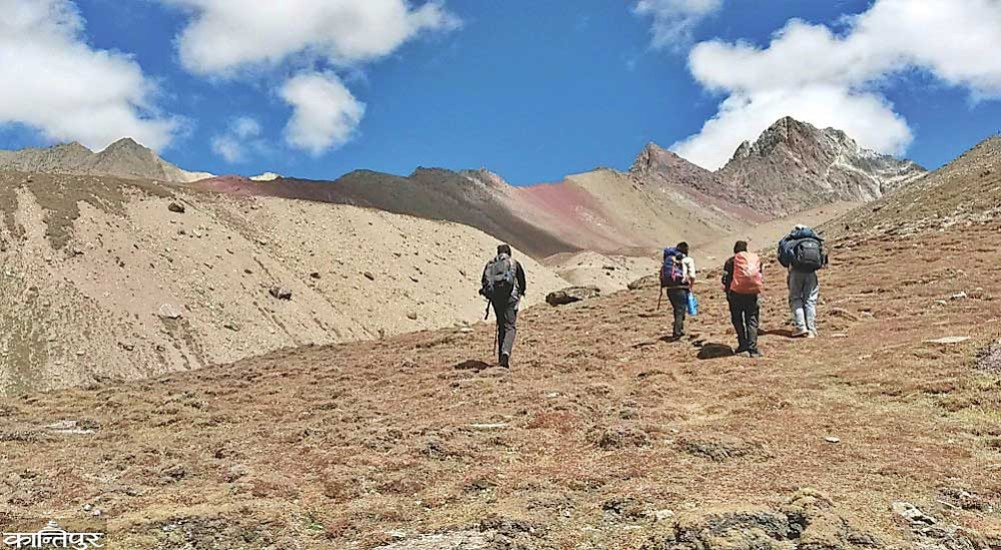
The agreement between China and India to continue the Kailash-Mansarovar pilgrimage seems to have opened the way for the traditional natural pilgrimage, but there is a smell of geo-political mischief hidden somewhere in it.
We use Google Cloud Translation Services. Google requires we provide the following disclaimer relating to use of this service:
This service may contain translations powered by Google. Google disclaims all warranties related to the translations, expressed or implied, including any warranties of accuracy, reliability, and any implied warranties of merchantability, fitness for a particular purpose, and noninfringement.
Kailash Mansarovar is a holy place of pilgrimage for Hindus, Buddhists, Jains and Bons, which includes holy places such as Mount Kailash, Mansarovar Lake, Rakshasa Lake, Gaurikunda etc. Kailash Mansarovar region is a unique pilgrimage site full of natural beauty, religious sanctity and spiritual attraction, which attracts pilgrims from Nepal, India, China and all over the world.
As it has to be reached through difficult mountainous terrain, this region can only be traveled through certain routes in Nepal, India and China. The easiest access from China is via the Tibet-Nagari highway, while the routes from Nepal via Kerung or Simikot-Hilsa are popular. There are two routes from India through Uttarakhand via Lipulek Pass and towards Sikkim via Nathula. The old route from Nepal through Kodari-Khasa has been blocked after the earthquake, while Pokhara-Jomsom-Korla is another possible option.
Since the days of British India, there was uninterrupted pilgrimage through the routes of Uttarakhand and Sikkim, but after Tibet came under China in 1950, the journey became difficult. Later, the journey was resumed by the Panchsheel Agreement of 1954, but the India-China War of 1962 interrupted it again. In 1981, with the agreement between India and China, the journey through the Lipulek Pass was resumed.
A new route through Sikkim's Nathula Pass was opened in 2015 but closed again after the Doklam standoff. After the covid-19 epidemic, all travel in this region was stopped. The 23rd meeting of China Border Affairs Special Representative held in Beijing on December 18, 2024, under the leadership of Chinese Special Representative Wang Yi and Indian Special Representative Ajit Doval, agreed to continue the Kailash-Mansarovar pilgrimage, which has been suspended since 2020 due to the Covid-19 epidemic. In the opening and closing of these latest pilgrimages, which look like traditional pilgrimages, there is a smell of geo-political manipulation hidden somewhere and it has become an objectionable subject for Nepal.
At a glance, what is the problem for Nepal, the third neighbor, when there is an agreement between the two neighboring countries, India and China, to open the pilgrimage that has been stopped due to the epidemic? It seems to say, but here the question is not about the pilgrimage, but about the pilgrimage route. When there is an agreement between India and China about the use of the Lipulekh route, Nepal's interest naturally increases.
Because since the Sugauli Treaty of 1816, Nepal has been claiming that Kalapani Lipulek Limpiyadhura region is its territory with sufficient grounds and evidence. The developments until the unanimous approval of the political and administrative map of Nepal on 13 June 2020 by the Parliament of Nepal on 13 June 2020 are examples of Nepal's claim and its continuation.
The Indian side accepts that there is a problem on the border of that area, but is reluctant to solve it and is using the area under its control. This series of acceptances and denials was also clearly mentioned in the letter written by the Acting Chief Secretary of the Government of India to the Commissioner of Kumaon in March 1817 during the British rule.
The third meeting of the Nepal-India Foreign Minister level joint commission held from July 25 to 27, 2014 instructed the foreign secretary level mechanism to take the necessary technical suggestions from the border working group and solve the remaining border related issues including Susta, Kalapani on priority and immediately after that on 3-4 August During the visit of the Indian Prime Minister Narendra Modi to Nepal in 2014, the joint statement of the Prime Ministers of the two countries made it possible to see that the directive was approved.
The declared/undeclared blockades, uncomfortable situations and obstacles created from time to time are not digestible for a free and sovereign nation. Because of that, the common Nepalese sentiment has developed that it is a vertical interference on the sovereignty of Nepal.
In order to resolve the Nepal-India border problem, actionable steps such as giving responsibility to the Foreign Secretary-level mechanism to resolve the border dispute in the Susta and Kalapani areas, and the formation of the Nepal-India Enlightened Group have not been taken. But in the ten-year period between 2014 and 2024, none of these issues seem to have reached a logical conclusion.
During the visit of Indian Prime Minister Narendra Modi to Nepal on August 3-4, 2014, through a joint statement, not only was the instruction to resolve all the remaining issues on the Nepal-India border once and for all, the foreign secretary-level mechanism was tasked with solving the significant border issues of Susta and Kalapani areas. The decision of the third meeting of the Nepal-India Joint Commission was also welcomed. One thing that is clear from this is that there is a border problem in the Kalapani region, where India has had a military presence since the 1960s and where India has a camp of the Armed Forces, and it has been accepted by the Prime Ministers of both countries.
However, during the visit of Chinese President Xi Jinping to India on 18 September 2014, India and China signed various documents, in an agreement, it was said that ``in addition to the current route at Lipulek Pass in Uttarakhand, the Kailash Mansarovar Yatra will be conducted via Sikkim's Nathula Pass''.
Then, in Point No. 28 of the joint statement issued by Prime Minister Li Keqiang of Indian Prime Minister Narendra Modi's visit to China from May 14-16, 2015, both sides expressed mutual trust in promoting cooperation in border areas through border trade, pilgrimages of the two countries' people, and other exchanges. Accepted that it can be increased effectively. They agreed to further expand this cooperation and transform the border area into a bridge of cooperation and exchange.
In this way, from the level of the Prime Minister, there is an agreement with Nepal that there is a problem on the Nepal-India border in the Kalapani, Lipulek, Limpiyadhura area and that the solution will be done through the foreign secretary-level mechanism of both countries. The Nepalese expectation that the border problem is now on the way to a solution has turned into suspicion. Nepal also formally expressed its displeasure with both countries. Subsequent events became more and more disappointing.
After India released the new political map of the 8th edition on 2nd November 2019 and the ninth edition on 8th November 2019, the controversy escalated further. On May 8, 2020, when the pilgrimage itself was stopped due to Covid-19, the controversy escalated after Indian Defense Minister Rajnath Singh inaugurated the 75.54 km road from Dharchula's Gwanabagar to Lipulek on May 8, 2020 through a video conference. On 31st June 2077, after the unanimous approval of the map of Nepal by both houses of the Parliament of Nepal, the border dispute of this region became more complicated.
The military activities and deployment of any country in the border area is a matter of mutual agreement based on the needs of border security on the basis of various bilateral, regional and international treaties and conventions. Also known as military deployment distance. Which should be kept away from the border line agreed upon by both the countries. But India has been conducting military activities and deployments in this region by denying access to the territory of Nepal within the borders claimed by itself. There are some reasons why India continues to occupy this region:
1. Lipulek Pass is not only the main route to Mansarovar but also the shortest route from Lhasa to Delhi.
2. Since the Kalapani area is a high mountain area, it will be easy to monitor the surrounding area from high places, so India is taking strategic advantage of protecting the border with China by maintaining a military presence.
3. For trade with Tibet, Lipulek Pass is geographically convenient to conduct commercial activities.
4. This route also has historical significance as it is also a section of the ancient Silk Road.
5. The easiest tourist route to reach Kailash Mansarovar is a very sacred place of pilgrimage for followers of Hindu, Buddhist, Jain and Bon religions.
Since 2015, India has been trying to legitimize its encroachment in the region in a different way since the border dispute has escalated. Linking the religious feeling with Kailash Mansarovar pilgrimage and as it happens in the bilateral agreement documents between China and India, the name of Lipulek Pass will be changed so that it will mean that China has also signed the agreements regarding Lipulek Pass as India.
On May 19, 2020, Zhao Lijian, spokesperson of the Chinese Ministry of Foreign Affairs, said that Nepal opposed the Gwanabagar-Lipulek road at the instigation of someone, refuting the then Indian Army Chief General MM Naravane's comment directed towards China. "Kalapani is an issue between Nepal and India and we hope that both countries will resolve their disputes properly", "Nepal and India should also refrain from unilateral steps that can complicate the situation", it seems that China is neutral in this context.
However, due to repeated agreements between India and China regarding the Lipulek Pass, which is in the Nepal-India border dispute area, on religious or commercial or any other occasion, there is no reason to be sure that China is neutral in this matter. Either Nepal is not able to communicate its position and expectations with China to China through reasonable dialogue or diplomatic initiatives or China is neglecting Nepal compared to its mutual interests with its equally influential neighbor with a large and emerging economy like India. If the second situation is the case, it will be unfortunate not only for Nepal but for all the three countries.
Nepal, which has never been subjugated in history, has maintained equal distance with both neighboring countries, and has never sided with one neighbor against another. Naturally, he had the same expectations from the neighboring countries. Nepalis are sensitive and united when it comes to self-respect and nationalism. Therefore, it is necessary for all the three countries to understand the sensitivity in time and move towards solving mutual problems through dialogue and discussion.
– The officer is a former secretary of the Government of Nepal.